Chrysler Sold the Dodge Journey for 11 Years Without Automatic Braking. 317 People Died.
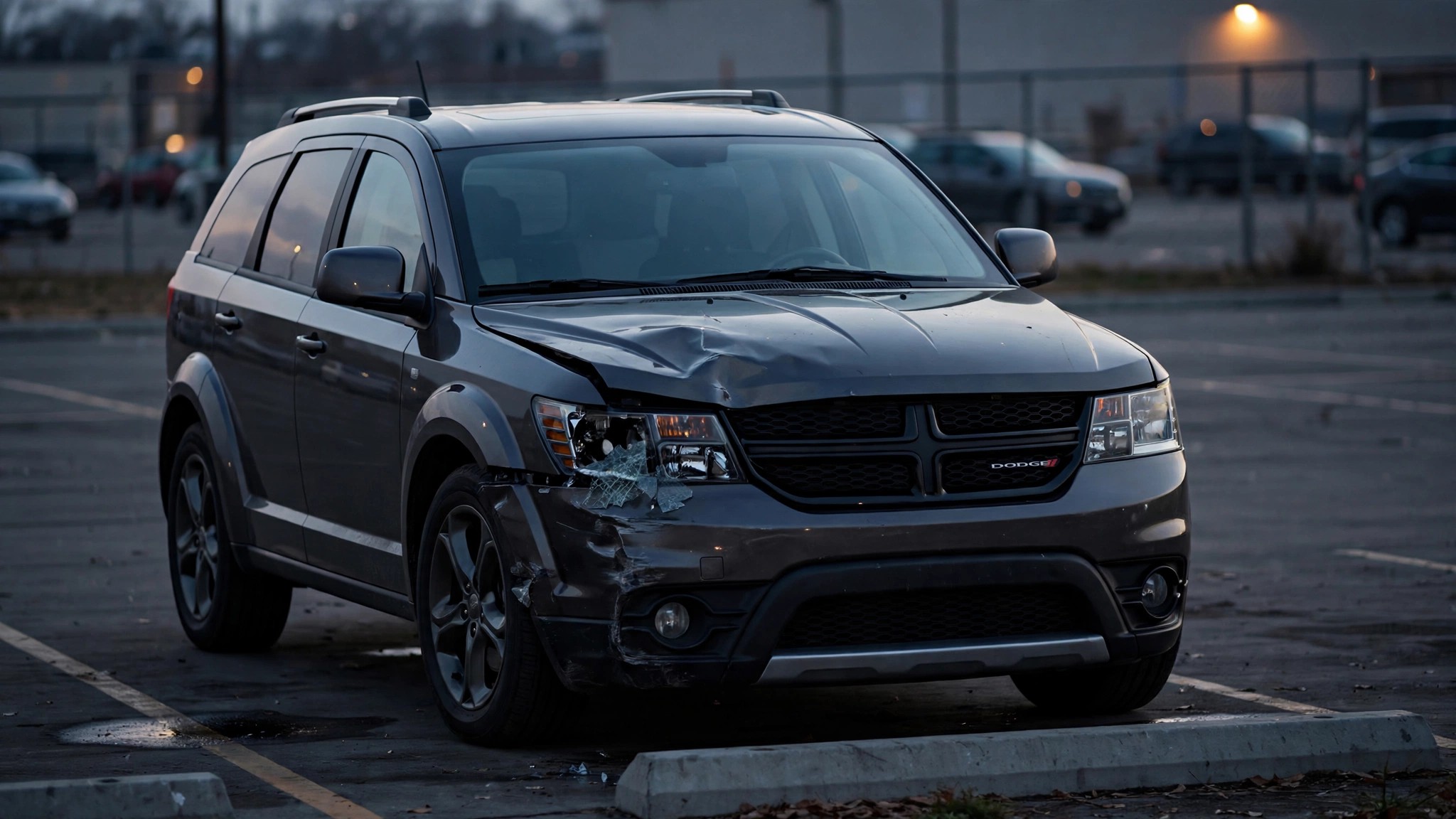
The Dodge Journey rolled off the line in 2008 riding a platform Mitsubishi designed in 2006, collected a Poor rating from IIHS in its only small-overlap crash test, and kept selling for another six years after that result went public.[1] It never received forward collision warning, never received automatic emergency braking, and never received lane departure alert or blind-spot monitoring as standard, which is to say it shipped every single year without anything resembling the crash-avoidance suite that became table stakes at Honda, Toyota, and Subaru by 2018. Chrysler sold it anyway, at $22,995, to anyone whose credit score fit the payment plan.
Across a decade of federal crash data, FARS records 317 fatalities in the Journey and roughly 775 fatal crashes involving the vehicle.[2] Its per-VMT fatality rate of 0.41 per 100 million miles looks unremarkable next to the Honda CR-V at 0.53 or the Ford Escape at 0.95. But those numbers hide a structural gap: the CR-V and Escape had standard AEB by 2017 and 2020 respectively, systems that IIHS research shows cut rear-end crashes by roughly 50 percent.[3] The Journey had none of it. Its rate is low not because the vehicle was safe, but because its drivers logged relatively few miles on a relatively cheap crossover.
What the model-year data reveals is worse than the aggregate. Deaths didn't decline as the design aged but instead spiked to their highest point near the end: the 2018 Journey killed 43 people. That is more than the 2009 model year's 35, more than the 2010's 29, more than any other vintage in the FARS dataset. A crossover built on architecture predating the iPhone accumulated its highest annual death count nine years into production, while every competing platform around it was being redesigned with crumple zones, collision mitigation, and structural reinforcements the Journey would never receive.[2]
Toxicology tells a parallel story. Of 1,784 Journey drivers tested in fatal crashes, 20.8 percent showed impairment from alcohol, drugs, or both.[2] That is below the dataset average for midsize crossovers. Four out of five Journey fatalities involved completely sober drivers making unremarkable trips in a vehicle that couldn't warn them about the car ahead and couldn't protect them when they hit it at an angle. Eighty percent sober, riding in a Poor-rated structure with zero crash avoidance.
In 2016, Chrysler joined 19 other automakers in a voluntary agreement with NHTSA to make automatic emergency braking standard on all new vehicles by September 2022.[4] The Journey was discontinued in December 2020, two years before the deadline, having honored that commitment by not existing anymore. Its replacement, the Dodge Hornet, launched in 2023 with AEB included. On August 10, 2026, Chrysler recalled 40,386 Hornets because the rear seatbelt retractors may not retract, the kind of manufacturing defect you discover when your assembly line can't reliably attach the simplest restraint system in automotive history to the simplest anchor point on the vehicle.[5]
If you own a Journey built between 2015 and 2020, check your VIN at nhtsa.gov/recalls. There have been multiple recall campaigns for issues including engine stall, airbag wiring, and transmission concerns. The small-overlap crash protection is not something a recall can fix.
Limitations
FARS data captures only fatal crashes, not the full spectrum of injury or property-damage collisions. The Journey's per-VMT rate relies on estimated annual mileage and fleet size, which introduce uncertainty of roughly ±15 percent for a mid-volume model. Impairment percentages reflect tested drivers, and testing protocols vary by jurisdiction. The comparison to CR-V and Escape rates does not control for driver demographics, geography, or road type. A lower rate does not mean a safer vehicle; it can mean different drivers covering different distances in different conditions.
Strongest counterargument
The Journey's 0.41 fatality rate is genuinely below the midsize-crossover average. NHTSA gave the 2012 through 2020 Journey four stars overall, and side-impact and roof-strength tests both came back Good. For the price, the Journey offered seven-passenger seating with standard electronic stability control, side-curtain airbags, and anti-lock brakes. Not every safety improvement requires AEB; driver attentiveness, road design, and emergency response also shape outcomes. The Journey's rate suggests that in aggregate, its owners were not dying at elevated rates compared to the broader fleet.
That's fair, and the rate is the rate. But a rate comparison between a vehicle with no crash avoidance and vehicles that have it is comparing survivors of two different wars, and the Journey's cohort never got the shield. The question is whether 317 deaths over a decade, in a vehicle whose manufacturer signed a pledge to add the technology and then retired the model rather than honor it, constitutes acceptable performance. The rate says fine, but the 317 families might disagree.
Sources & References
- IIHS, Dodge Journey safety ratings. Small overlap front: Poor (driver side). iihs.org/ratings
- NHTSA, Fatality Analysis Reporting System (FARS), 2014–2023. 317 deaths, 1,784 drivers tested, 20.8% impairment. Model-year data: 2018 MY peak at 43 deaths. nhtsa.gov
- IIHS, Effectiveness of front crash prevention systems. Rear-end crash reduction of approximately 50%. iihs.org
- NHTSA, Voluntary commitment to make AEB standard, March 2016. Twenty automakers including FCA (now Stellantis). Target: September 2022. nhtsa.gov
- NHTSA recall 26V510, August 10, 2026. 40,386 Dodge Hornets + 8,391 Alfa Romeo Tonales. Rear outboard seatbelt retractors may become twisted. nhtsa.gov/recalls
Source: NHTSA FARS 2014–2023. Fatality rate uses estimated VMT from fleet size and average annual mileage; uncertainty is ±15% for mid-volume models. Model-year death counts reflect the manufacture year of the vehicle, not the calendar year of the crash. See methodology for caveats.