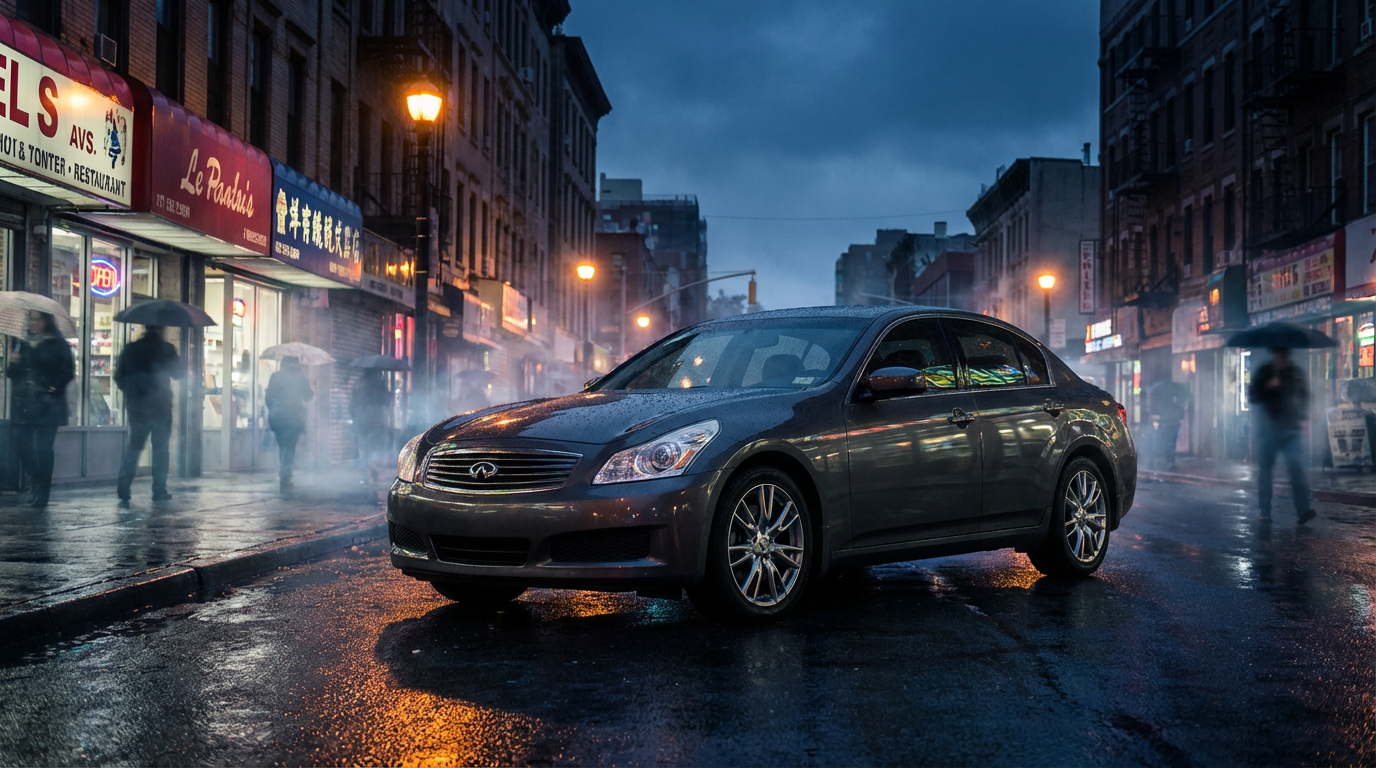
Infiniti Built Three Generations of the Same Car. The Impairment Rate Never Changed.
According to the toxicology reports — and there are a lot of them — the Infiniti G-series has a drinking problem that survived three name changes, two platform overhauls, and twenty years of engineering improvements. The G35, G37, and Q50 collectively account for 698 fatalities and 2,824 fatal-crash drivers, and across all three generations, roughly one in four of those drivers tested positive for alcohol or drugs.
The numbers are remarkably consistent. The G35 (2003–2008): 265 deaths, 1.05 per 100M VMT, 24.0% impairment across 936 fatal-crash drivers. The G37 (2008–2013): 226 deaths, 0.90 rate, 25.0% impairment across 959 drivers. The Q50 (2014–present): 207 deaths, 0.82 rate, 23.5% impairment across 929 drivers. The car got meaningfully safer each generation — the death rate dropped 22% from G35 to Q50. But the impairment rate barely budged. It’s locked at roughly 24%, four full points above the national average, generation after generation.
For context, the BMW 3 Series — the car the G35 was explicitly built to steal buyers from — has a 22.1% impairment rate. The Lexus IS, Nissan’s in-house competitor, sits at 21.4%. The Audi A4 comes in at 21.6%. The Mercedes C-Class at 21.8%. Every comparable luxury sport sedan clusters around 21–22%. The Infiniti G-line runs a consistent 2–3 points hotter across all three generations.
Model year data tells the rest of the story. The G35’s worst year was the 2008 model with 64 deaths. The G37 peaked at the 2012 with 45. The Q50’s deadliest vintage is the 2014 at 45 deaths, declining steadily as newer models arrived. Nissan improved the car — better structure, more airbags, smarter stability control. The death rate kept falling. But they couldn’t engineer away whoever was buying them.
The only Infiniti with a higher impairment rate is the QX56 at 26.3% — a full-size luxury SUV that attracted an even more enthusiastically intoxicated clientele. But the G-series is special because it gives us a controlled experiment across time. Same brand, same market position, same buyer demographic, three successive nameplates. And the same stubbornly elevated impairment rate. Nissan built a better car every time. The drivers stayed the same.