IIHS Just Rated 14 Vehicles. The Failures Kill at 5× the Rate of the Winners.
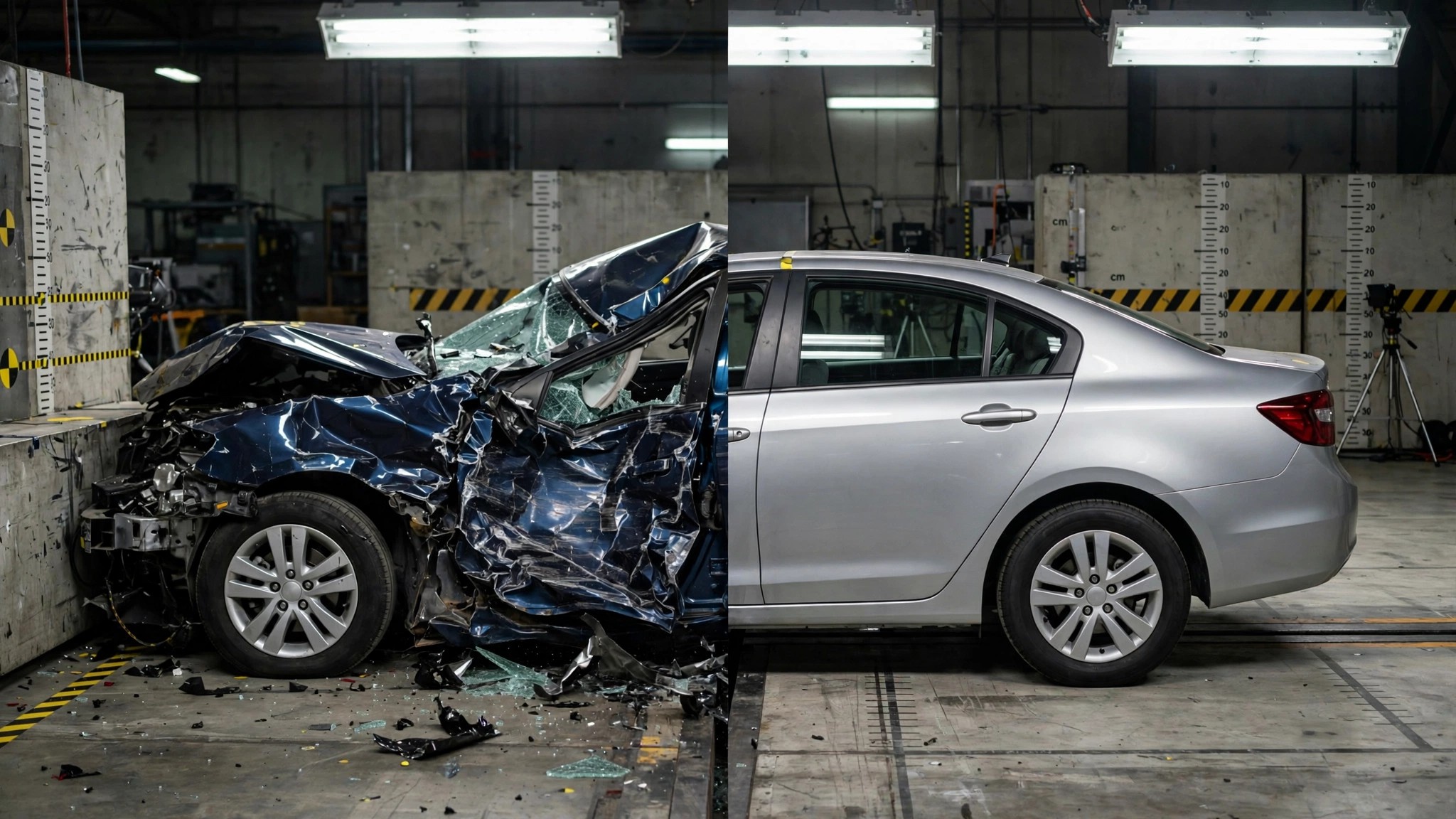
IIHS dropped its latest batch of crash evaluations this month, running fourteen vehicles through the gauntlet and awarding four of them Top Safety Pick+ while giving five absolutely nothing, which would normally produce a few headlines about the Cadillac CT5's embarrassing "poor" side-impact score before everyone moves on.
We ran those nine vehicles against FARS fatality data from 2014 to 2023, and the result should concern anyone currently shopping. The five failures average a death rate of 0.78 per 100 million vehicle miles traveled; the four TSP+ winners average 0.15. That 5.2-to-1 gap means the crash lab is measuring something that's been killing people on American roads for a decade.
The winners read like a safety-nerd fantasy draft: Subaru Crosstrek at 0.08 deaths per 100M VMT with only 86 total FARS deaths across the entire model run, BMW X1 at 0.09 with just 29 deaths, Mazda CX-5 at 0.12 despite over a million on the road and only 162 dead, and Audi A6 at 0.32. These vehicles pass the only test that counts, the one measured in coroner's reports.
On the failure side, Toyota's Tacoma Crew Cab missed its Top Safety Pick with 2,274 FARS deaths and a rate of 0.80, while Nissan's Kicks, marketed as an affordable crossover for young buyers, carries 0.69 and 339 deaths from a fleet of under 400,000. Cadillac's CT5 lineage (the prior-generation CTS, same platform DNA) sits at 1.32, Lexus IS at 0.87, and even the Audi A3 (the mildest failure in the batch) still runs 0.23, a full 50% above the Crosstrek.
Drop the CTS as a generational mismatch and the remaining four failures still average 0.65, producing a 4.3-to-1 gap that holds under every reasonable sensitivity cut. Remove the low-sample A3 too and the three core failures (Tacoma, Kicks, Lexus IS) average 0.79.
IIHS is testing 2026 models while FARS counts deaths in 2005 through 2019 vintages, and the fact that the correlation holds across generations suggests design DNA persists in ways that transcend any single model year, because a structural philosophy that makes a nameplate fail in the lab is the same one that produced elevated death rates on the road for years.[1][2]
The counterargument writes itself: a 2026 Tacoma is a completely different truck than a 2006 Tacoma, and that's true. But Toyota didn't suddenly fail the IIHS side test by accident; they made a structural choice that echoes the same compromises that produced 2,274 deaths over the preceding decade, whereas redesigns that genuinely prioritize occupant protection (Subaru's entire lineup, generation after generation) show it in both the lab and the field.
If you're cross-shopping this month, check both scores, because a TSP+ winner from a brand with low FARS rates is a double buy signal while a vehicle that fails IIHS and carries an elevated FARS rate for its nameplate is a double warning. At 0.08 and 0.80 respectively, the Crosstrek and Tacoma aren't in the same conversation, aren't in the same category, aren't even in the same species.[3]
Sources & References
Source: NHTSA FARS 2014–2023. FARS data reflects cumulative fatalities across all model years of each nameplate, not exclusively 2026 models. CTS/CT5 treated as lineage match; acknowledged as generational approximation. Audi A3 sample (34 deaths) carries high statistical uncertainty. See methodology for caveats.