The Palisade Got IIHS’s Highest Safety Award. 68 Days After It Killed a Toddler.
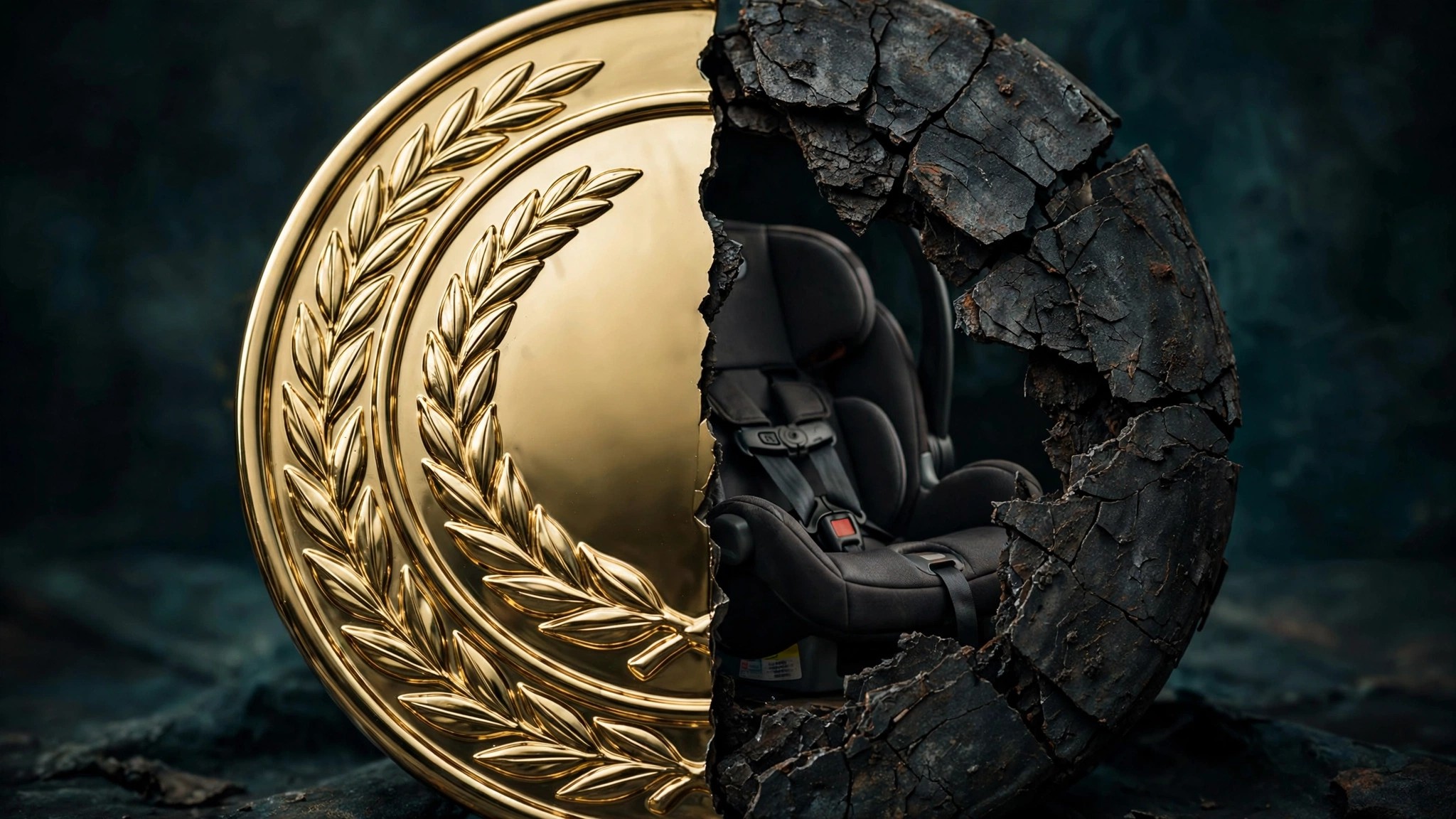
On March 7, two-year-old Lucia Ayala was pinned by a power-folding third-row seat inside a 2026 Hyundai Palisade in an Akron, Ohio parking lot. Bystanders freed her. She had already suffocated.[1] On May 14, the Insurance Institute for Highway Safety awarded that same vehicle its Top Safety Pick+, the highest accolade the industry’s most respected crash-test organization bestows.[2]
IIHS runs six evaluation categories: small overlap front, moderate overlap front, side crash, headlights, vehicle-to-vehicle crash prevention, and pedestrian crash prevention. Every one measures what happens when a car hits something. Not one measures what happens when a car’s own interior does the killing. The Palisade aced them all. It earned that gold star because it protects occupants beautifully in collisions, and IIHS never asked whether it might crush a child between appointments.
Six months before Lucia died, a California owner named Ashley Groussman warned Hyundai directly. Her daughter had been caught by the same power-folding mechanism on day one of ownership. Groussman called it “urgent.” Hyundai inspected the vehicle, declared the system “working as intended,” and closed the case.[3] The seat was working as intended. That was the problem.
After Lucia’s death, Hyundai recalled roughly 68,500 Palisades. Kia pulled 568 Tellurides with the same power seat architecture. Then a GM engineer, prompted not by GM’s own complaint database but by news of a dead child in a competitor’s SUV, ran a test on the Cadillac Vistiq’s third row. A 33-to-40-pound box placed on the seat was pinned in place with no auto-reverse. GM recalled every Vistiq ever sold: 14,540 vehicles, 100% defect rate.[4] GM had received six complaints about its own power seats dating back to May 2025, ten months before anyone died. It took a competitor’s fatality to make them look.
Three automakers. Roughly 83,600 vehicles. One dead child. And the industry’s gold-standard safety rating system tested none of it, because “safety” means “crash performance” and always has. Power windows got federal auto-reverse standards in 2010 after a string of child strangulations. Power seats that fold with the force to trap a toddler have no equivalent federal standard and no IIHS evaluation protocol. Automakers are free to ship motorized mechanisms that pin children in place, and IIHS is free to give them a trophy for it.
What to do
If you own a 2026 Palisade (Limited or Calligraphy), a 2027 Kia Telluride Hybrid SX Prestige, or any 2026–2027 Cadillac Vistiq, check your VIN at nhtsa.gov/recalls. Vistiq owners should take the vehicle to a dealer immediately; GM is disabling the third-row folding feature until a permanent fix arrives. Do not assume a Top Safety Pick+ badge means every part of your vehicle is safe. It means the crash tests went well. That is a different question from whether the seat behind your child can fold onto them without stopping.
Sources & References
- Akron Police Department report; NY Post, “Cadillac recalls electric SUV months after toddler killed in tragic Hyundai power seat incident,” July 7, 2026. nhtsa.gov
- IIHS, “Two additional models earn awards in latest IIHS ratings,” May 14, 2026. iihs.org
- Carscoops, “She Tried To Warn Hyundai The Palisade Seat Could Kill Someone. It Did,” April 2026. carscoops.com
- Jalopnik, “Cadillac Recalls Every Vistiq After Internal Investigation Spurred By Deadly Hyundai Palisade Power-Folding Seat Incident,” July 6, 2026; NHTSA Recall N262555780. nhtsa.gov
Limitations
IIHS is a crash-test organization by design, and criticizing it for not testing non-crash hazards is, to some degree, faulting a thermometer for not measuring humidity. IIHS has never claimed to evaluate powered interior mechanisms. Power seat entrapment deaths are extremely rare relative to the ~40,000 annual crash fatalities in the U.S., and expanding IIHS’s scope risks diluting focus on the collision testing that saves thousands of lives per year. Groussman’s account is based on press interviews, not court filings. The 68-day gap is a chronological fact, not evidence that IIHS should have delayed its award.
Counterargument
IIHS could reasonably argue that its mission is crashworthiness and crash avoidance, and that regulating powered mechanisms falls to NHTSA’s FMVSS process, not a private testing body. That is structurally correct. But consumers do not read Top Safety Pick+ as “this vehicle performed well in six specific laboratory crash tests.” They read it as “this vehicle is safe.” When the gap between those two statements is a dead child, the label has outrun its meaning.