Zero Minivans Earned a Safety Award in 2026. The Back Seat Is the Reason.
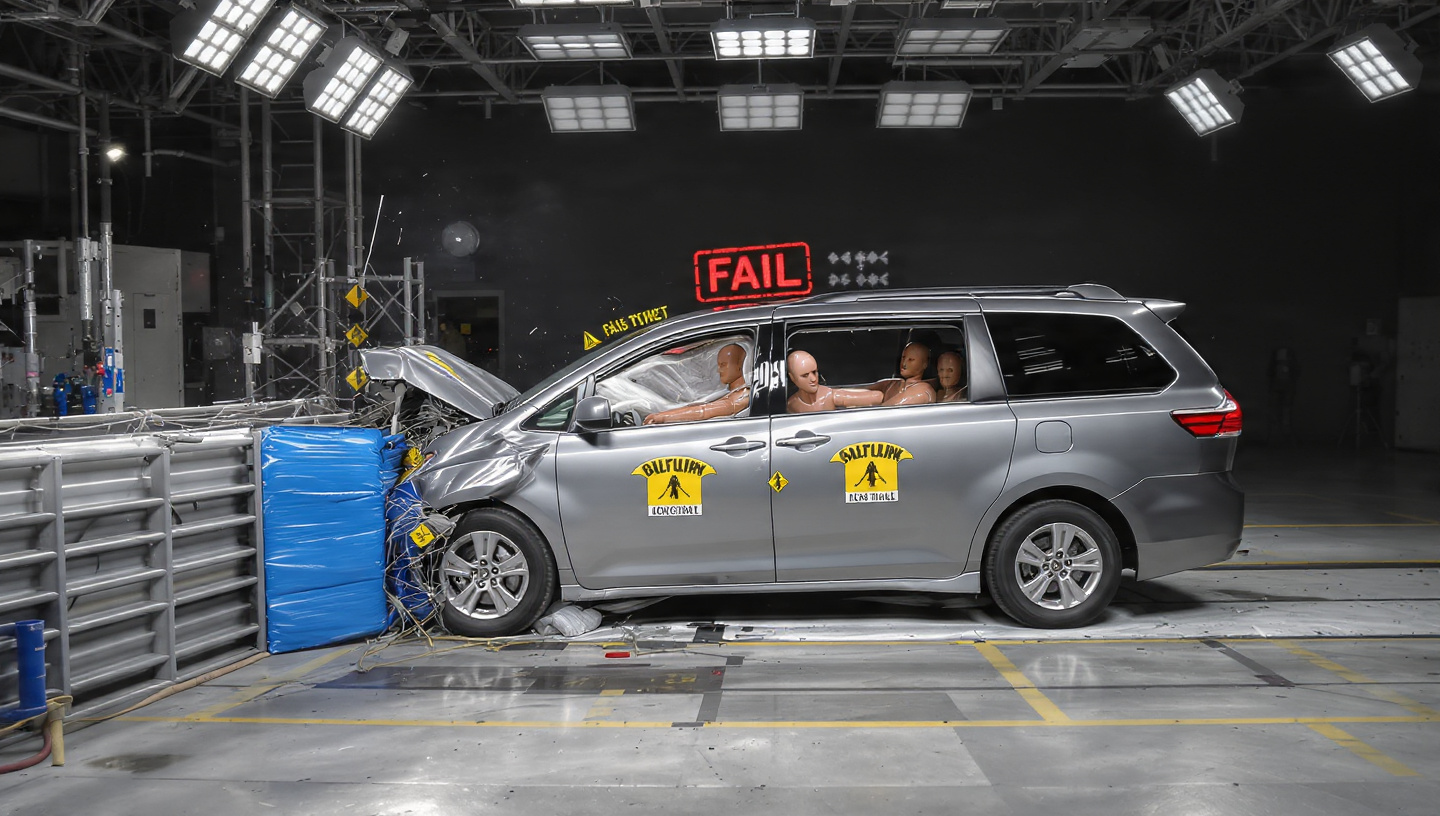
IIHS published its 2026 safety awards in March. Forty-five vehicles earned Top Safety Pick+, eighteen earned Top Safety Pick, and not a single minivan appeared on either list. America's best-selling family hauler couldn't pass a test designed to measure how well it protects people sitting in the back.
IIHS's updated moderate overlap front crash test is the culprit, and it now evaluates rear-seat occupant protection as a mandatory criterion for both award tiers. Previously, a good rating in this test was only required for the higher-tier TSP+, meaning a minivan could squeak by with mediocre back-seat performance. For 2026, it gates everything. IIHS President David Harkey didn't mince it: "It's disappointing that minivans continue to struggle to provide the best-available protection for passengers in the back, considering that these are supposed to be family vehicles."[1]
That word "continue" matters, because this isn't new. IIHS has been evaluating rear-seat protection since 2022, and minivans have been failing since 2022. Four model years of warnings, and the segment still can't clear the bar.
The data gets perverse from here. I pulled FARS fatality rates for every minivan with enough fleet data and compared them to vehicles that earned 2026 TSP+ awards. Chrysler's Pacifica posts a fatality rate of 0.19 deaths per 100 million vehicle miles traveled. Toyota's Sienna comes in at 0.49. For context, the Toyota Camry earned TSP+ with a FARS rate of 2.03, Honda's Civic earned TSP at 2.25, and Subaru's Outback, another TSP+ winner, sits at 0.45.[2] By the blunt metric of "how often do people die in this vehicle per mile driven," the Pacifica is safer than every single TSP+ winner in the FARS dataset with sufficient sample size.
FARS measures aggregate fleet outcomes across a decade of model years, road types, driver demographics, and crash configurations, which explains the apparent contradiction. A Camry's 2.03 rate reflects millions of 2005-era Camrys driven by everyone from teenagers to retirees across every road type in America. IIHS tests one specific thing: how does the current production vehicle perform when a specific mass hits a specific barrier at a specific speed? These are fundamentally different questions, and they can produce opposite answers for the same nameplate. Empirically, the Pacifica is less likely to be involved in a fatal crash per mile driven, yet it is demonstrably unable to protect a rear-seat occupant in the exact collision geometry IIHS uses to evaluate back-seat safety. Both statements are true simultaneously, and for a parent loading three car seats into the second row, only one of them matters.
IIHS also added a vehicle-to-vehicle front crash prevention evaluation for 2026, running at 31, 37, and 43 mph using car, motorcycle, and semitrailer targets. TSP+ demands good pedestrian crash prevention and acceptable-or-better results on this new test, all as standard equipment across every trim.[1] Minivans didn't even get far enough into the criteria to face those hurdles, because rear-seat testing eliminated them first.
Meanwhile, SUVs claimed 47 of the 63 total awards. Hyundai's Tucson (TSP+, FARS rate 0.34), Subaru's Forester (TSP+, 0.26), and Hyundai's Santa Fe (TSP+, 0.39) all earned the top badge while carrying comparable or higher fatality rates than the Sienna. If you're shopping for a vehicle to protect your kids, the data now points away from the vehicle category that was invented for exactly that purpose and toward compact and midsize SUVs that passed the back-seat test.
Some caveats before you sell your Odyssey: FARS data is a crude instrument that doesn't separate front-seat from rear-seat fatalities. A minivan's low per-mile rate could reflect cautious driving patterns, suburban usage, lower speeds, or simply more miles logged by attentive parents rather than structural superiority. IIHS's test isolates structural performance from driver behavior, which is precisely its value and its limitation. And FARS covers 2014-2023, meaning much of the fleet data predates the current generation of every vehicle on either list.
Here is the strongest counterargument: IIHS tests the car you can buy today, while FARS reflects the car everyone bought over the last decade. A 2026 Camry is a radically different vehicle from a 2008 Camry. Fair enough. But a 2026 Sienna is also a current-production vehicle, engineered by Toyota, tested by IIHS under 2026 rules, and it still can't protect the back seat to the standard that a $22,290 Kia K4 sedan manages with ease. That disparity should bother Toyota, Honda, and Chrysler. A sedan that costs less than half the price of most minivans protects rear passengers better than any minivan on sale today.[1]
What to do about it: If you drive a minivan, check IIHS's detailed moderate overlap front test results for your specific model at iihs.org/ratings and pay close attention to the rear-seat dummy readings. If you're buying new and rear-seat safety is non-negotiable, compare the Subaru Ascent, Hyundai Santa Fe, or Kia Sorento, all of which earned TSP+ with documented rear-seat protection. Four years of warnings, and the minivan segment has chosen not to fix the problem, and at some point that choice becomes yours to make with your wallet.
Sources & References
- IIHS, “IIHS pushes improvements in crash avoidance with 2026 awards,” March 2026. iihs.org
- NHTSA, Fatality Analysis Reporting System (FARS), 2014–2023. nhtsa.gov
- IIHS Vehicle Ratings, iihs.org/ratings