Hyundai and Kia Build the Same Car. The Hyundai Kills 3.8× More People.
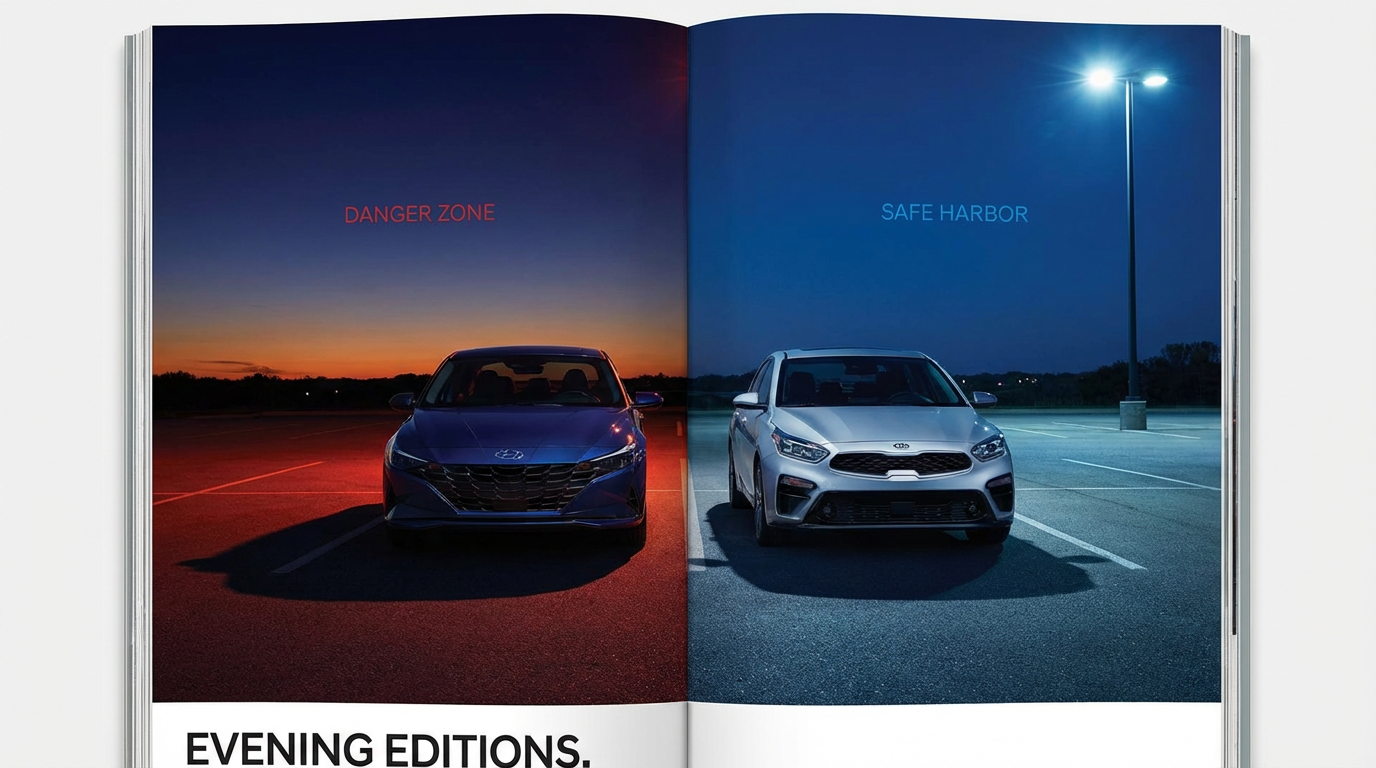
Let’s talk about what happens in the first 150 milliseconds. In a frontal collision, the crash pulse travels through the body structure, the crumple zones collapse in a choreographed sequence, and the airbag module decides whether you live or die. All of that engineering is supposed to be identical between the Hyundai Elantra and the Kia Forte. They share the K3 platform. They share engines, transmissions, and a parent company. They’re built by the same conglomerate — Hyundai Motor Group — in factories that use the same welding robots.
The Elantra has killed 2,407 people. The Forte has killed 604. Adjust for fleet size and miles driven, and the Elantra’s death rate is 1.50 per 100 million VMT. The Forte: 0.40.
It’s not a fluke. The pattern repeats one segment up. The Hyundai Sonata — midsize sedan, same Hyundai Motor Group playbook — kills at 1.56 per 100M VMT with 1,887 deaths. The Kia Optima, its mechanical twin: 0.58, with 611 deaths. That’s a 2.7× gap between cars that share a platform, a powertrain catalog, and a corporate overlord in Seoul.
The impairment data won’t save this story from being uncomfortable. Elantra drivers test positive for any substance at 18.6% — actually below the roughly 20% national average. Forte drivers: 20.1%. Sonata: 20.4%. Optima: 22.0%. If anything, Kia drivers are slightly more impaired than their Hyundai counterparts, yet dying at dramatically lower rates. Whatever is killing Elantra and Sonata drivers, it isn’t alcohol.
The model-year data tells part of the story. The Elantra’s worst single year is model year 2013 with 338 deaths — an astonishing spike. That’s the fifth-generation Elantra, which sold in enormous volumes on the strength of 40-mpg highway claims (later revised downward after an EPA audit). Model years 2010 and 2017 each topped 150+ deaths. The Forte’s worst year is 2017 at 81. The volume gap matters: Hyundai simply sold far more Elantras in the 2000s and early 2010s, flooding the used-car market with older, less-safe vehicles that are still killing people a decade later.
But volume alone doesn’t explain a 3.8× rate gap. The Elantra’s fleet is estimated at 1.4 million vehicles versus the Forte’s 1.3 million — nearly the same size. The rate calculation already normalizes for fleet and miles. Something about how these cars age, who buys them secondhand, and how they perform in real-world crashes — not IIHS lab tests — is fundamentally different.
The SUVs tell a calmer story. The Tucson (0.34) and Sportage (0.28) are within 1.2× of each other. The Santa Fe (0.39) and Sorento (0.29) are 1.3× apart. Bigger vehicles, smaller gaps. The sedan divergence is where the bodies are.
Here’s the uncomfortable summary: if you’re shopping for a Korean compact sedan and you pick the Hyundai badge over the Kia badge, you’re choosing a car that is nearly four times deadlier per mile than its mechanical twin. Same parent company. Same engineering DNA. Same price point. Very different odds of making it home.