880,000 of Honda’s Safest Vehicles Are Rotting From Underneath
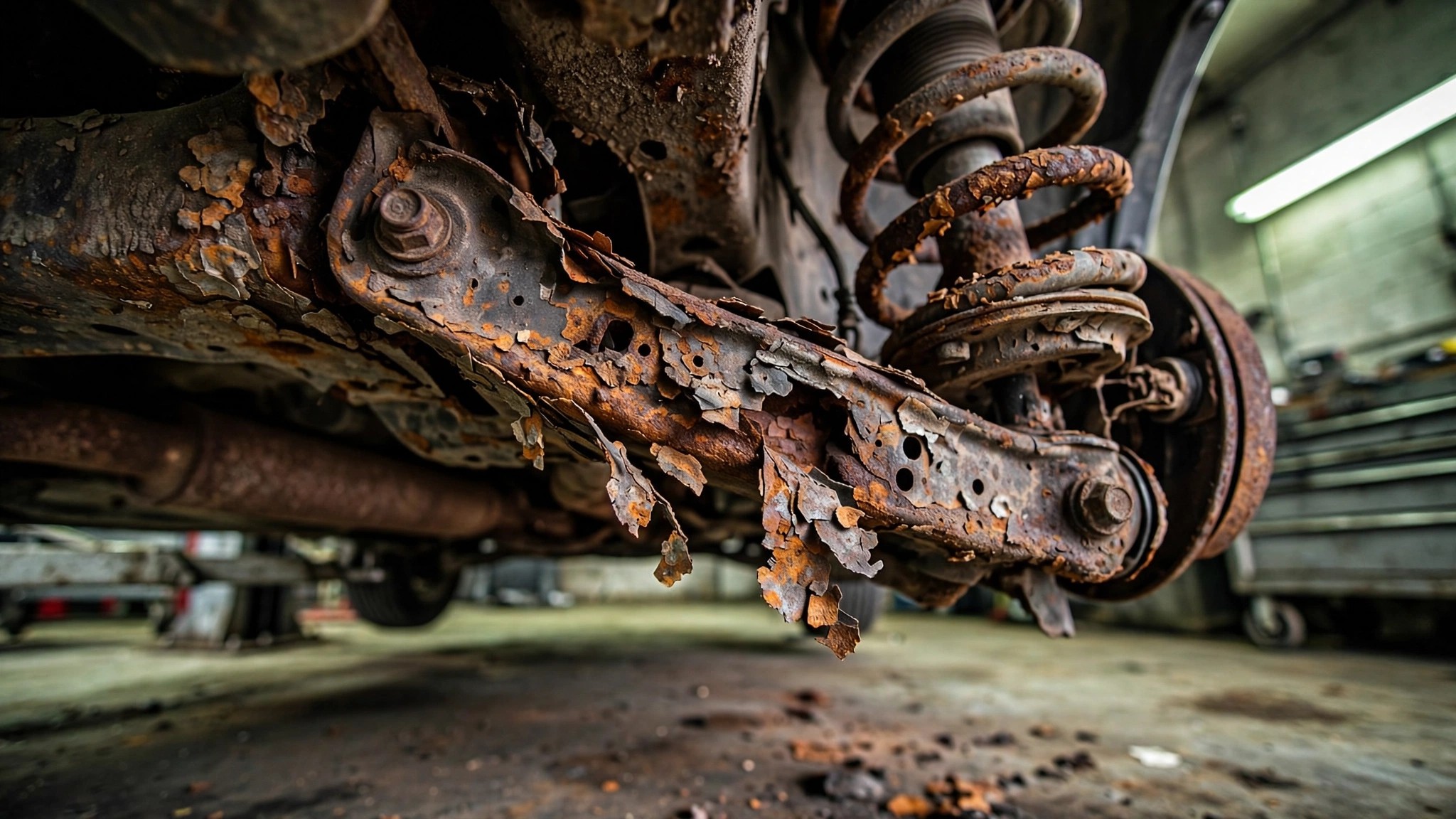
Honda recalled 880,514 vehicles on Wednesday for rear subframe corrosion that can rip a control arm clean off the chassis.[1] The affected models are the Pilot (2016–2022), Ridgeline (2017–2023), Passport (2019–2023), and Acura MDX (2014–2020). Four vehicles. All of them among the statistically safest SUVs and trucks in a decade of federal crash fatality data.
Run those four models through FARS and you get fatality rates that border on absurd. Passport: 0.10 deaths per hundred million vehicle miles traveled. Ridgeline: 0.24, making it the safest pickup truck in the dataset by a wide margin, beating the F-150 (1.04) by a factor of four and the Silverado (1.25) by five. Pilot sits at 0.29 and MDX at 0.30. In a universe of 337 models with enough data to matter, all four land in the top decile for crash survivability. Combined, they account for 794 deaths across ten years of FARS reporting, on a fleet of roughly 2.36 million vehicles that collectively drove an estimated 29.8 billion miles annually.[2]
Those numbers assumed intact subframes.
Rust changes everything.
Straightforward and terrifying, the failure mode works like this: road salt corrodes the rear subframe at the suspension mounting points, the rear control arm detaches, and the driver loses handling and control at whatever speed they happen to be traveling when the part gives way.[1] NHTSA does not mince words about what happens next. Neither does physics.
What makes this recall interesting from a data standpoint is not the defect itself, since corrosion recalls happen all the time. What matters is the gap between what FARS measures and what corrosion destroys. FARS records the outcome of a crash: who died, what vehicle they were in, how fast, what substances showed up in the toxicology report. It does not record pre-crash mechanical condition. When a 2018 Pilot with a corroded subframe loses its rear control arm on I-90 outside Buffalo, loses control, and strikes a median barrier, FARS logs a Honda Pilot fatality. Honda's safety statistics absorb the incident without blinking. No column in the dataset distinguishes "Pilot crashed because the driver ran a red light" from "Pilot crashed because six winters of road salt ate through a load-bearing structural member."
Every rate calculation we publish contains this blind spot at its center. Every fatality rate on this site treats the vehicle as a fixed object whose crashworthiness was determined at the factory and remains constant until the crusher. In reality, structural degradation is continuous, accelerated by geography, and invisible to the only federal database that tracks fatal outcomes at the vehicle level. Honda's 0.29 rate reflects Pilots with intact subframes crashing into things. A Pilot whose rear suspension mounting point has corroded to failure is a fundamentally different vehicle, and FARS will never tell us how different.
We can estimate the exposure, even if we can't quantify the risk precisely. Recall coverage: 880,514 vehicles out of a combined active fleet of approximately 2.36 million for these four models, or about 37% of the fleet. For the Ridgeline (2017–2023) and Passport (2019–2023), the recall spans essentially every production year of the current generation. For the MDX, Honda limited the recall to salt-belt states: Connecticut, Illinois, Massachusetts, New York, Pennsylvania, and Wisconsin. For the Pilot, Ridgeline, and Passport, no geographic limitation, meaning Honda believes the corrosion risk extends nationwide, though severity concentrates where winter road maintenance does.[3]
A controlled-for-everything calculation is impossible with available data, but the directional math warrants stating. If compromised subframes elevated the fatality rate for just the recalled vehicles from their current weighted average of roughly 0.27 to the fleet-wide average of 1.13, that represents a 4.2x increase in expected fatalities for 880,000 vehicles. Not a particularly high bar, that fleet-wide average. It includes every 20-year-old Cobalt and Cavalier still limping down I-75. Reaching it from Honda territory would require a catastrophic degradation in vehicle behavior, which is precisely what rear suspension separation at highway speed delivers.
Credit where it is earned: Honda caught this through internal monitoring, not through a pile of FARS fatalities. NHTSA's filing reports no deaths and no injuries linked to the defect, making this preventive rather than reactive. Dealers will inspect the rear subframe, install a reinforcement kit, and repair or replace components at no cost.[1] If the remedy rate reaches the affected vehicles before corrosion reaches the control arms, this recall becomes a case study in the system working. Time is the critical variable: corrosion does not wait for appointment availability.
Strongest counterargument, stated at full strength: a Honda Pilot with a corroded subframe is still a Honda Pilot. It retains its side-curtain airbags, its collision-mitigation braking, its front crumple zone geometry, its Honda Sensing suite. Subframe corrosion degrades handling, not necessarily crashworthiness. A driver who loses a rear control arm and crashes into a barrier at 40 mph is still inside a structure engineered to distribute that impact. Honda's safety record reflects hundreds of design decisions, and the subframe is one component among thousands.
Counterpoint to the counterargument: a driver who never loses a rear control arm never hits the barrier in the first place. Crash avoidance versus crash survival matters enormously in FARS, because FARS only sees the crashes that happen. Every avoided crash is invisible. Every vehicle in FARS arrived there through a sequence of failures. Adding a mechanical failure to that sequence, one that the data cannot identify and that the driver cannot anticipate, degrades the effective safety of the vehicle by a quantity we cannot measure with the tools we have.
Actionable version: if you own a 2016–2022 Honda Pilot, a 2017–2023 Ridgeline, a 2019–2023 Passport, or a 2014–2020 Acura MDX, check your VIN at nhtsa.gov/recalls and schedule the free subframe inspection immediately. If you live in a state that salts its roads, move it up the priority list. If you hear unusual clunking or feel looseness in the rear suspension, stop driving the vehicle until it has been inspected. Do not assume that a vehicle with a 0.29 fatality rate will protect you when the structural member holding the rear wheels on has been compromised. That 0.29 was earned with an intact chassis, and FARS does not issue partial credit.
Sources & References
- Reuters, “Honda America recalls more than 880,000 vehicles over rear suspension components failure,” June 10, 2026. reuters.com
- NHTSA, Fatality Analysis Reporting System (FARS), 2014–2023. nhtsa.gov
- Morningstar / Dow Jones, “Honda Issues Recall Due to Rear Subframe Corrosion Risks,” June 10, 2026. morningstar.com
- NHTSA Vehicle Safety Hotline and recall lookup tool. nhtsa.gov/recalls
Source: NHTSA FARS 2014–2023. Fatality rates are estimates based on fleet size and VMT calculations with approximately ±15% uncertainty for lower-volume models. FARS does not track pre-crash mechanical condition; corrosion-related crash contributions cannot be isolated from the dataset. See methodology for caveats.