Toyota’s Safest Family SUV Has a Rear Axle That Can Break
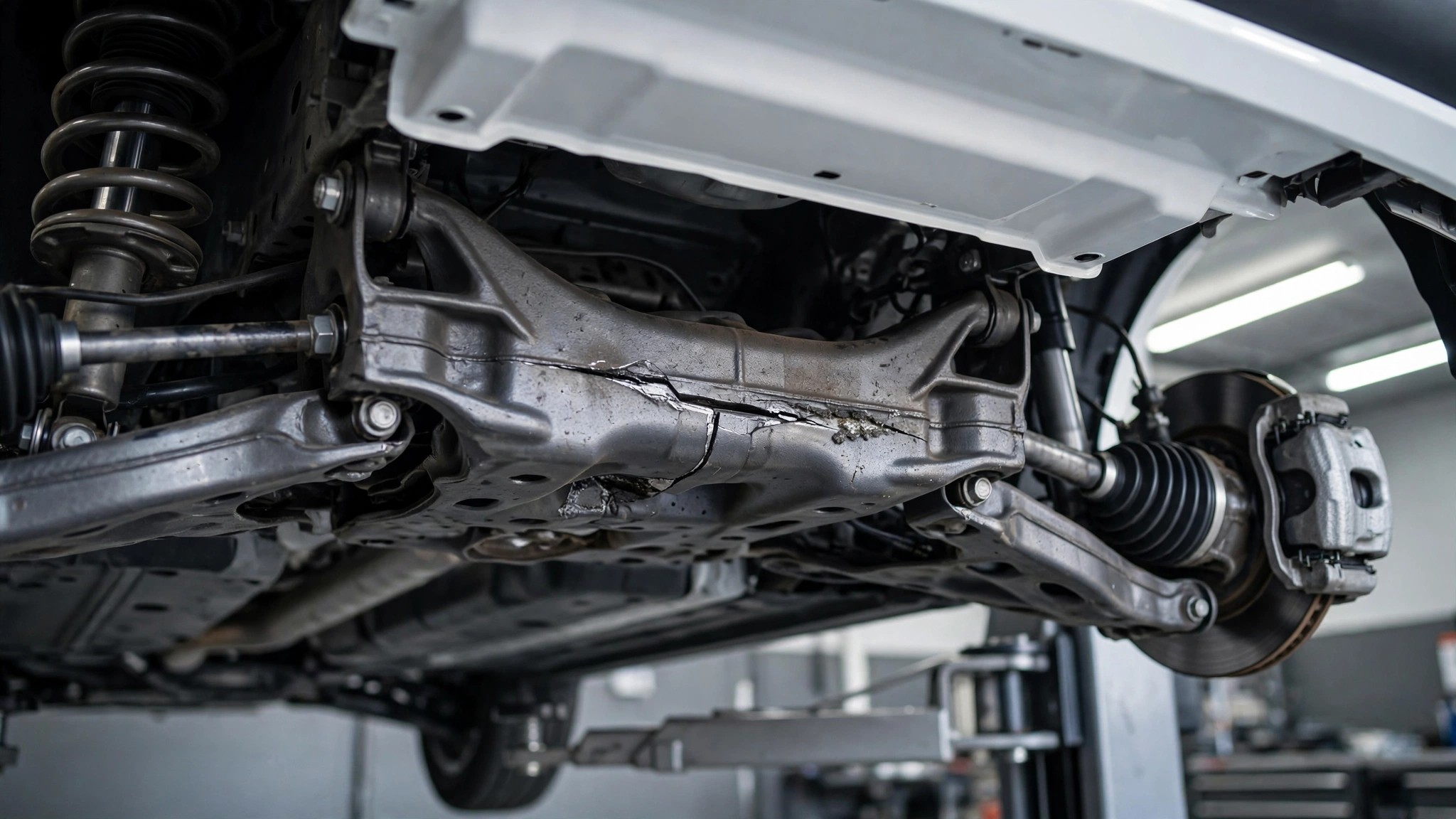
The rear axle carrier in the 2026 Toyota Grand Highlander can crack at its attachment point. Not under extreme conditions, and not after years of abuse. From the factory, with insufficient material strength, per NHTSA’s own language in the July 8 recall filing.[1] That component holds the rear wheels to the chassis. When it breaks, rear stability goes with it.
This is Toyota’s flagship three-row SUV, the vehicle positioned above the regular Highlander as the modern family fortress. It shares a recall filing with the Lexus TX, TX Hybrid, and TX Plug-In Hybrid, the luxury badge on the same TNGA-K platform. Every one of them carries the same defect in the same rear axle carrier sub-assembly.[2]
What makes this interesting isn’t the recall itself. Five thousand units is small. Nobody got hurt, and Toyota caught it before the axle carrier actually broke on a highway at speed, which is proactive engineering doing exactly what proactive engineering should do. What’s interesting is the pattern it completes: three separate Toyota recalls in 2026, all targeting the back end of the vehicle, the part of the car where families put their children.
Earlier this year, Toyota recalled 550,000 regular Highlanders for rear seat seatbelt defects.[3] In March, the company recalled portions of the RAV4 Hybrid, Tundra, Grand Highlander Hybrid, Lexus TX, and others because the load carrying capacity modification labels displayed inaccurate weight values, meaning owners could unknowingly overload the rear axle beyond its rated capacity.[4] Seatbelts in the back, weight limits for the back, and now the axle that carries the back. If your 2026 three-row Toyota has a recall, the defect lives behind the B-pillar.
Where the Highlander Actually Ranks
FARS tracks what happens when vehicles crash fatally. Occupant lethality (the fraction of fatal crash involvements where the vehicle’s own occupant dies) measures how well the vehicle protects the people inside it. Lower is better. Among the twelve most common three-row SUVs in the 2014–2023 FARS dataset, the regular Toyota Highlander scores 0.454: for every 100 fatal crashes involving a Highlander, about 45 occupants died.[5]
That is not the best in class. The Chevrolet Traverse posts 0.393, the Mazda CX-9 manages 0.411, and the Honda Pilot is 0.453. Even Dodge’s Durango, a vehicle nobody confuses with a safety leader, scores 0.430. All of them protect their occupants better than the Highlander in fatal-severity crashes, measured across a decade of FARS data and thousands of crash involvements.
Fatality rate per 100 million VMT tells a different story and a more flattering one for Toyota. The Highlander posts 0.42, well below the Ford Explorer at 1.54 or the Chevrolet Tahoe at 2.49. This reflects Toyota demographics as much as Toyota engineering; Highlander buyers tend to be suburban, moderate-speed, low-impairment drivers who crash less frequently per mile driven. The Tahoe’s 2.49 rate has more to do with who buys a Tahoe than how the Tahoe is built, and pretending otherwise would be dishonest data analysis. But even granting the Highlander favorable demographics, its per-crash occupant protection is middle-of-the-pack, not best-in-class.
The Gap FARS Cannot See
FARS measures crash outcomes. What it cannot measure is whether the structural components that determine those outcomes are intact before the crash happens. A vehicle can build a decade of excellent FARS data — 2,434 fatal crash involvements, 1,106 occupant deaths, solid mid-pack performance in a competitive segment — while the newest version rolls off the assembly line with an axle carrier that doesn’t meet material specifications. The historical record is real, and so is the metallurgical deficiency. They coexist without contradiction, which is precisely the problem. FARS data creates confidence. Structural recall data reveals whether that confidence has a physical foundation under the rear wheels, and right now, for 5,408 Grand Highlander and Lexus TX owners, it does not.
The Strongest Case for Toyota
Catching a manufacturing defect before anyone gets hurt is the system working. No crashes, no injuries, voluntary recall. Most automakers would let this ride until warranty claims started trickling in. Toyota traced the issue to specific sub-assemblies, identified affected VINs, and issued a recall proactively, the kind of behavior that builds the long-term safety record reflected in FARS. One manufacturing lot with insufficient material strength doesn’t invalidate a decade of crash data. It validates the quality control apparatus that keeps the decade of crash data accurate.
What You Should Actually Do
If you own a 2026 Grand Highlander or Lexus TX, do not wait for the notification letter in August. Check your VIN at Toyota.com/recall or nhtsa.gov/recalls today. The rear axle carrier is a structural component bearing the full dynamic load of the rear suspension. It is not a sensor recalibration or a label reprint. If your VIN is flagged, get it inspected before your next highway trip with kids in the back seat.
If you are shopping the three-row SUV segment, know that FARS data reveals a 7.7x death rate gap between the Chevrolet Traverse (0.20 per 100M VMT) and the Ford Explorer (1.54), both with statistically robust crash counts above 600. Occupant lethality spans from 0.393 (Traverse) to 0.574 (Expedition), a 46% relative spread in your probability of dying in a fatal crash. These vehicles park next to each other on the same dealer lots. The safety difference between them is larger than the safety difference between having ABS and not having ABS.[6]
Limitations
The recalled 2026 Grand Highlander is too new to appear in FARS. All safety data cited here reflects the regular Highlander (2014–2023 models on earlier platforms). Grand Highlander shares the TNGA-K architecture but is a distinct vehicle with different dimensions, weight, and crash structures. Lethality comparisons across the three-row SUV class are confounded by demographics: buyer age, geography, driving behavior — which FARS does not isolate. Small-sample vehicles (Telluride: 86 crashes; Palisade: 83) are included for completeness but should be read cautiously. And 5,408 recalled units is a fraction of Grand Highlander production; the defect may affect a small manufacturing window, not the platform itself.
Sources & References
- NHTSA, Recall Campaigns 26TB13, 26TA13, 26LB08, 26LA08, filed July 8, 2026. nhtsa.gov/recalls
- Toyota Motor North America, “Toyota Recalls Certain Model Year 2026 Toyota Grand Highlander and Lexus TX Vehicles,” July 8, 2026. pressroom.toyota.com
- Autoblog, “Toyota Recalls 550,000 Highlander SUVs For Rear Seat Safety Defect,” March 2026. autoblog.com
- NHTSA, Recall Campaigns 26LB04, 26LA04, 26TB07, 26TA07 (load carrying capacity modification labels), March 2026. nhtsa.gov/recalls
- NHTSA, Fatality Analysis Reporting System (FARS), 2014–2023. nhtsa.gov
- IIHS, “Life-saving benefits of ESC continue to accrue,” 2011. iihs.org