GM Has Built the Same Van for Thirty Years and Still Can't Tighten a Nut
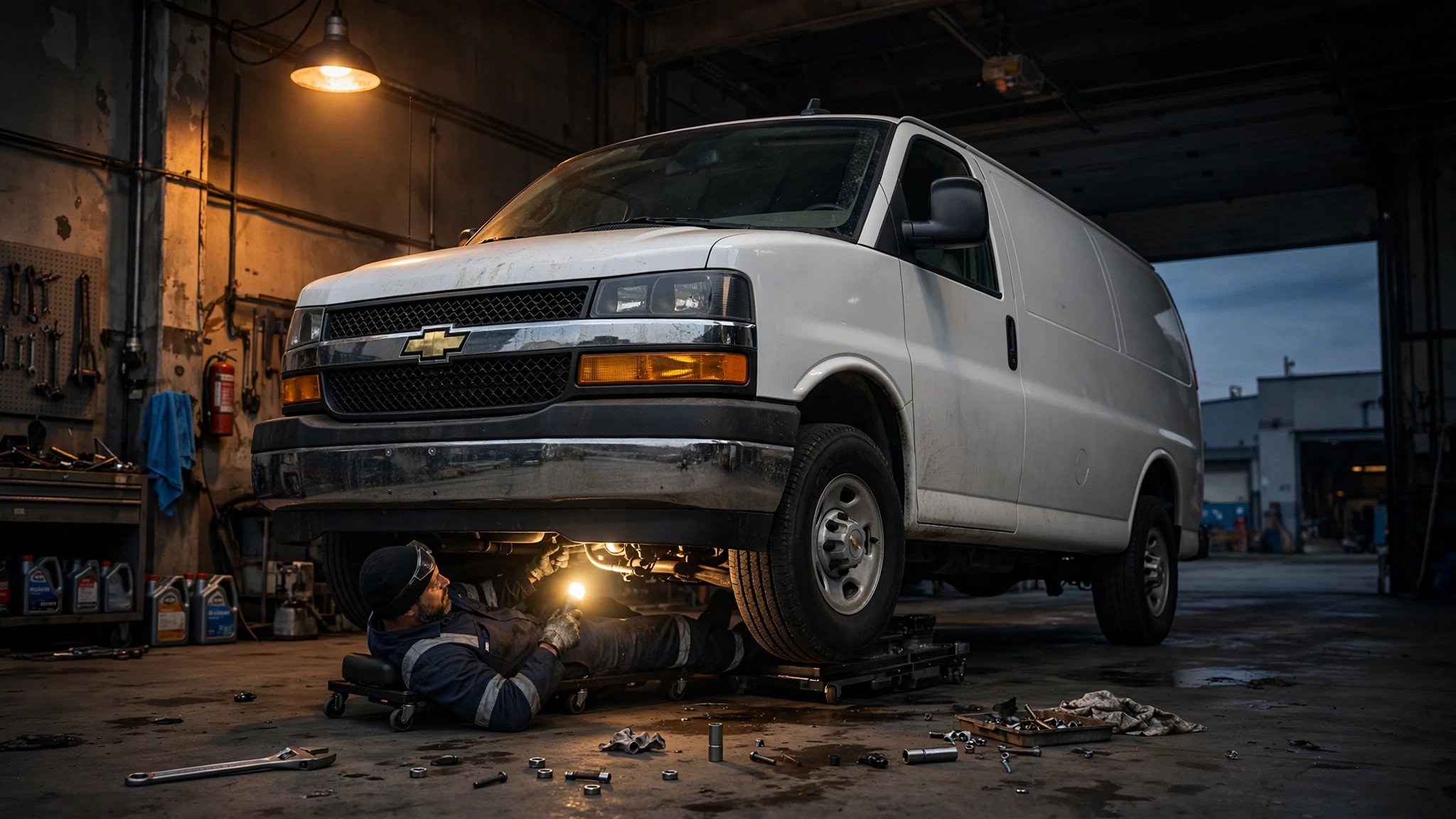
Fifty-one steering gear assemblies left a supplier's factory with a nut that was only hand-tight. Not torqued. Not checked. Hand-tight. The sensor that was supposed to catch the error had malfunctioned, and nobody noticed until a dealership tech crawled under a 2025 Chevrolet Express and found the steering box rattling like a loose tooth.
That's the math of modern supply chain traceability: GM knows exactly which 51 serial-numbered steering assemblies were botched, but can't figure out which vans they ended up in. So every 2025 and 2026 Express and Savana gets a recall letter, and a tech gets to lie on their back checking part stickers on 26,541 chassis. NHTSA Recall 26V399, filed June 2026, joins a growing collection.[1]
This is the fourth recall for the Express and Savana since January 2025. Earlier this month, 232 vans were pulled back because a Nexteer-supplied steering column gave drivers tactile feedback saying the van was in Park when it wasn't.[2] Before that, fuel system and other issues. Four quality escapes in 18 months, all for a vehicle GM has been assembling since Bill Clinton's first term.
The Express and Savana rolled off the line as 1996 models, making them the oldest continuously produced vehicle design in America, a distinction they've held for years while competitors redesigned their lineups around them. GM refreshed the interior in 2003, swapped in a new steering gear in 2017, and otherwise left the thing alone, because it keeps selling to commercial fleets who value parts availability and simplicity over infotainment screens. Its electric successor, BrightDrop, already failed and was discontinued. The van that predates Google outlasted the van that was supposed to replace it.
Naturally, four recalls on a 30-year-old platform invites the question that CarBuzz put bluntly: can't GM build this thing in its sleep?[3] Apparently not. But the FARS data adds a dimension the recall headlines miss entirely.
The Chevrolet Express has a FARS fatality rate of 0.92 deaths per 100 million vehicle miles traveled across the 2014–2023 dataset. GMC Savana comes in even lower at 0.54. For context, the Dodge Grand Caravan sits at 1.33, the Chrysler Town & Country at 1.26, and the Honda Odyssey at 0.93. The Ford E-350, the Express's direct commercial competitor and a van that generates far fewer recall headlines, has a rate of 2.51, which is 2.7 times deadlier per mile driven.[4] The full-size Ford van kills at a rate that would make a midsize sedan blush, and nobody writes "Even After 30 Years" headlines about it.
This is the gap between manufacturing quality and design safety, and they measure fundamentally different things. A loose steering nut is a quality control failure at the supplier level, a sensor malfunction that let 51 assemblies slip through what should have been an automated torque verification station. It's serious. A 5,600-pound van losing steering authority at highway speed is a potential multi-fatality event. But it's a production defect, not a design defect, and the distinction matters when you're making a buying decision.
Its fundamental architecture, its body-on-frame construction, its weight distribution, its crashworthiness geometry, those things are embedded in the death rate. Over ten years and hundreds of millions of miles driven by commercial fleets across America, the Express kills its occupants at a lower rate than most family minivans, and at a fraction of the rate of its Ford equivalent. The steering box has been the same part since 2017, and the design works. What failed was a sensor in a parts plant that let a technician's hand-tightening pass as machine-verified.
Impairment data reinforces the picture rather than complicating it. Express drivers test positive for alcohol or drugs in 19.0% of fatal crashes, essentially the fleet average of 20.0%. Savana drivers run slightly above at 20.4%, with a notably high drug-positive rate of 11.2%. These figures aren't outliers in either direction, sitting right at the fleet mean. The driver demographics mirror the general population of fatal-crash-involved motorists, which makes the low death rate a cleaner signal about the vehicle itself rather than the behavior of the people driving it.
If you're running a fleet and your procurement team is nervous about the recall headlines, show them the FARS numbers. The Express with its four recent quality escapes has killed fewer occupants per mile than the Odyssey (0.93), the Grand Caravan (1.33), and every full-size Ford van in the dataset. If you own a 2025 or 2026 model, check your VIN at nhtsa.gov/recalls today, not in August when the letters arrive. If the steering feels off-center or imprecise, don't drive it to the dealer. Have it towed.
But don't confuse recall frequency with crash risk. GM should be embarrassed that it can't build a 30-year-old van without quality escapes. Its customers should not be scared to drive one.
Sources & References
- NHTSA, Recall No. 26V399, “Steering Gear Assembly Nut Not Properly Tightened,” June 2026. nhtsa.gov/recalls
- NHTSA, Recall No. 26V345, “Inaccurate Gear Selection Feedback,” June 2026. nhtsa.gov/recalls
- CarBuzz, “Even After 30 Years In Production, Recall Proves Chevy Can't Assemble This V8 Van In Its Sleep,” June 29, 2026. carbuzz.com
- NHTSA, Fatality Analysis Reporting System (FARS), 2014–2023. nhtsa.gov