Ford Has Recalled One Million Vehicles for Rolling Away. It's June.
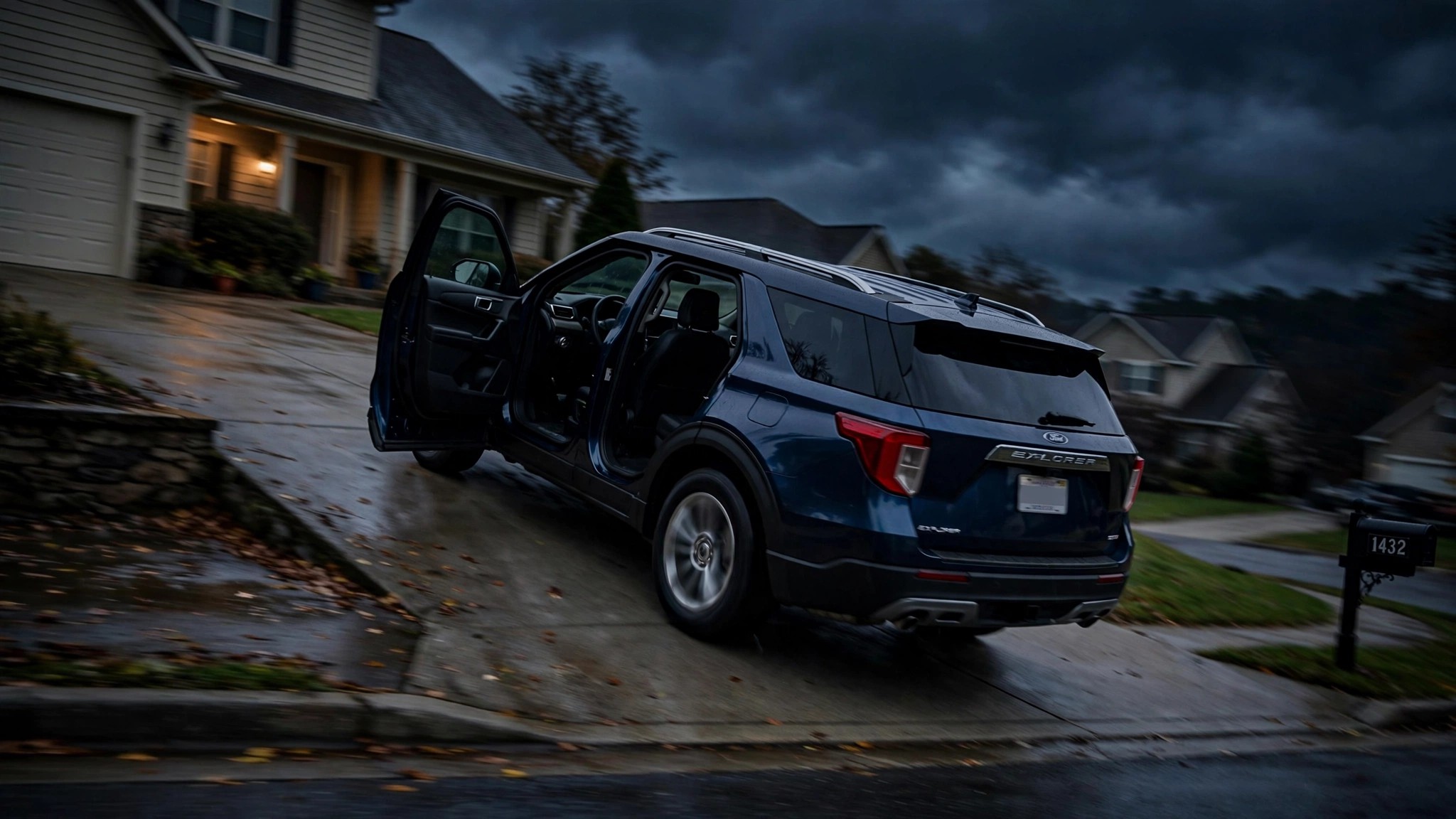
On Tuesday, NHTSA posted recall 26S48: 741,195 Ford and Lincoln vehicles whose transmission park pawl can engage while the car is still moving, chewing up the park mechanism and leaving the vehicle free to roll away once you walk inside.[1] The affected list reads like a suburban driveway census: 2018–2021 Expeditions, 2020–2021 Explorers, 2021 F-150s, plus the Lincoln Navigator and Aviator twins that share the same platform and apparently the same appetite for wandering off when you turn your back. The fix is a software update and possible hardware replacement, which sounds reassuring until you learn the timeline: April 2027, a full ten months from now.[4]
That number combines two entirely separate recalls, which is where the story stops being about one bad batch of transmissions and starts being about a pattern. In January, Ford pulled back 272,645 F-150 Lightnings, Mustang Mach-Es, and Mavericks because their electronic park modules could fail to lock into position.[2] Those are EVs and hybrids with electronic drivetrains that have nothing mechanically in common with the 10-speed automatics in today's recall, yet the failure mode is identical: you shift into Park, you get out, and the vehicle decides it has somewhere else to be.
Two platforms, two fundamentally different powertrains, one company that cannot make its vehicles stay where you leave them.
The January recall at least had a relatively quick over-the-air software fix, but today's is a different animal entirely because NHTSA's notice says interim letters go out August 3 while the actual remedy won't be available until April 2027. That means ten months of driving a vehicle you know violates FMVSS 114, the federal safety standard specifically written to prevent rollaway, with no recourse beyond "use your parking brake more carefully and hope you remember every single time."[5] Ford itself acknowledges the vehicles fail to comply with the standard, and NHTSA has no regulatory deadline for how quickly an automaker must produce a remedy once a recall is announced, which means there is no clock running on Ford's obligation to actually fix the problem it disclosed.
The five nameplates in today's recall are not low-volume exotics that show up in FARS as rounding errors. The Explorer logged 3,797 fatalities at a rate of 1.54 per 100 million vehicle miles traveled over the 2014–2023 FARS window, the Expedition racked up 1,515 deaths at a rate of 2.31, and the F-150 contributed 9,194 fatalities across its fleet of 6.5 million registered vehicles, making it the second-deadliest nameplate in the entire FARS dataset behind only the Silverado.[3] Navigator and Aviator add another 398 fatalities between them, and collectively these five models appear in 30,125 fatal crash investigations over the decade, a number that has nothing to do with rollaway defects specifically but everything to do with how many of these vehicles are on the road and how much rides on Ford getting basic transmission behavior right.
Rollaway isn't even the only transmission-behavior recall Ford has issued this year. In April, Ford recalled 1.39 million F-150s for an unrelated defect involving unexpected downshifting that can cause loss of vehicle control, and when you add it all up, Ford has recalled roughly 2.4 million vehicles in six months for some variation of "the transmission did something the driver didn't ask it to do." The Wall Street Journal reported today that Ford led all automakers in 2025 with nearly 13 million vehicles recalled, and the 2026 pace shows no sign of deceleration.[4]
The strongest case for Ford is that they found this defect themselves and reported it before anyone got hurt, because no crashes, injuries, or deaths have been attributed to the park pawl issue as of this writing. Voluntary disclosure before casualties is exactly how the recall system is supposed to work, and that deserves genuine credit rather than reflexive cynicism. But the ten-month remedy gap inverts the goodwill, because telling a million people their vehicle might roll away and then asking them to wait until next spring transforms what should be a safety action into something that reads more like a preemptive liability notice.
If you own a 2018–2021 Expedition or Navigator, a 2020–2021 Explorer or Aviator, or a 2021 F-150, check your VIN at nhtsa.gov/recalls and start using your parking brake with the devotion of a convert, because until Ford delivers the fix sometime next year, the word "Park" on your gear selector is more of a suggestion than a promise.
Sources & References
- NHTSA Recall 26S48, Ford Motor Company, June 30, 2026. 741,195 vehicles, park pawl / rollaway defect. nhtsa.gov
- NHTSA Recall 25V863 / 25C69, Ford Motor Company, December 2025. 272,645 vehicles, integrated park module failure. nhtsa.gov
- NHTSA, Fatality Analysis Reporting System (FARS), 2014–2023. Explorer, Expedition, F-150, Navigator, Aviator fatal crash data. nhtsa.gov
- De Avila, Joseph. “Ford Recalls More Than 740,000 Vehicles Over Transmission Issue.” Wall Street Journal, June 30, 2026. wsj.com
- 49 CFR §571.114, FMVSS No. 114: Theft Protection and Rollaway Prevention. govinfo.gov
What This Doesn’t Prove
FARS fatality data for these five models covers all-cause fatal crashes from 2014–2023, not rollaway incidents specifically. The recalled model years (2018–2021) represent a subset of the FARS fleet. No crashes, injuries, or deaths have been attributed to the park pawl defect as of this writing. Rollaway risk primarily threatens bystanders and property rather than vehicle occupants. The ten-month remedy timeline may reflect genuine engineering complexity across multiple platforms and model years rather than indifference.