Ford and Tesla Recalled 1.3 Million Vehicles This Month. One Brand Kills at 19× the Rate of the Other.
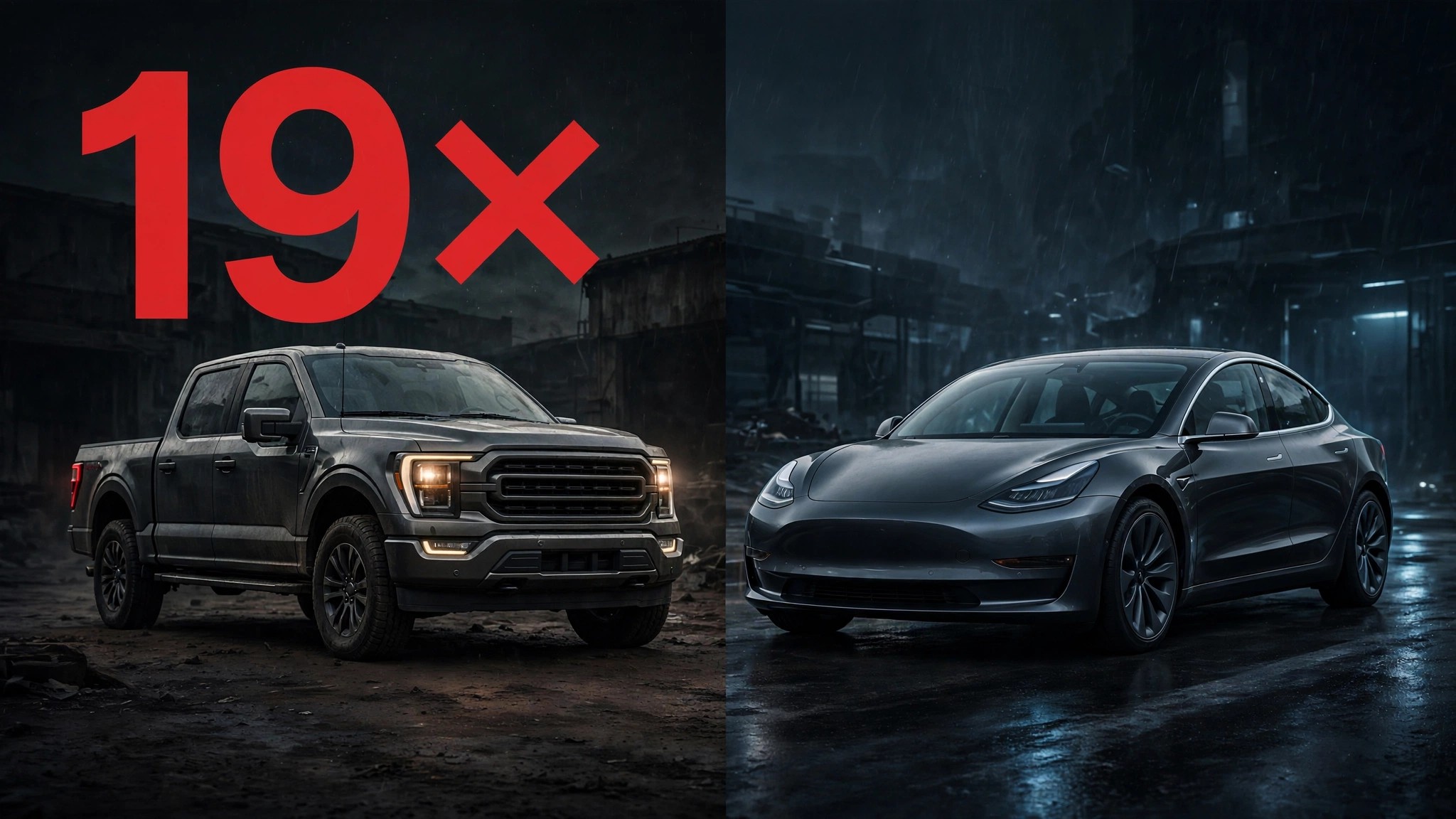
I ran the numbers, then I ran them again, and they didn't get better.
Ford recalled 965,000 vehicles in the first two weeks of July: Bronco Sports shedding fenders at highway speed, Mustangs with dead wipers, Mach-Es with fracturing differential shafts.[1] Days later, Tesla recalled 363,000 FSD vehicles for running stop signs and ignoring turn-only lanes.[2] Combined: 1.33 million vehicles, processed by the same agency, generating the same headline font size.
FARS counts bodies, not recalls. Ford's 23.9-million-vehicle fleet has produced 34,954 deaths over the 2014–2023 window. Tesla's 3.66 million vehicles: 278.[3] Normalize per million fleet vehicles and Ford produces 1,463 FARS deaths for every 76 Tesla produces. The F-150 alone, at 9,194 deaths, has killed 33 times more people than Tesla's entire four-model lineup.
Compressed into July's recall volumes: for every thousand Ford vehicles recalled this month, the brand has accumulated 36.2 FARS deaths, while every thousand Tesla vehicles recalled carries 0.77. A 47-to-1 ratio flowing through a regulatory system that treats both brands identically.
The honest caveat, because these numbers demand one: Ford's fleet is 6.5 times larger and decades older, with the F-150 accumulating road exposure since 1980 while Tesla barely existed before 2017. Limit both brands to 2020–2023 model years and the gap narrows considerably; Ford's Bronco (rate 0.05, 25 deaths) looks a lot like a Model Y, which proves Ford knows how to build safe vehicles. It also sells millions of the ones it built before it learned how, and Tesla's youth, heavy curb weight, and affluent driver base inflate its advantage in ways no fleet-age correction can untangle.
Still: even after you correct for age, weight, and composition, the gap doesn't collapse; it shrinks from 18.5x to maybe 5–8x, and neither brand's July recalls address it. Ford fixes wipers and fenders while Tesla patches intersection judgment, but the 34,954 deaths came from speed, mass, crash structure, and impairment, the structural killers no recall has ever targeted.
What this means for you
If you drive a pre-2015 Ford, your vehicle carries a materially higher fatality risk than nearly anything sold today, so check your VIN at nhtsa.gov/recalls for open recalls. If you're shopping, Ford's 2020+ models (Bronco, Maverick, Transit) have rates approaching Tesla's, but the pre-2010 fleet is where the bodies are. Recalls fix manufacturing defects, not design-era safety gaps — know the difference before you assume a clean recall record means a safe car.
Limitations: FARS captures fatal crashes only, and Ford's fleet spans 40+ model years while Tesla's spans roughly 10. The 18.5x rate gap is real but partially reflects this age disparity. Fleet-weighted VMT estimates carry ±15% uncertainty for low-volume models. Neither recall is expected to reduce FARS fatalities in a measurable way.
Sources & References
- NHTSA Recall Notices 26V417000, 26V418000; USA Today, “Ford recalls nearly 1M vehicles in 2 weeks,” July 2026. nhtsa.gov/recalls
- CNN, “Tesla recalling nearly 363,000 vehicles equipped with ‘Full Self-Driving,’” July 2026; NHTSA FSD recall notice. nhtsa.gov/recalls
- NHTSA, Fatality Analysis Reporting System (FARS), 2014–2023. nhtsa.gov