Ford Recalled 19.6 Million Vehicles Last Year. Then Won a Quality Award.
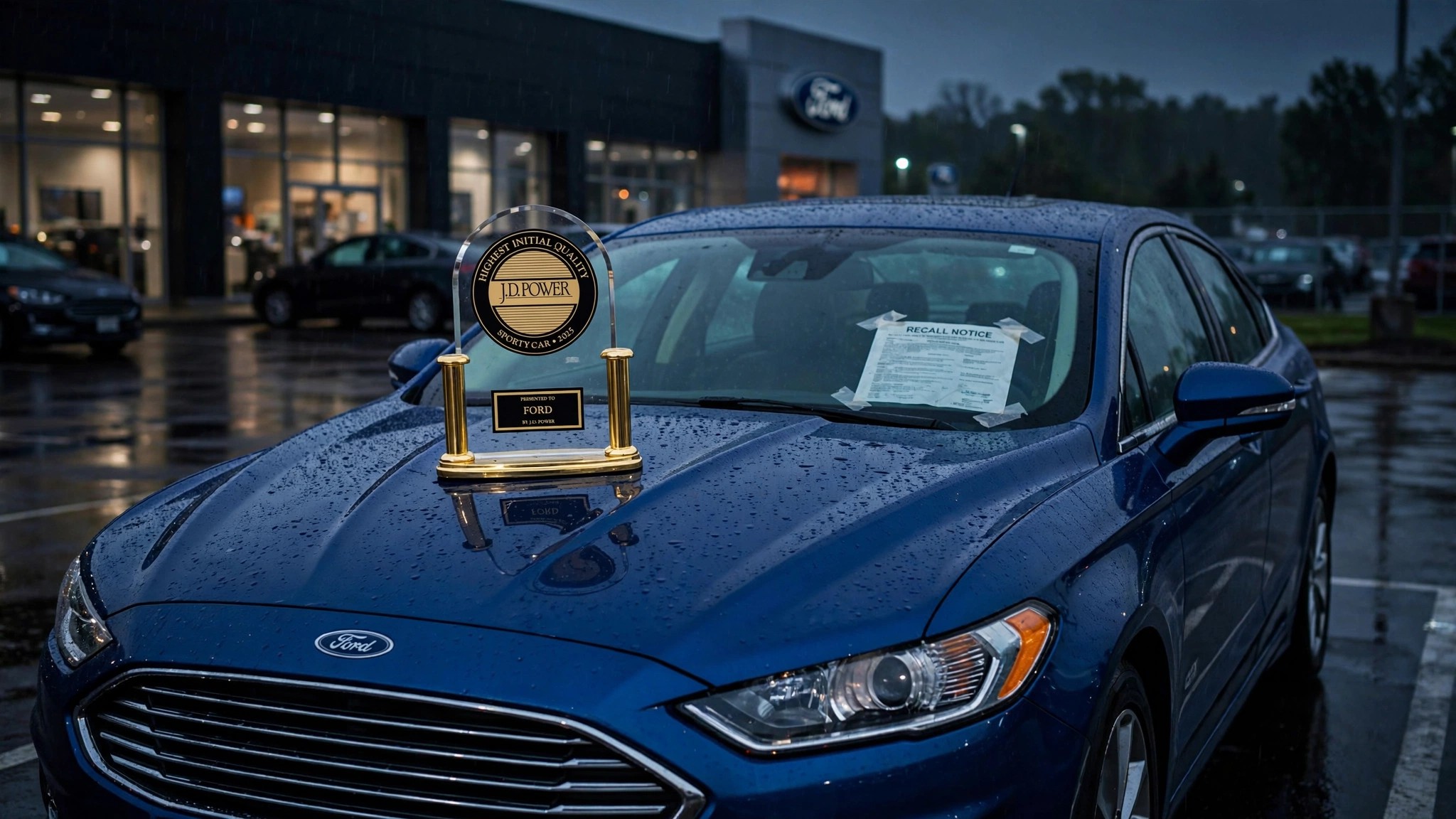
Ford spent 2025 issuing 153 safety recalls covering roughly 13 million vehicles, a volume so large it accounted for 35% of all recalls from the top twelve manufacturers.[1] Through early July 2026, they’ve already filed 56 more, three times the count of the next closest automaker.[2] An iSeeCars study found that in the past twelve months alone, Ford recalled 19.6 million vehicles. More than every other automaker on the planet combined.[3]
Then, on June 25, JD Power handed Ford the No. 1 spot in its 2026 Initial Quality Study among mainstream brands. Ford launched an ad blitz over the Fourth of July: “We put quality first. Now Ford is first in quality.”[3]
There is a third number that didn’t make the press tour. Over the FARS decade window (2014–2023), Ford vehicles appear in fatal crashes that produced 34,954 deaths. That is 18.3% of all fatalities in the dataset, second only to Chevrolet at 35,905.[4] Normalized to vehicle miles traveled, Ford’s fleet-wide fatality rate sits at 11.68 per 100 million VMT. Not the worst (Chevrolet holds that distinction at 13.75), but more than three times the rate of Subaru (3.80) or Kia (3.77), and meaningfully above Toyota (9.47).[4]
Ford’s spokeswoman Sharyn Ghacham told USA Today that the recalls are a feature, not a bug: “At Ford, customer safety is our top priority. More than 80% of our recalls this year are resolved through convenient, software-only updates.”[5] And there is real evidence the recall volume correlates with improvement. Ford slashed warranty and material costs from $4.8 billion in 2023 to about $3.3 billion in 2025, a $1.5 billion reduction that executives credit partly to catching defects earlier.[2]
But some of those catches are breathtaking in their triviality. Fox Business reported that a $5 plastic retention clip, the kind you could replace with a trip to AutoZone and a YouTube video, has generated more than two million Ford Explorer recall notices across three separate campaigns since 2023. The clips hold trim pieces to A-pillars, B-pillars, and roof rails; when they fail, body panels fall off on the highway. Three recalls, one nickel part, two million letters to owners.[6] The Explorer, meanwhile, logged 3,797 deaths in FARS at a rate of 1.54 per 100 million VMT.[4] The clips got the recall notices; the death rate got nothing.
The Ford Mustang illustrates the fracture most sharply. At 6.02 per 100 million VMT, its fatality rate makes it the deadliest vehicle in Ford’s lineup by a wide margin, accounting for 2,739 deaths in the FARS window.[4] This month, Ford recalled 67,553 Mustangs and 289 Mustang GTDs (the $325,000 track weapon) for windshield wipers that stop working in cold weather. The fix won’t be available until March 2027, so owners get to navigate an entire winter without functioning wipers.[7] The Mustang’s 6.02 death rate doesn’t appear in the recall notice.
This isn’t exactly Ford’s fault, and the counterargument is genuine: JD Power measures the first 90 days of a new car’s life, while FARS captures a decade of fleet aging. Ford’s 2026 models may truly be better-built than anything in the FARS window. The Mustang’s grotesque rate is partly a function of who buys Mustangs and what they do behind the wheel, not just how the car crumples. Subaru’s low rate reflects an AWD-heavy, safety-conscious buyer demographic as much as engineering superiority, and these are real confounders.
But there is something structurally broken when the recall system is this prolific and this disconnected from the death data. Ford filed 209 recalls in eighteen months while averaging about 3,495 FARS deaths per year. That means for approximately every recall Ford issues, seventeen people die in a Ford that same year — from causes the recall system never addresses.[4] The recalls fix wiper motors and plastic clips and software glitches, because those are the defects NHTSA can enumerate. The fatality rate reflects vehicle mass, structural design, driver demographics, road geometry, and decades of fleet composition, forces that no recall can touch.
JD Power told Ford their new cars are excellent. NHTSA told Ford their old cars need fixing. FARS tells a story neither institution is equipped to tell: that the fleet as it actually exists on American roads killed 34,954 people in ten years, and the system that sends out 19.6 million recall letters annually has no mechanism to address it.
What This Means For You
If you drive a Ford, check your VIN at nhtsa.gov/recalls. With 56 recalls this year alone, the odds are nontrivial that one applies to you. If you’re shopping, know that Ford’s 2026 models genuinely scored well on initial quality, but “quality” in that context means “nothing broke in the first 90 days.” It does not mean “this vehicle will protect you in a crash.” For that, check the IIHS ratings page and look at the actual crashworthiness scores. And if you own one of the two million Explorers affected by the plastic clip recalls: yes, the letter you got is real. No, $5 clips falling off at highway speed is not “cosmetic.” Get it fixed.
Sources & References
- Louisville Courier-Journal, “Ford issues major recalls for over 761,000 vehicles,” July 2026. courier-journal.com
- Autoblog, “Ford Beat Every Mass-Market Brand In Initial Quality, But Recalls Still Haunt It,” July 2026. autoblog.com
- Detroit Free Press, “Ford recalls nearly 1M vehicles in 2 weeks,” July 2026. freep.com
- NHTSA, Fatality Analysis Reporting System (FARS), 2014–2023. nhtsa.gov
- USA Today, “Ford leads all carmakers in recalls. Is your Blue Oval car safe?” July 2026. usatoday.com
- Fox Business, “The $5 plastic clip behind millions of Ford Explorer recalls,” July 2026. foxbusiness.com
- Autoblog, “Even Ford’s $300,000 Mustang GTD Is Being Recalled Over Faulty Wipers,” July 2026. autoblog.com