Ford Says 90% of Its Recalls Are Old Cars. This Week, It Recalled a Million New Ones.
Ford spokesperson Sharyn Ghacham told USA Today last month that "more than 90% of our recalls this year are for older vehicles built between 2013 and 2020."[1] That line did a lot of heavy lifting. It sat next to claims about a $500 million warranty cost reduction, the best Consumer Reports reliability ranking in 15 years, and segment wins in J.D. Power's Initial Quality Study. Ford's message was unmistakable: the bad old days are behind us, and the new Ford builds them right.
Then came this week. Between Monday and Friday, NHTSA posted three Ford recall campaigns covering 1,241,916 vehicles. Let's break them down by the metric Ford's own PR chose: model year.
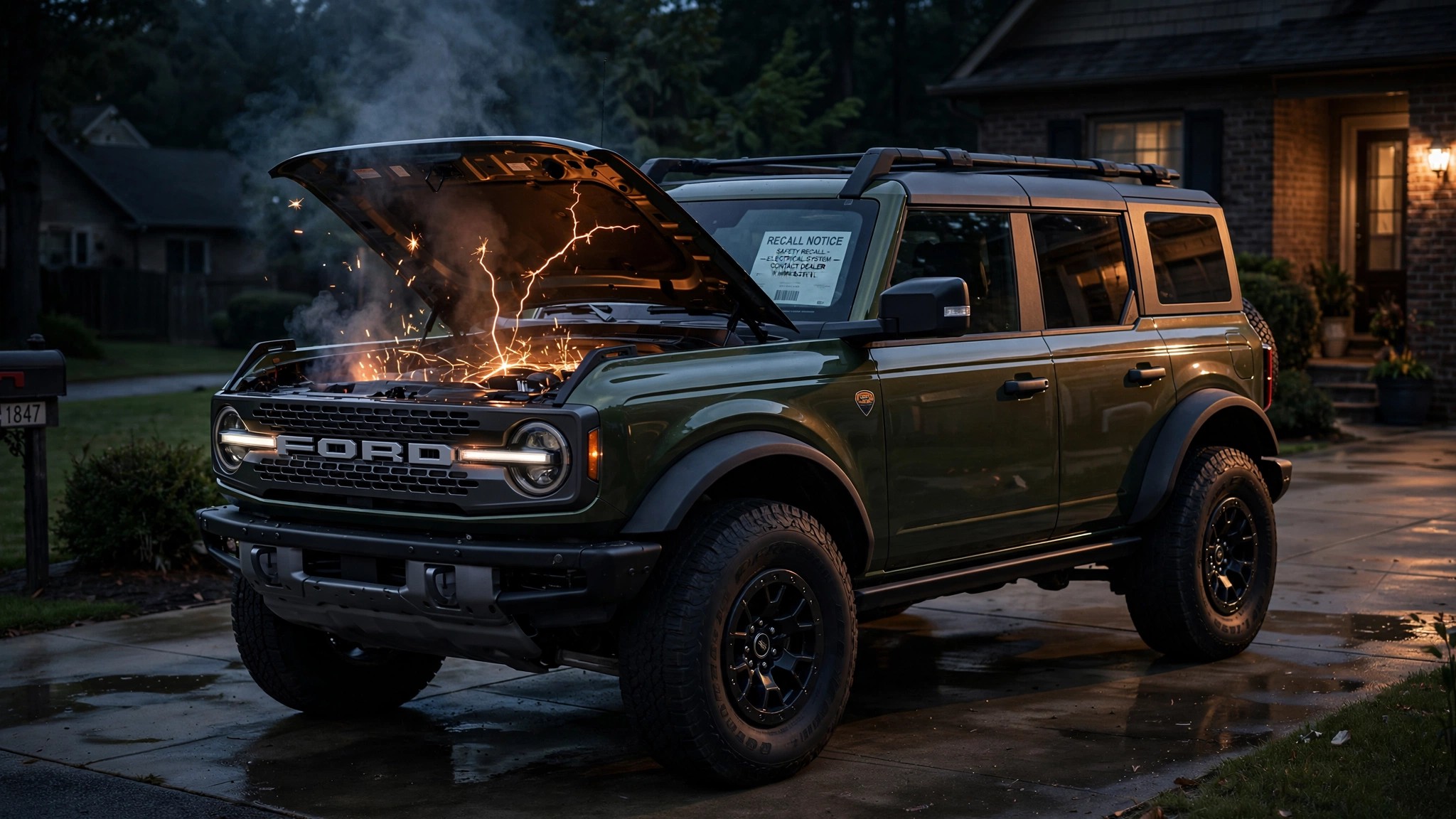
Campaign one: 565,691 Bronco and Bronco Raptor SUVs, model years 2021 through 2026, recalled because a wiring harness in the engine compartment can short-circuit and start a fire.[2] Every single unit is a post-2020 vehicle. Campaign two: 387,911 Explorers and Lincoln Aviators, model years 2020 through 2027, for second-row seats that can unlatch, tip, or slide while the vehicle is moving.[3] Again, overwhelmingly 2020-plus. Campaign three: 288,314 Explorers from 2016 to 2019 for roof rail covers that detach at highway speed.[4] That last one fits Ford's narrative perfectly. The other two obliterate it.
Run the arithmetic Ghacham's quote invites you to run. Of the 1.24 million vehicles Ford recalled this week, 953,602 are model year 2020 or newer. That is 76.8% of the week's volume, leaving the old-car share at a threadbare twenty-three percent. Ford's quality renaissance is recalling nearly a million vehicles built under its supposedly improved regime in five days, and two of the three defects are the kind that make your stomach drop: uncontrolled fire and seats that move while you drive.
Ford's relaunched Bronco tells the story in miniature. Ford relaunched it in 2021 as a premium off-road icon, the anti-Wrangler with modern engineering. In the five years since, it has been recalled for wiring fires, seat bolt failures, ball joint separations serious enough to warrant a do-not-drive order, body panels detaching at speed, instrument panel blackouts, and transmission parking-pawl failures.[5][6] Hemmings counted the Bronco line's separate recall campaigns at 33 before this latest one even posted.[7] A vehicle meant to embody Ford's new quality commitment has been recalled for nearly every major subsystem it has.
Ford's rebuttal writes itself, and in fairness, it has some weight. In all likelihood, the 90% figure refers to the number of distinct recall campaigns, not the number of vehicles affected. Many small, targeted campaigns hit older models, while a few massive campaigns hit newer ones, so the campaign-count math could be technically accurate while the vehicle-count math tells the opposite story. It is also true that recalling aggressively is better than the alternative, and Ford's proactive posture probably prevents injuries that a slower manufacturer's silence wouldn't. Carscoops reported that Ford had 7.3 million vehicles recalled by March 3, barely two months into the year, outpacing every competitor by a factor of three.[8] You could read that as an indictment or as evidence of a company that actually hunts for problems, and both readings have genuine merit.
But the PR framing doesn't invite that nuance. It says quality is improving on new vehicles and most recalls hit old ones. This week's data says otherwise. When your flagship off-roader can catch fire in your driveway and your best-selling family SUV's seats slide around in traffic, the Consumer Reports ranking becomes a participation trophy.
What to do: If you own a 2021–2026 Ford Bronco or Bronco Raptor, check your VIN at nhtsa.gov/recalls immediately. Fire risk is real and the recall is active. For 2020–2026 Explorer and 2020–2027 Aviator owners, the seat defect recall is posted but Ford says the remedy won't be available until January 2027. That is a six-month window where you know your second-row seats may unlatch mid-drive and nobody can fix them. Keep rear passengers buckled and watch for a stuck easy-entry button.
Methodology
Model year ranges are taken directly from each recall's NHTSA filing. Vehicle counts are from NHTSA and Reuters reporting on July 20–24, 2026. We classified the 565,691 Bronco/Raptor (2021–2026) and 387,911 Explorer/Aviator (2020–2027) as "2020 or newer" since the overwhelming majority of units within these ranges are post-2020 production. The 288,314 Explorer (2016–2019) units are classified as pre-2020. Ford's "90%" claim source is a direct quote from spokesperson Sharyn Ghacham to USA Today, published June 20, 2026. We could not independently query NHTSA's full 2026 recall database to verify the campaign-count version of the claim.
Sources & References
- USA Today, “Ford leads among carmaker recalls so far in 2026,” June 20, 2026. usatoday.com
- Reuters, “Ford to recall more than 565,000 US vehicles over engine compartment fire risk,” July 24, 2026. reuters.com
- NY Post, “Ford recalling nearly 388K vehicles over injury hazard in second-row seats,” July 22, 2026. nypost.com
- Delaware Online / USA Today, “Ford recalls more than 676,000 vehicles,” July 20, 2026. delawareonline.com
- Pickup Truck Talk, “2024–2026 Ford Ranger & Bronco Recall: 180K Seat Bolts,” May 2026. pickuptrucktalk.com
- Fast Company, “Ford recalls 200,000 Bronco, Bronco Sports over instrument panel,” Nov 2025. fastcompany.com
- Hemmings, “Ford Hits Recall Number 33 for 2026,” 2026. hemmings.com
- Carscoops, “Ford Has Already Recalled Nearly Three Times As Many Cars As All Other Brands Combined,” March 2026. carscoops.com