Ford Will Spend Millions Telling You It's #1 in Quality. It Recalled 8.9 Cars for Every One It Sold.
I ran the numbers. Then I ran them again. They didn't get better.
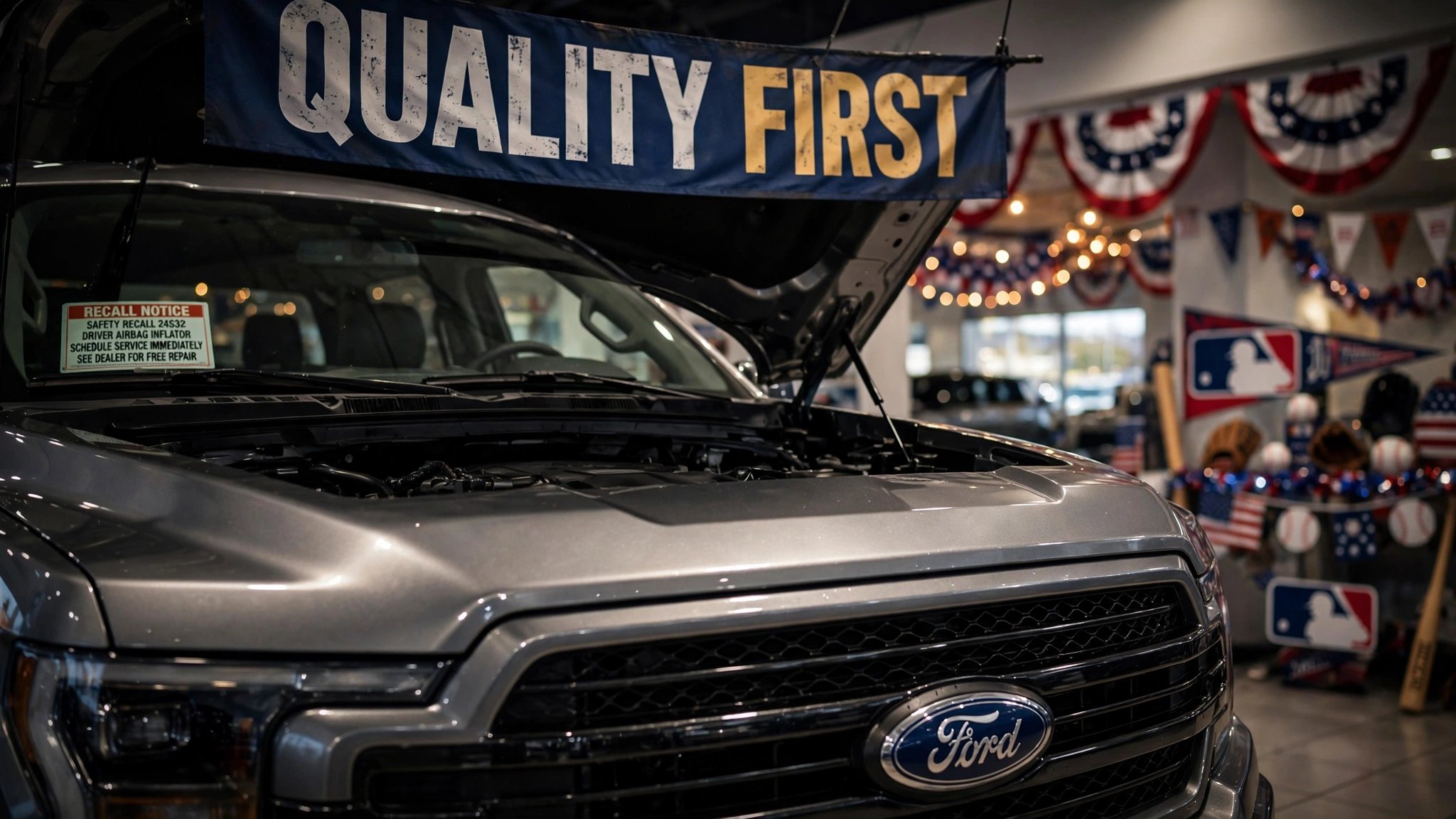
On July 4, while you're grilling burgers and dodging bottle rockets, Ford Motor Company will air its new advertising blitz during Major League Baseball broadcasts. Its tagline: "We put quality first. Now Ford is first in quality." Phil O'Connor, Ford's global head of marketing communications, told the Detroit Free Press the campaign will roll through "every marketing tactic that we have" and run through the end of the year, possibly into 2027.[1] He described the spend as "substantial."
Ford's confidence rests on one number. On June 25, JD Power crowned Ford the top mainstream brand in its 2026 Initial Quality Study, with a score of 152 problems per 100 vehicles. That's a stunning climb from 15th place in 2023.[2] Seven of Ford's top 10 models ranked in the top three of their segments. Ford's F-150, Mustang, and Super Duty each won their categories for the second consecutive year. By the narrow metric JD Power measures, Ford has genuinely improved.
That metric measures exactly 90 days of ownership.
An average car on American roads is 12.6 years old, according to NHTSA.[3] Ford's spokesperson, Sharyn Ghacham, noted that more than 90% of Ford's recalls affect vehicles built between 2013 and 2020. In other words, Ford's own recall data tells us the typical recalled Ford is 6 to 13 years old. JD Power's 90-day window captures 1.9% of that vehicle's operational life. The other 98.1% is where the recalls live.
An iSeeCars.com study published in April found that between April 2025 and March 2026, Ford recalled 19.6 million vehicles. That is more than every other automaker in America combined.[4] Toyota, the next-closest manufacturer, recalled 4.1 million. Ford recalled 4.8 times more vehicles than Toyota. Lincoln's Aviator, Ford's luxury SUV, was projected to receive 23.4 times more lifetime safety recalls than the average new car.
Ford sold 2.2 million vehicles in 2025, which means dividing recalled vehicles by vehicles sold gives a ratio of 8.9 to 1. For every car Ford put on the road last year, it recalled nearly nine.
Since January 1, 2026, Ford has filed 51 recalls with NHTSA. Chrysler, the nearest competitor, filed 19. Ford accounts for 28% of all industry recall actions this year despite producing roughly 14% of registered vehicles.[5] Fifty-one recalls in 182 days is one recall every 3.57 days. Ford issues recalls faster than most people change their oil.
Here is my favorite part: the week before the quality ad campaign launched, Ford filed two more recalls: 741,195 vehicles for a transmission defect that allows them to roll away in park, and 36,046 Broncos whose fender flares detach at highway speed.[6] The transmission recall covers 2018-2021 Expeditions, Navigators, Explorers, Aviators, and F-150s. These are Ford's flagship products, with nine alleged injuries, twenty-four allegations of property damage, and no permanent repair available until April 2027.
Ford's COO, Kumar Galhotra, calls the recall volume a "trailing indicator." The argument goes like this: recalls hit old cars, quality improvements hit new cars, give it time. And to be fair to Ford, the company has backed this claim with action. It rehired 350 veteran engineers after realizing its AI-powered quality inspection systems needed human expertise to function.[7] The 2026 Expedition got 1,200 additional inspections and 203 new inspectors at the Kentucky Truck Plant. Warranty costs dropped $500 million in 2025 versus 2024. Ford went from ranking 10th in JD Power's IQS to 1st in a single year, beating Toyota, Lexus, and Honda along the way, and none of it is fake.
But Ford isn't aiming the July 4 campaign at 2026 model-year shoppers; it's aiming at everyone. "You'll see it at dealerships at point of purchase displays... and at all our consumer touchpoints," O'Connor said. His message is simple: Ford equals quality. Not "Ford's newest cars score well on a 90-day survey." Not "Ford's legacy fleet is a different story." Ford. Quality. First.
So let's do what the ad won't: in FARS data covering 2014 to 2023, the Ford Expedition killed 1,515 people at a rate of 2.31 deaths per 100 million vehicle miles traveled. Ford's Ranger killed 3,089 at a rate of 2.91, and its Mustang killed 2,739 at 6.02. Its Explorer, the family SUV, killed 3,797 at 1.54.[8] These are the vehicles Ford's ad campaign will tell you are "first in quality" while you watch fireworks.
JD Power's IQS also has a methodological limitation worth naming: its survey counts "problems" reported by new owners in the first 90 days, and it weights infotainment glitches, rattles, and Bluetooth pairing failures alongside brake issues and transmission defects. A vehicle that pairs perfectly with your phone but rolls away in park scores better than one that has a finicky touchscreen but stays put when you tell it to. By design, Ford's crown metric is more sensitive to user experience than to safety.
The strongest version of Ford's case is this: it is genuinely possible to have the best new vehicles rolling off the line today AND the worst legacy fleet on the road simultaneously. These are measuring different things at different times. Ford's improvement may be real, and the trailing indicator argument may be correct. In three to five years, the recall volume may drop as the 2013-2020 cohort ages out.
That is a reasonable argument, and also an argument for patience. Ford's ad campaign is an argument for purchase. "First in quality" does not come with an asterisk directing you to read the 51 recall notices filed this year. It does not tell you that NHTSA's recalls database lists more Ford actions than any other automaker in the past twelve months. It does not mention that the warranty repairs those recalls require cost Ford $4.8 billion in 2023 alone, triple the industry average.[9]
If you're watching the July 4 game and you own a Ford built between 2013 and 2021, check your VIN at nhtsa.gov/recalls before the seventh-inning stretch. The ad will tell you Ford puts quality first. Your recall status will tell you whether Ford got to your car yet.
Methodology & Limitations
That 19.6 million figure counts vehicle-recall instances, not unique VINs. A single vehicle affected by three separate recalls is counted three times. Ford's actual number of unique vehicles with active recalls is lower but cannot be precisely determined from public data. That 8.9:1 ratio is a recall-action-to-sale ratio, not a unique-vehicle ratio. Recall completion rates are estimated at approximately 50% within the first year based on NHTSA historical data, but vary widely by recall severity and remedy availability. FARS fatality data covers 2014-2023 and includes legacy models no longer in production; fatality rates for current-production Ford vehicles may differ. JD Power's IQS methodology surveys new-vehicle owners at 90 days; it does not measure long-term reliability, safety outcomes, or recall exposure.
Sources & References
- Detroit Free Press, “Ford launches a quality ad campaign, but can it win back customers?” July 2, 2026. freep.com
- JD Power, 2026 U.S. Initial Quality Study (IQS), published June 25, 2026. jdpower.com
- NHTSA, average vehicle age on U.S. roads (Bureau of Transportation Statistics). bts.gov
- iSeeCars.com, “Ford Recalls 19.6 Million Vehicles in Past 12 Months,” study published April 8, 2026, reported via Detroit Free Press. iseecars.com
- NHTSA Recalls Database, Ford recall actions January 1 – July 2, 2026. nhtsa.gov/recalls
- NHTSA Recall Notice, Ford transmission park system defect (741,195 vehicles) and Ford Bronco fender flare detachment (36,046 vehicles), filed June 24, 2026. nhtsa.gov/recalls
- Bloomberg, “Ford rehired 350 veteran engineers to retrain AI quality inspection systems,” reported June 30, 2026. bloomberg.com
- NHTSA, Fatality Analysis Reporting System (FARS), 2014–2023. nhtsa.gov
- Detroit Free Press / CarBuzz, Ford warranty cost data, 2023 fiscal year. freep.com