Ford Won JD Power’s Top Quality Award, Recalled 12 Million Vehicles, and You’re Supposed to Find This Reassuring
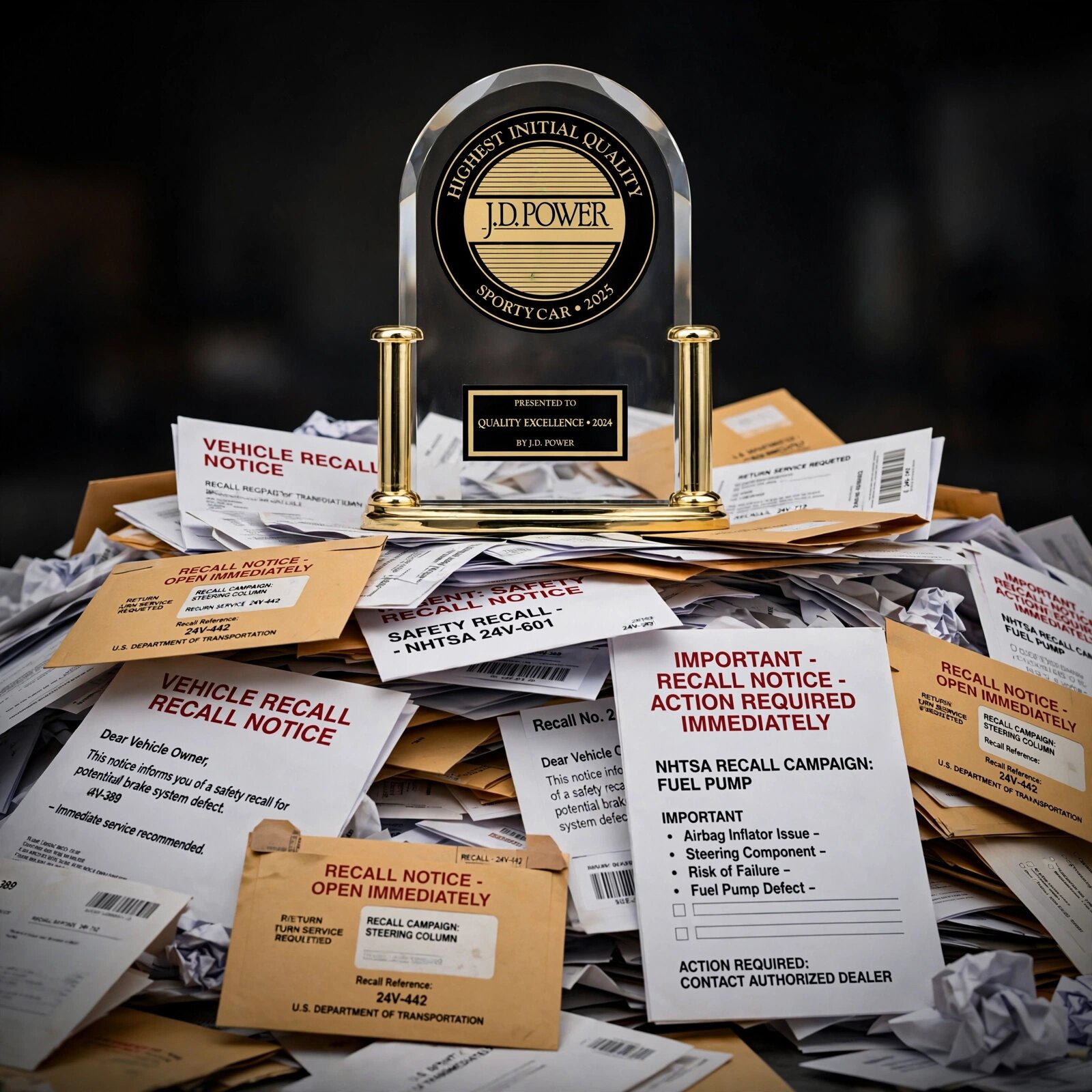
On June 25, Ford ranked first among mainstream brands in JD Power’s 2026 Initial Quality Study.[1] Five days later, a banner the size of a city bus appeared on Ford World Headquarters in Dearborn: “We put quality first. Now Ford is first in quality.”[2] Two days after that, NHTSA posted Ford’s 52nd and 53rd recalls of 2026, covering 777,000 additional vehicles for transmissions that won’t stay in park and fender flares that detach at highway speed.[3] Today, Ford is airing a 30-second TV spot celebrating the quality milestone during your barbecue, and both announcements are factually correct, which is exactly what makes the situation so instructive.
JD Power’s Initial Quality Study measures problems reported during the first 90 days of ownership: infotainment glitches, confusing cup holder placement, a seat that doesn’t adjust smoothly.[1] Ford improved by 41 problems per 100 vehicles in a single year, from 14th to 3rd overall, a genuine manufacturing turnaround that required rehiring 350 veteran engineers and retraining its AI quality-control systems from scratch.[2] Ford’s spokesperson frames the recall volume as a separate timeline entirely: “More than 90% of our recalls this year are for older vehicles built between 2013 and 2020.”[4]
She’s right, and roughly 12,017,708 of those older vehicles have been recalled in the first half of 2026 alone.[3] NHTSA’s weighted completion rate for vehicle recalls initiated between 2012 and 2022 is 65.8%, meaning about 34% of recalled vehicles never get repaired.[5] Apply that rate to Ford’s 2026 recall volume and you get an estimated 4.1 million vehicles from this year alone that will likely stay on the road with known defects, accumulating alongside the millions from 153 recalls in 2025. That unrepaired figure grows every quarter because Ford’s recall pace shows no sign of slowing. FARS data covering 2014 through 2023 already records 34,954 Ford occupant deaths, second only to Chevrolet, at a rate of 11.68 per 100 million vehicle miles traveled.[6]
The strongest counterargument deserves full weight: Ford’s quality trajectory is real, warranty costs dropped $500 million in 2025, and if assembly-line improvements hold then future recall volumes should shrink as pre-2020 vehicles age out. CEO Jim Farley isn’t wrong that the IQS win represents genuine progress. But “quality” and “safety” are being used interchangeably in a 30-second ad, and they measure different things: quality is what your car does in its first 90 days, safety is whether its transmission holds it in park three years later. Ford has demonstrably improved at the first while carrying 12 million outstanding reasons to prove it can deliver the second.
Caveats: FARS data predates Ford’s recent improvements, recall completion rates are industry-wide averages, and the 4.1 million unrepaired estimate is a projection rather than a Ford-audited count. If you own a Ford built between 2013 and 2026, check your VIN at nhtsa.gov/recalls before the fireworks start, because at 53 recalls in six months the odds are decent that something applies to you, and the banner in Dearborn won’t fix it for you.
Sources & References
- JD Power, 2026 U.S. Initial Quality Study (IQS), June 2026. jdpower.com
- USA Today / Detroit Free Press, “Ford launches a quality ad campaign, but can it win back customers?” July 2026. usatoday.com
- Jalopnik, “Honda CR-V Takes Advantage Of Ford F-150, Toyota RAV4 Misadventures,” July 2, 2026 (Ford recall tally: 53 recalls, 12,017,708 vehicles). jalopnik.com
- USA Today, “Ford leads all carmakers in recalls. Is your Blue Oval car safe?” July 2026. usatoday.com
- NHTSA, Improving Vehicle Safety Recall Completion Rates: Research on Outreach, Comprehension, and Incentive Strategies. Weighted average completion rate 65.8% for recalls 2012–2022. nhtsa.gov
- NHTSA, Fatality Analysis Reporting System (FARS), 2014–2023. nhtsa.gov
Source: NHTSA FARS 2014–2023, JD Power 2026 IQS, NHTSA recall database and completion rate reports. The 4.1M unrepaired estimate applies the 65.8% industry-wide weighted completion rate to Ford’s 2026 recall volume; Ford-specific completion rates may differ. FARS fatality data covers a period before Ford’s recent quality improvements, so current production vehicles may perform differently. See methodology for caveats.