Ford Issued 153 Recalls Last Year. 98% of Their Death Toll Can’t Receive One.
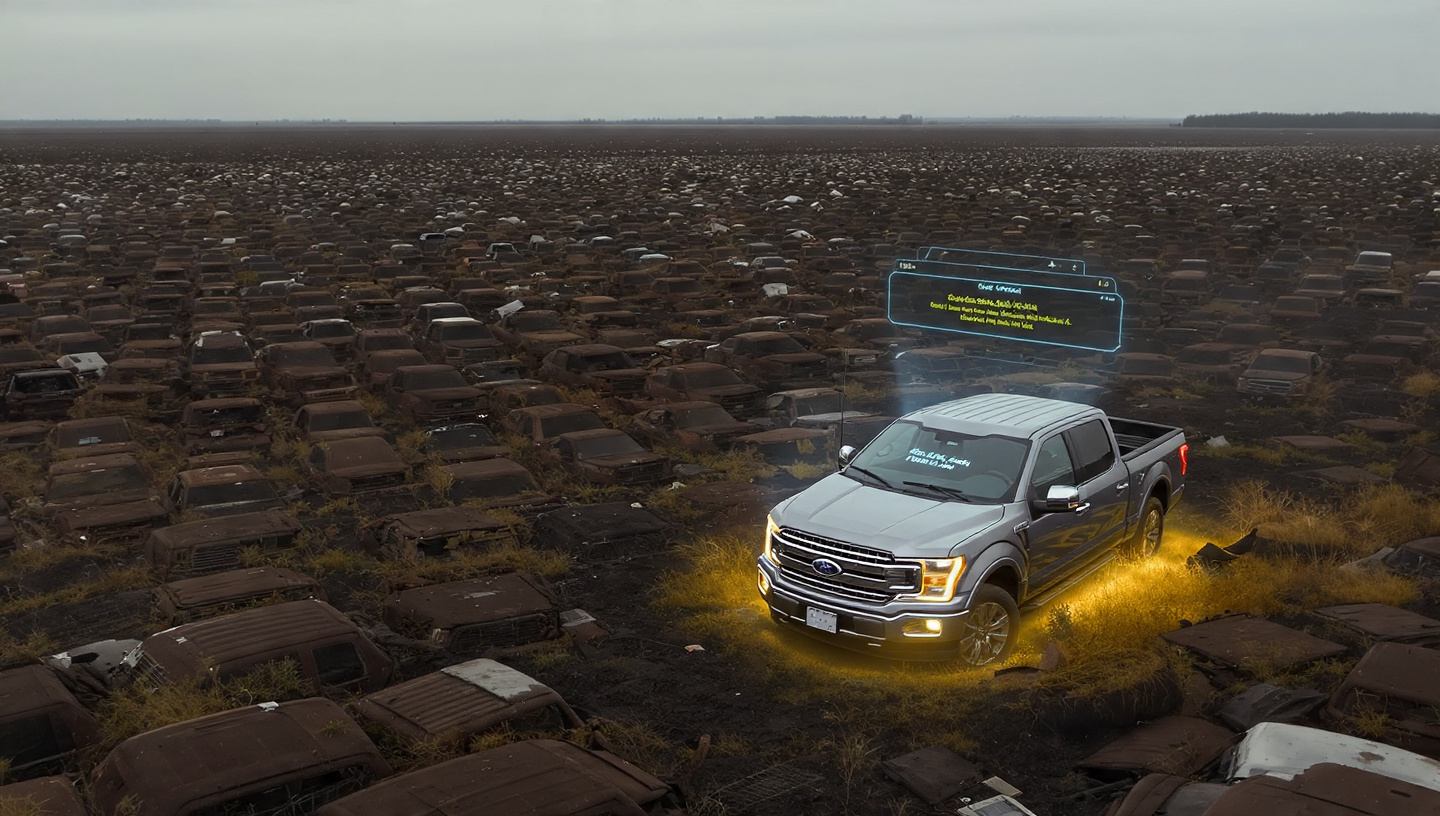
Ford broke its own recall record in 2025, issuing 153 safety campaigns covering millions of vehicles. In a statement to Torque News this month, a spokesperson volunteered a figure meant to reassure: approximately 80% of Ford's 2026 recalls can be resolved through over-the-air software updates.[1] The subtext was clear: this is a company that has mastered the art of fixing cars remotely, overnight, while you sleep.
Then we ran the FARS numbers on which Ford vehicles are actually dying.
NHTSA's Fatality Analysis Reporting System tracks every fatal crash in the United States. Cross-tabulating Ford's 34,493 FARS deaths by model year produces an ugly distribution: 98.4% of fatal crash deaths in Ford vehicles involve model years before 2020, vehicles built before Ford's SYNC 4 platform brought meaningful OTA recall capability to the fleet.[2] The remaining 1.6% (555 deaths) come from 2020-and-newer models. Ford's 80% OTA fix rate is a technological achievement applied to the sliver of the fleet that barely registers in the death data.
The model-level breakdown makes the paradox sharper. Ford Rangers involved in fatal crashes are 98% pre-2015 vintage. Ford just recalled 140,201 Rangers from model years 2024 to 2026 for wiring defects posing fire risk.[3] Those recalled Rangers are not the Rangers killing people. The Ranger's FARS death rate of 2.91 per 100 million VMT is driven overwhelmingly by trucks old enough to vote. Same story across the lineup: Taurus deaths are 95% pre-2015, Expedition 95%, Explorer 91%, F-150 89%, Crown Victoria 100%.[2]
Consider Ford's latest splashy recall: 1.39 million 2015-to-2017 F-150s pulled back for a powertrain software defect that can slam the transmission into second gear.[4] Those recalled model years account for 6.3% of all F-150 fatal crash deaths. The other 89% of F-150 deaths come from trucks built before 2015, trucks that will never receive that fix or any other software patch, trucks that will keep accumulating body count until they rust into the salvage yard or wrap around a tree, whichever comes first.
This is not exclusively Ford's problem. Industry-wide, vehicles from model year 2020 and newer account for just 3.2% of all FARS deaths. The pre-2020 fleet owns 96.8%.[2] But Ford's position is uniquely awkward because Ford is the company setting recall records, Ford is the company trumpeting OTA capability as progress, and Ford's OTA-reachable fleet is responsible for a smaller share of deaths (1.6%) than the industry average (3.2%). Ford's fleet skews older, heavier, and more truck-dependent, which means Ford's death problem is especially concentrated in vehicles that predated remote fixes.
Ford's spokesperson told Torque News that vehicles "designed between 2016 and 2020 continue to account for the majority of our recalls, an impact we will see until they cycle out of operation."[1] Cycle out. That is the plan: not fix, not retrofit, but wait for the fleet to age out and die, sometimes literally.
To be fair, no recall system was designed to solve the entirety of road death. NHTSA estimates vehicle defects contribute to roughly 2% of crashes nationally. The other 98% are driver behavior, road design, speed, impairment, weather.[5] And OTA capability is genuinely new; it prevents future deaths in new vehicles even if it cannot touch historical FARS counts. But Ford chose to frame 80% OTA as a narrative of progress, and that narrative collapses the moment you ask: progress on what share of the problem? The answer is 1.6%, and Ford is getting dramatically faster at patching the lifeboats while 98% of the ship remains underwater.
What to do: If you drive a pre-2015 Ford, particularly a Ranger (2.91 death rate), Taurus (2.74), Focus (2.52), or Expedition (2.31), check your VIN at nhtsa.gov/recalls, but understand that the safety gap between your vehicle and a 2024 model is not a defect. It is a decade of crumple zone engineering, electronic stability control, automatic emergency braking, and structural rigidity that no recall can retrofit. The cheapest safety upgrade for a pre-2015 Ford is not a recall; it is a different vehicle.
Sources & References
- Torque News, “I Reached Out to Ford for Comment on Its Recall Record, The Statement Revealed More Than the Company Intended,” May 6, 2026. torquenews.com
- NHTSA, Fatality Analysis Reporting System (FARS), 2014–2023. Cross-tabulation of Ford model-year death distribution by The Crash Report. nhtsa.gov
- NHTSA recall of 140,201 Ford Rangers (2024–2026) for A-pillar wiring fire risk, 2026. nhtsa.gov/recalls
- NHTSA recall of 1.39 million Ford F-150s (2015–2017) for powertrain control module software defect, May 2026. nhtsa.gov/recalls
- NHTSA, “Critical Reasons for Crashes Investigated in the National Motor Vehicle Crash Causation Survey,” DOT HS 812 115, 2015. crashstats.nhtsa.dot.gov
Source: NHTSA FARS 2014–2023. Model year death distribution is an original cross-tabulation; OTA capability dates are approximate and vary by model and trim. FARS captures only fatal crashes, not the full injury spectrum. See methodology for caveats.