Ford Won the Quality Award the Same Day It Recalled 741,000 Vehicles
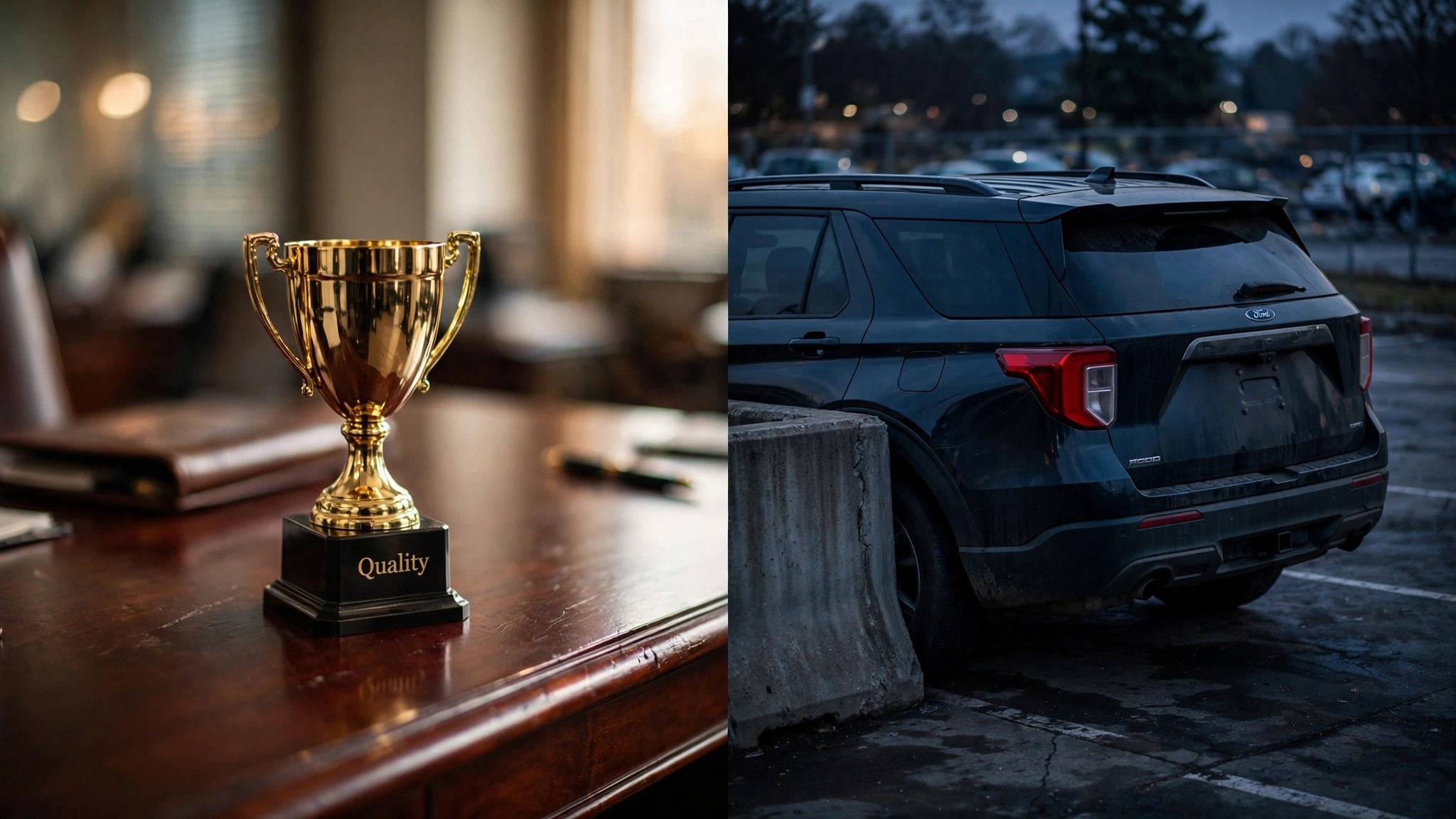
I ran the numbers. Then I ran them again. They didn't get better. On June 24, 2026, Ford Motor Company achieved two milestones that should not coexist in the same press cycle: JD Power named it the highest-quality mainstream brand in America, and NHTSA published recall 26S48 covering 741,195 Ford and Lincoln vehicles whose transmissions can't reliably keep the car in park.[1][2]
JD Power's Initial Quality Study surveys 78,514 new-car buyers about problems they encounter in the first three months of ownership. Ford scored 152 problems per 100 vehicles, beating Toyota, Honda, and every other mass-market competitor. Only Porsche and Genesis, which build a fraction of the volume, scored higher.[3] Ford's trajectory is almost comically steep: 23rd place in 2023, ninth in 2024, back down to 14th in 2025, then straight to the top. CEO Jim Farley called it "a culmination of a lot of hard work by thousands of our team members."
Here is what those team members were also working on that same day. NHTSA recall 26S48 covers 2018–2021 Ford Expeditions and Lincoln Navigators, 2020–2021 Explorers and Lincoln Aviators, and 2021 F-150s. The transmission park pawl can engage while the vehicle is still rolling, damaging the park system so thoroughly that the vehicle won't stay parked. It rolls. Ford received over 200 reports of vehicles moving after drivers shifted to park, unable to shift into park, or stuck in the gear entirely. The full remedy won't be available until April 2027, ten months from now. Ford's interim advice: use your emergency brake.[2]
Two datasets. Two definitions of "quality." One is measuring whether your CarPlay pairs on the first try. The other is measuring whether your F-150 stays where you left it.
What JD Power Actually Measures
The IQS asks 227 questions across ten categories: infotainment, driving experience, seats, climate, powertrain, exterior, interior, features, and a pair of catch-alls. Phone connectivity was the single largest source of problems in 2026, with Android Auto and Apple CarPlay hiccups accounting for more complaints than any mechanical issue, which means the survey's biggest problem category isn't structural integrity or brake performance but whether your phone's Spotify playlist transferred to the dashboard screen without a three-second lag.[4] So when JD Power says Ford has the fewest "problems," a substantial portion of what it measured was whether Bluetooth synced cleanly in March.
IQS cannot capture latent defects by design, because its 90-day window closes before most of them manifest. A transmission park system that fails after 20,000 miles doesn't exist in this dataset, and a corrosion-prone rear subframe that fractures in year four is invisible. Every category of defect that triggers NHTSA recalls falls outside the measurement aperture, because recalls almost always address conditions that develop long after the odometer passes 3,000 miles. JD Power knows this perfectly well; they publish a separate Vehicle Dependability Study that measures problems at three years, and Ford ranked 24th on that one in 2025.
What FARS Actually Measures
FARS records every fatal crash on American roads. Between 2014 and 2023, Ford vehicles accumulated 34,954 occupant deaths across 29 tracked models, second only to Chevrolet's 35,905. The Ford F-150 alone accounts for 9,194 of those deaths, at an estimated rate of 1.04 per 100 million vehicle miles traveled. The Explorer, another vehicle in the June 24 recall, recorded 3,797 deaths at a rate of 1.54. The Expedition recorded 1,515 deaths at 2.31.[5]
None of this is JD Power's fault, and they never claimed IQS measures safety. But the press release machine doesn't make that distinction, and neither does the average buyer reading "Ford: #1 in Quality" while shopping for an Expedition. That word carries a halo that extends well past infotainment. When the Detroit Free Press reports that Ford "issued more recalls than all other automakers combined from April 2025 to April 2026," the IQS score doesn't footnote that context.[6]
The Measurement Gap
JD Power's top five mainstream brands for 2026 include Ford, Buick, and Chevrolet. In FARS, those same brands account for 74,569 deaths across a decade, a body count accumulated while JD Power's surveyors were asking whether the lane departure warning chimed at a pleasant frequency, whether the seat heater buttons felt premium, and whether the paint matched between panels. Fleet size, vehicle type mix, and driver demographics all confound the comparison, so correlation is not causation here. But the absence of correlation is the point. JD Power's quality metric has approximately zero predictive relationship with real-world fatality outcomes, and everyone in the industry knows it, and nobody says it in the press release.
Ford's "industrial system team," created in 2023 to catch quality issues before production, appears to have genuinely reduced early-ownership complaints on 2026 model-year vehicles, and that is a real engineering achievement. But it is also completely orthogonal to whether a 2021 F-150's transmission park pawl will shear its engagement teeth at 40,000 miles, stranding the truck on an incline with nobody behind the wheel. These are different engineering problems solved by different teams on different timelines, measured by different organizations using different methods, and collapsed into a single word by the press.
What You Should Do
If you own a 2018–2021 Expedition or Navigator, a 2020–2021 Explorer or Aviator, or a 2021 F-150: use your parking brake every time you park and check your VIN at nhtsa.gov/recalls. The software update and inspection are free, but the full remedy won't arrive until spring 2027, and Ford's recall hotline (1-866-436-7332) can tell you where you stand.
If you're shopping for a new car and JD Power's IQS ranking is part of your decision: understand what it measures. A low PP100 score means your infotainment will probably work on day one. It tells you nothing about whether the car will still be in one piece on day 1,825.
Sources & References
- Reuters, “US automotive quality increased industrywide last year, with Ford taking top honors,” June 25, 2026. reuters.com
- NHTSA, Recall 26S48, “Ford Motor Company — Park System Damage,” filed June 24, 2026. nhtsa.gov
- JD Power, 2026 U.S. Initial Quality Study. Methodology: 78,514 purchasers/lessees of 2026 model-year vehicles surveyed after 90 days of ownership. jdpower.com
- Autoblog, “Your New Car's Biggest Quality Problem Might Be Your Phone,” June 29, 2026. autoblog.com
- NHTSA, Fatality Analysis Reporting System (FARS), 2014–2023. nhtsa.gov
- Detroit Free Press, “Ford celebrates a top quality spot after years of quality struggles,” June 25, 2026. freep.com
Source: NHTSA FARS 2014–2023 for fatality data. JD Power 2026 IQS for quality scores. FARS estimated rates use VMT approximations from NHTS data and carry ±15% uncertainty for lower-volume models. JD Power IQS measures owner-reported problems in the first 90 days; it does not assess long-term reliability or crash safety. See methodology for full caveats.