Ford Used the Nuclear Option on a Ball Joint. That Warning Used to Mean “Your Car Contains a Bomb.”
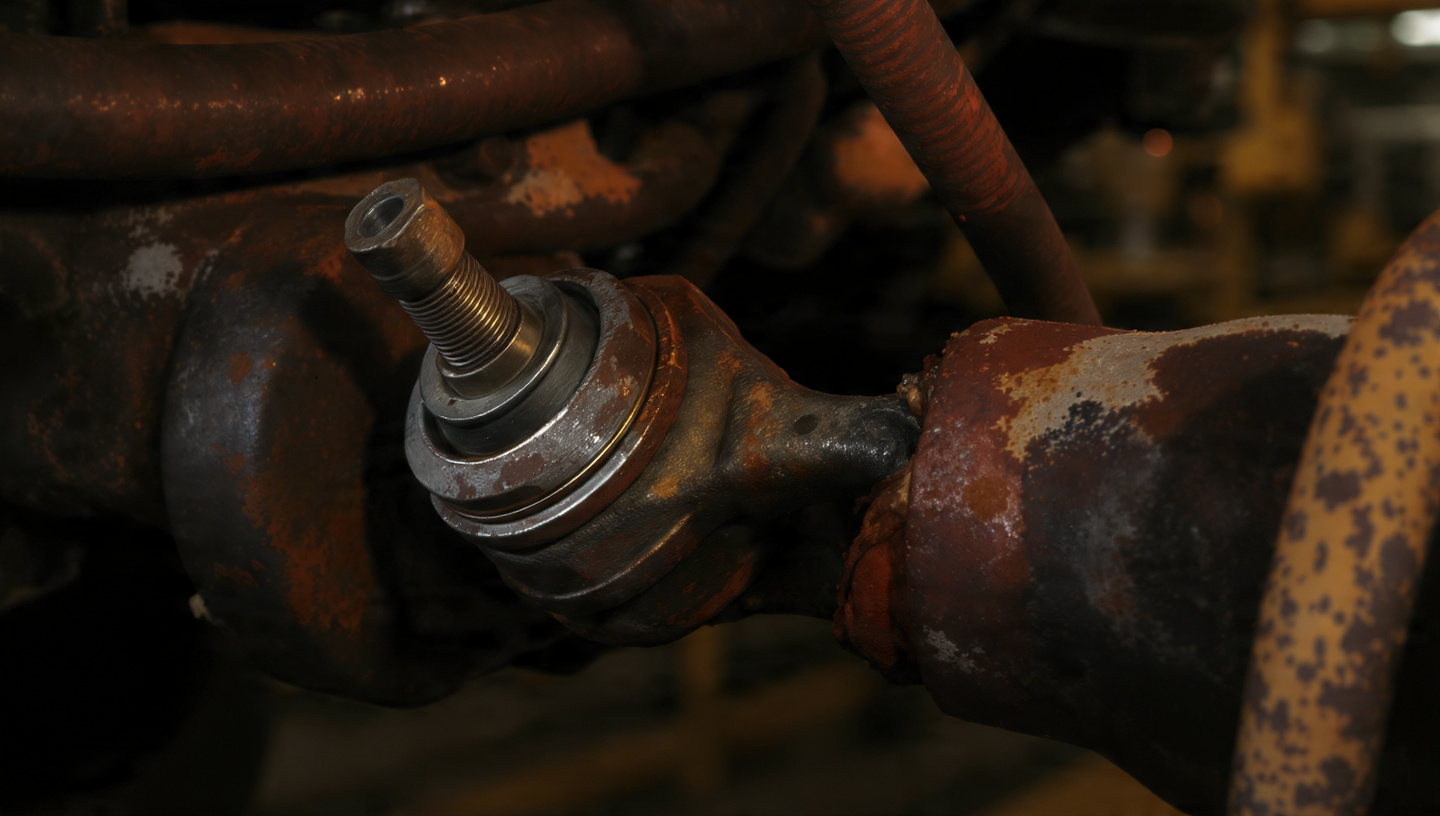
A ball joint stud goes into a knuckle, you push it in until it seats, and a first-year technician can do it blindfolded. But at Ford's Hermosillo assembly plant in Sonora, Mexico, workers apparently couldn't manage this on 4,653 Bronco Sport and Maverick vehicles spanning six model years, and now NHTSA has deployed its heaviest consumer-facing weapon: the "do not drive" order.[1]
Stop for a second and consider what that phrase means. "Do not drive." Two decades of recall history have trained the American public to associate those three words with exactly one thing: Takata airbags. Inflators packed with ammonium nitrate propellant that degrades over time, turning your steering column into a pipe bomb that fires metal shrapnel through your face at deployment speed. NHTSA issued "do not drive" for 457,000 Ford and Mazda vehicles with Takata bags.[2] For 90,000 BMWs with Alpha inflators carrying a 50% failure rate.[3] For 276,000 Chrysler and Dodge sedans after two people died from ruptured inflators in 2010 Chargers.[4]
Ford just put the same words on a ball joint.
Not an explosive, not a component that sends nickel-plated fragments into your orbital cavity at 200 miles per hour, but a ball joint. Recall number 26S36 covers 2021 through 2026 Bronco Sports and 2022 through 2026 Mavericks built at Hermosillo, where assembly operators failed to fully insert the front lower control arm ball joint stud into the wheel knuckle.[1] If the stud works loose, the control arm disconnects from the knuckle entirely. Your front wheel goes where it wants, and you go where physics decides. There is no recovering from that at highway speed.
Ford's Chassis team discovered the problem on April 30, 2026, after a single warranty claim on a 2025 Bronco Sport with a misaligned left front wheel led a dealership technician to find a separated ball joint. One claim. One technician. Six model years of production at a plant that had been building these vehicles since March 2020.[5]
It gets worse. Vehicles produced after June 1, 2025, required an in-plant repair because Ford's own quality process identified the issue internally. Some of those vehicles were shipped to dealers anyway, repair not completed, ready for customers to drive off the lot with a front suspension held together by optimism and gravity.[5]
The ball joint recall didn't arrive alone. The same week, Ford recalled 419,967 Expedition and Navigator SUVs because seat belt pretensioners were deploying randomly and locking the belt in place, making it useless in an actual crash.[6] And 179,000 Bronco and Ranger vehicles joined the pile for a separate seat defect. Combined: roughly 603,620 Ford vehicles recalled between June 2 and June 4, 2026, across three distinct failure modes from at least two assembly plants.
FARS data from 2014 through 2023 shows Ford vehicles accounting for significant fatality volumes: the F-150 at 9,194 deaths (1.04 per 100 million VMT), the Explorer at 3,797 (1.54), the Escape at 2,284 (0.95).[7] Both the Bronco Sport and Maverick are too young to have meaningful crash data. That should terrify you more, not less. We have no baseline for how these vehicles perform when their front suspensions are structurally compromised from the factory. The first warranty claim was a misalignment; the next one could be a guardrail.
What "Do Not Drive" Actually Means
NHTSA does not use the phrase casually. Historically, the threshold has been imminent risk of death from a known, well-characterized failure mode with confirmed fatalities: Takata Alpha inflators with a verified 50% rupture rate, ammonium nitrate propellant that had already killed 27 people worldwide. The regulatory machinery built around "do not drive" assumed a very specific scenario: an explosive device degrading inside your dashboard, where every additional day of exposure raises the probability of catastrophic failure in a crash you'd otherwise survive.
A ball joint is different because it won't kill you while your car sits in the driveway. It creates risk only in motion, and only when the separation actually occurs. Ford reports zero crashes and zero injuries related to the defect.[1] That makes the "do not drive" advisory either admirably cautious or semantically reckless, depending on your perspective. If the phrase that was built to warn Americans about literal bombs in their steering columns now also covers assembly errors on a $27,000 crossover, what does it mean next time NHTSA says "do not drive" and actually means "your airbag is a fragmentation grenade"?
What to Do If You Own One
Check your VIN at nhtsa.gov/recalls. Affected VINs start with 3FM (Bronco Sport) or 3FT (Maverick). If yours is on the list, do not drive it. Ford will tow it free, pay up to $250 for towing, cover a rental for 30 days, and have dealers inspect and repair the ball joints at no charge. Customer notification letters go out by June 5, 2026, and you can also call Ford directly at 1-866-436-7332. Dealers who sell or demonstrate affected vehicles face civil penalties of $27,168 per unit.[1]
For context on what it means when a vehicle's front suspension gives out: the control arm connects the wheel to the frame. A ball joint is the pivot that lets the wheel move up and down over bumps while maintaining steering geometry. When it separates, the wheel tilts at whatever angle gravity and road surface dictate. Steering becomes decorative. Braking becomes theoretical. At 35 mph on a residential street, you might end up on a lawn. At 70 on I-280, you end up in the median or in someone's passenger door.
Limitations
We can't quantify the real-world crash risk because Ford reports zero incidents and the Bronco Sport/Maverick fleet is too young for robust FARS analysis. The 4,653-vehicle recall population is tiny by industry standards. We don't know what percentage of affected vehicles actually have a defective ball joint versus how many passed through the same production window without error. The "do not drive" threshold is a manufacturer decision endorsed by NHTSA; it isn't formally defined in regulation, which means comparing it across manufacturers and defect types introduces subjective judgment.
Strongest Counterargument
Ford's decision to issue "do not drive" for a ball joint, when it could have issued a standard recall and let owners schedule repairs at their convenience, might actually be responsible. The defect can produce immediate, total loss of vehicle control with no warning. There is no dashboard light for a ball joint that hasn't been installed properly, no gradual degradation. It either holds or it doesn't. Arguing that Ford overreacted by using the strongest possible language for a defect with no intermediate failure state is arguing that the warning should be weaker when the consequences are binary and catastrophic. Ford chose to err on the side of keeping people alive. That should probably count for something.
Sources & References
- NHTSA, Safety Recall 26S36, Ford Motor Company, Bronco Sport and Maverick front lower control arm ball joint. Filed June 2026. nhtsa.gov
- NHTSA, “Do Not Drive Warnings: Ford, Mazda | Takata Air Bags.” 457,000 vehicles with non-desiccated Takata inflators. nhtsa.gov
- NHTSA, “BMW Takata Air Bag Recall Update, Do Not Drive.” 90,000 MY 2000–2006 BMWs, Alpha inflators. nhtsa.gov
- NHTSA, “Fiat Chrysler Do Not Drive Warning | Takata Recall.” 276,000 Magnums, Chargers, Challengers, 300s after two fatalities. nhtsa.gov
- autoevolution, “Ford Issues Do-Not-Drive Advisory and Safety Recall for Certain Bronco Sport and Maverick Vehicles,” June 2, 2026. autoevolution.com
- Reuters, “Ford to recall nearly 420,000 US vehicles over seat-belt issue, NHTSA says,” June 4, 2026. reuters.com
- NHTSA, Fatality Analysis Reporting System (FARS), 2014–2023. nhtsa.gov