Ford Discontinued Your Car. NHTSA Says Its Engine Might Seize at Highway Speed. Nobody Is Coming.
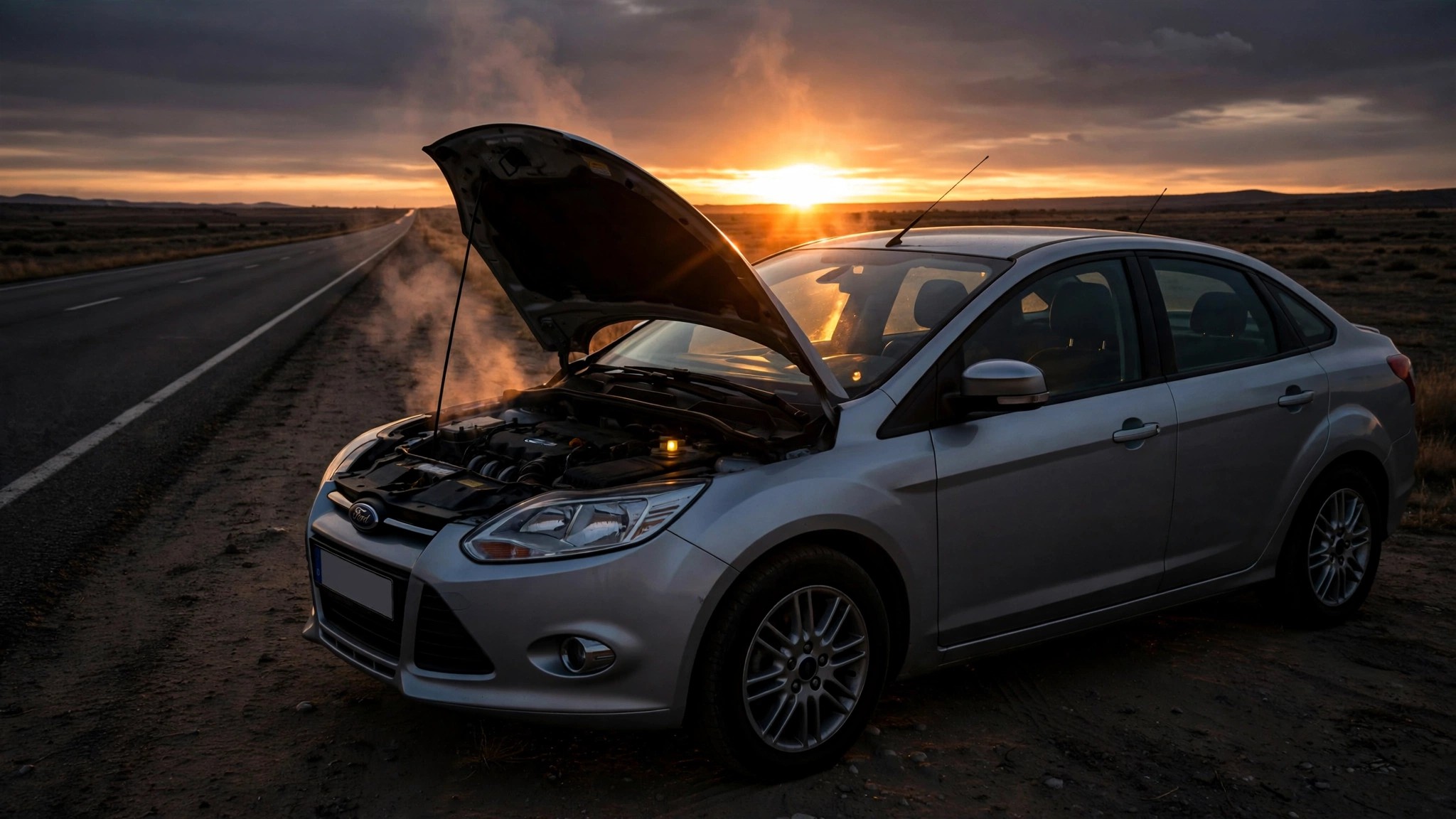
On August 4, NHTSA upgraded its investigation into Ford's 1.0-liter EcoBoost three-cylinder engine to an engineering analysis, the agency's last procedural step before it can force a recall. NHTSA's language was blunt: "unreasonable risk to motor vehicle safety."[1] Translation: the agency looked at the data, and what it found was bad enough to put the word "unreasonable" on paper.
Mechanically, the defect is elegant in its cruelty. Inside that engine, the timing belt, which synchronizes the engine's internal components, sheds material as it ages. That debris migrates into the mesh screen on the oil pump pickup, gradually choking oil flow to the engine. When pressure drops below a threshold, a warning light appears on the dashboard. Seconds later, the engine either loses power completely or seizes. You are now coasting, unpowered, in whatever lane you happened to be occupying when Ford's engineering caught up with you.[1]
NHTSA counted 355 incidents. Ninety-eight percent of them occurred before the manufacturer's own 150,000-mile belt replacement interval.[2] Drivers who changed their oil on schedule, who followed every page of the owner's manual, whose maintenance records are immaculate, watched their engines die at 70,000 miles anyway. A driver in Wilmington, Delaware reported the oil pressure light and then, within an eighth of a mile, the 2017 Focus "lost all power and the engine began to sound like a tank."[1]
Three models carry the 1.0L EcoBoost: the Ford Fiesta, Ford Focus, and Ford EcoSport. About 135,000 vehicles between model years 2014 and 2021 are in the investigation scope.[2] All three have been discontinued. Ford stopped building the Fiesta in 2019, the Focus in 2018 (for the U.S. market), and the EcoSport in 2022. There is no newer version of your car to trade into. Ford exited the segment.
FARS data adds a layer of context that NHTSA's filing does not address. Over the decade from 2014 to 2023, the Ford Focus was involved in 4,455 fatal crashes that produced 3,046 deaths, a fatality rate of 2.52 per 100 million vehicle miles traveled. That rate sits 74 percent above the sedan class average of 1.45 and ranks the Focus 11th deadliest among 89 sedans with 100 or more recorded deaths.[3] The Honda Civic, its closest competitor, runs a rate of 2.25. The Focus's crash-to-death ratio is 1.46, meaning that for roughly every three fatal crashes, two people die. Small cars die hard.
Fiesta carries 513 deaths and a rate of 1.02 per 100M VMT. Lower than the Focus, but still above the median for its size class. Across the three affected models, FARS records 3,645 deaths in the investigation decade.[3]
An engine that seizes without warning at highway speed does not create a new risk category for Focus and Fiesta drivers. It amplifies an existing one. These were already small, light vehicles absorbing disproportionate punishment in collisions with the trucks and SUVs that dominate American roads. Losing propulsion at 65 mph turns a dangerous car into a stationary object in a stream of 4,500-pound vehicles whose drivers are looking at phones.
Ford had no immediate comment on the investigation. Ford cannot be reached for a trade-in, because the brand walked away from every sedan and subcompact in its North American lineup. 135,000 owners are on their own, driving engines NHTSA has labeled an unreasonable risk, maintaining timing belts that will disintegrate before the interval Ford printed in the manual, watching a dashboard light that gives them an eighth of a mile to find salvation.
If you own a 2014-2021 Ford Fiesta, Focus, or EcoSport with a 1.0L engine: Check your VIN at nhtsa.gov/recalls for any open recalls. If your oil pressure warning light illuminates, pull over immediately. Do not attempt to nurse the vehicle to a service station. The window between warning and seizure can be measured in seconds, not minutes. Budget for a timing belt inspection well before 100,000 miles, and document every maintenance visit. When the recall comes, you will want proof that the failure was the belt, not the owner.
Sources & References
- Reuters, “US says some older Ford cars, SUVs pose unreasonable safety risks,” August 4, 2026. reuters.com
- Fox Business, “Some older Ford vehicles pose ‘unreasonable’ safety risks, regulators warn,” August 4, 2026. foxbusiness.com
- NHTSA, Fatality Analysis Reporting System (FARS), 2014–2023. nhtsa.gov
Limitations: FARS does not track engine displacement, so we cannot isolate 1.0L-equipped Focus fatalities from 2.0L-equipped ones. The 355 incident reports do not specify highway vs. city driving context. The EcoSport’s low fatality count (86) reflects recent entry and modest sales, not necessarily superior crashworthiness. The original contribution here is the intersection: FARS fatality rates establish baseline risk; the NHTSA defect investigation adds a compounding failure mode that proper maintenance cannot prevent. The strongest counterargument is that the 1.0L was a minority engine option in total Focus/Fiesta sales, limiting the population at risk. NHTSA’s decision to label it “unreasonable” suggests the defect rate within that population is severe enough to override the denominator defense. See methodology for general caveats.