The $3 Fix That Could Save 67 Lives a Year Has Been Sitting on a Desk for Two Years
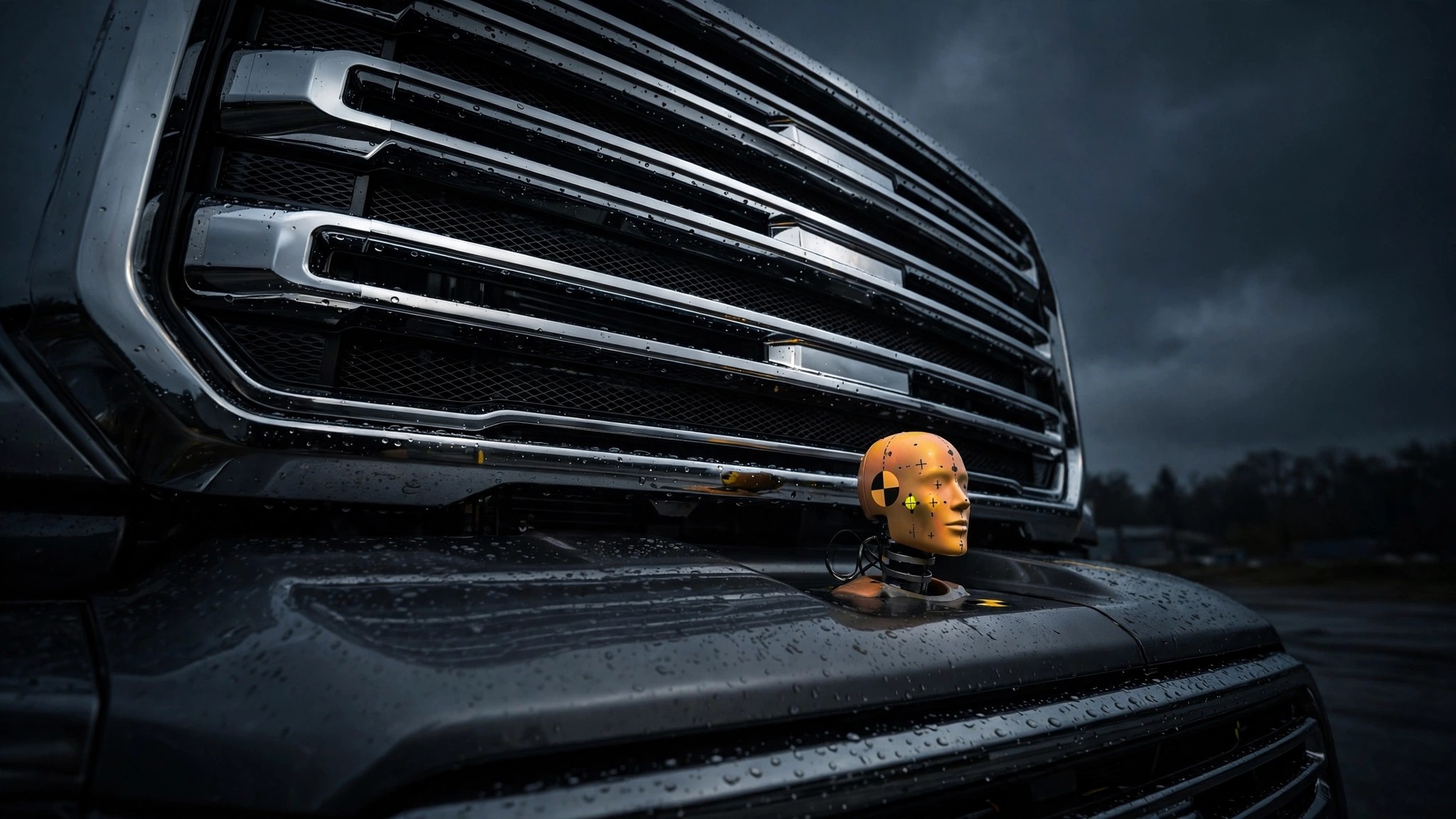
NHTSA wants automakers to soften the front ends of trucks and SUVs so that a pedestrian's head doesn't hit what amounts to a brick wall when it strikes the hood. NHTSA published a proposed rule in September 2024, estimated it would save 67 lives a year, and priced the fix at roughly three dollars per vehicle.[1] The comment period closed in December 2024. Since then, nothing.
Designated FMVSS 228, it would require new vehicles under 10,000 pounds to keep the Head Injury Criterion below 1,000 across two-thirds of the hood surface during simulated impacts with child and adult headforms. Europe and Japan have enforced nearly identical tests for years under UN Global Technical Regulation No. 9. The U.S. had no pedestrian crashworthiness standard of any kind until this proposal appeared in the Federal Register twenty-three months ago.[2]
Run the cost-benefit arithmetic and the numbers border on embarrassing. NHTSA's own value of a statistical life sits at approximately $13.2 million. Multiply that by 67 projected saves per year: $884 million in annual benefits. Annual cost across roughly 17 million new vehicles at three dollars each: $51 million. That benefit-cost ratio lands at 17.3 to 1. For context, the electronic stability control mandate carried a ratio around 3.5 to 1, and that rule is credited with saving thousands of lives per decade.[3]
Meanwhile, the hoods keep getting taller. A June 2026 analysis by the crash-reconstruction firm Forensic Rock, conducted for a New York Times investigation, found that the average new-vehicle hood now clears roughly three feet off the ground, tall enough to floor anyone under five-foot-six, which describes approximately half the adult population according to CDC height distributions. Silverado's forward blind zone has nearly doubled over the past two decades. Sierra and Tacoma saw increases around 60 percent. Ford's F-150, which at least tries, posted growth of about 25 percent.[4]
Physics explains why this matters beyond aesthetics. A sedan hood at 30 inches strikes a pedestrian below the waist, folding the person onto the hood in what engineers awkwardly call the "least worst" outcome. A pickup hood at 45 inches catches the torso or chest, shoving the pedestrian forward and down. "Before the driver knows what happened, the pedestrian's head is under the wheel," Forensic Rock's Shawn Harrington told Carscoops.[4] The difference between rolling onto sheet metal and being punted under 6,000 pounds of rolling steel is geometry, not fate.
Our FARS dataset (2014 through 2023) captures what happens inside these vehicles rather well. America's four biggest pickup nameplates accumulated staggering occupant death counts over the decade: the Silverado at 9,591, the F-150 at 9,194, the Ram at 4,407, and the Sierra at 3,337. Collectively, the pickup class logged 40,122 occupant deaths across roughly 82,000 fatal-crash involvements.[5] The irony embedded in those numbers is that pickups boast the lowest crash lethality of any vehicle class at 48.5 percent: when a pickup is involved in a fatal crash, its occupants die less often than those in sedans (64.4 percent) or sports cars (65.9 percent). The steel cage works. It works so well, in fact, that NHTSA has never needed to regulate what happens to the person standing in front of it.
That regulatory gap has cost lives at a pace the agency's own data can quantify. Pedestrian fatalities climbed 75 percent between 2009 and 2023. NHTSA's deputy administrator stated in 2024 that pedestrian fatalities increased 57 percent between 2013 and 2022 alone, from 4,779 to 7,522.[1] Independent researchers estimate that the growth in hood heights since the early 2000s accounts for roughly 3,000 excess pedestrian deaths between 2016 and 2024, or 200 to 400 additional fatalities per year.[4] NHTSA's own projected savings of 67 lives per year from FMVSS 228 is conservative by comparison, and even at that modest figure, every year the rule sits unfinalized is a year those 67 people remain unprotected.
The standard's engineering requirement is, to be blunt about it, a packaging instruction disguised as a safety test. Keeping the HIC below 1,000 across the hood surface dictates how much crush space sits under the panel, how steep the leading edge can be, and how rigid the underlying structures are allowed to be. European manufacturers have been meeting these constraints for over a decade. Raised, flat, blunt hood profiles that dominate American showrooms exist because no regulation told designers they couldn't build them that way. FMVSS 228 would change exactly one variable in the design equation, and it would change it for three dollars.
So why hasn't it been finalized? Honestly, NHTSA rulemaking moves at a pace that makes plate tectonics look ambitious. Backup cameras took seven years from proposal to final rule, and AEB took five. FMVSS 228 is still young by those standards. But the cost-benefit math makes the delay harder to defend than usual. At three dollars a vehicle and 17.3 to 1 returns, this is not a close call that requires additional data or extended legal review. This is a regulation whose only remaining obstacle is institutional velocity.
What this means for you
If you drive a truck or SUV built in the last decade, your forward blind zone is meaningfully larger than it was in the vehicle you replaced. Cameras and automatic emergency braking help, but they are supplements, not substitutes, for direct visibility. Before backing out of a driveway or turning through a crosswalk, assume there is a person in the space you cannot see, because NHTSA has not yet required your vehicle to be designed with their skull in mind. The proposed rule that would do exactly that costs less than a gallon of gas per vehicle. It has been proposed, and it has not been finalized. You can submit a comment to NHTSA's docket (NHTSA-2024-0090) asking why.
Sources & References
- NHTSA, Notice of Proposed Rulemaking: Federal Motor Vehicle Safety Standard No. 228, Pedestrian Head Protection, September 19, 2024. nhtsa.gov
- Depix AI, “The front end that sells the truck is the one the pedestrian in front of it doesn’t survive,” 2026. depix.ai
- IIHS, “Life-saving benefits of ESC continue to accrue,” 2011. iihs.org
- Carscoops, “The Average New Truck Hood Can Floor Anyone Under 5-Foot-6, Which Is Half The Country,” June 24, 2026. carscoops.com
- NHTSA, Fatality Analysis Reporting System (FARS), 2014–2023. nhtsa.gov