The Ford Explorer Has Five Stars, 3,797 Deaths, and 676,000 Recalls This Week
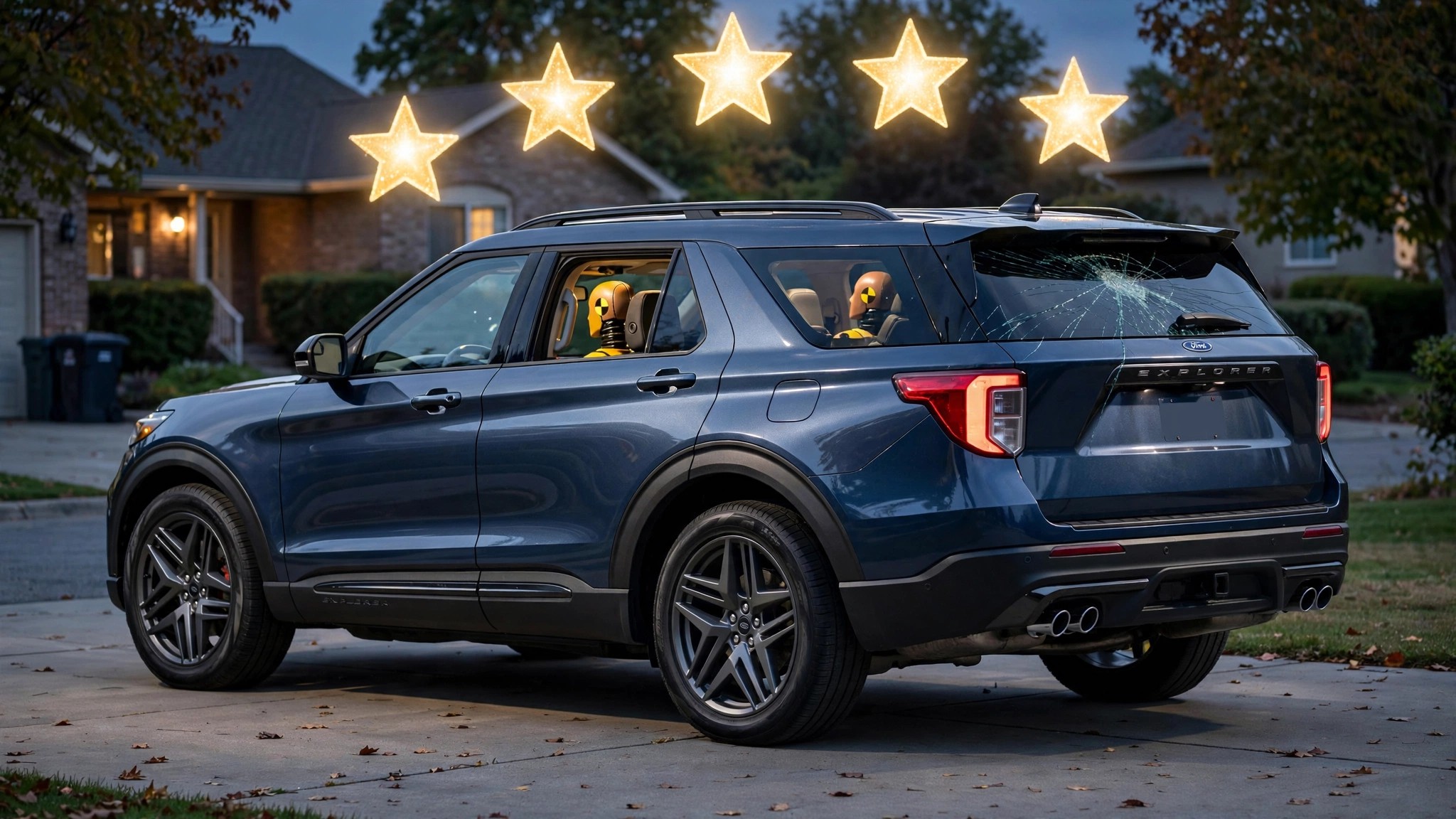
Ford dropped 676,000 Explorer and Aviator recalls in a single NHTSA bulletin this week. 387,911 for second-row seats that can unlatch, tip, or slide while the vehicle is in drive. Another 288,314 for roof rail covers that detach at highway speed.[1] The Explorer still carries a five-star NHTSA rating and IIHS Top Safety Pick+. Good scores in every crash test, every one of them earned by hitting barriers in a lab. On actual roads, over the last decade, it has accumulated 3,797 deaths.[2]
That number gets worse in context. We pulled FARS fatality rates for every three-row family SUV with enough fleet data to calculate a per-mile death rate. Same segment. Same pitch from the dealer: room for seven, peace of mind for the school drop-off. Rates per 100 million vehicle miles traveled:
Tahoe: 2.49. Expedition: 2.31. Explorer: 1.54. Pathfinder: 0.93. Highlander: 0.42. Pilot: 0.29. Traverse: 0.20. Palisade: 0.06. Atlas: 0.06. Telluride: 0.04.
At 1.54 per 100M VMT, Ford's bestselling SUV kills at 38 times the rate of Kia's Telluride. GM's Tahoe manages 62 times worse, and yet every model in the segment aces crash tests. Honda's Pilot carries the same TSP+ and five-star rating as the Explorer and dies at one-fifth the rate. Toyota's Highlander, with a comparable fleet size and age profile, sits below a third.
Drunk drivers don't explain it. FARS toxicology data shows impairment rates in fatal crashes cluster between 19% and 21% for nearly every model in this segment. Tahoe: 20.6%. Explorer: 19.5%. Pilot: 19.4%. Highlander dips to 16.4%, but a 3-point gap in impairment doesn't produce a 3.7-fold difference in death rate. Something about the vehicles themselves is doing the killing.
And now one of them has seats that come loose while you're driving. Ford's own Critical Concern Review Group found 14 reports of the second-row sliding or tipping while the vehicle was moving.[3] Six of those were in vehicles that had already been "fixed" under a previous Field Service Action. Ford thought a supplier tweak to the switch installation would solve it, but customer reports proved otherwise. A year later, the quiet FSA became a full recall.
Same week, Toyota recalled 5,408 Grand Highlanders and Lexus TXs because rear axle carriers, forged aluminum components bolted to the suspension, weren't fully manufactured.[4] They can break where they attach to the toe control arms, causing sudden alignment failure at speed. No incidents yet, because Toyota's supplier caught it before the axles did.
Here is the strongest argument against reading too much into the Explorer's FARS rate: fleet age. Ford launched the Explorer in 1990, and older models with rear-wheel drive, no ESC, and pre-modern crash structures are still on the road, still dying. Kia put the Telluride on sale in 2020. Its fleet is young, its buyers are wealthier, and six years isn't long enough for statistical stability at 31 total deaths. If you want a fairer comparison, take the Highlander: similar fleet size, similar production run length, similar vintage mix. Even controlling for that, the Explorer dies at 3.7 times the Highlander's rate. Fleet age narrows the gap, but it doesn't close it.
Crash tests measure what happens when a 3,500-pound sled hits a deformable barrier at a calibrated angle inside a laboratory. FARS measures what happens when 1.97 million Explorers meet 24.6 billion miles of American road every year. One earns a sticker on the window; another fills a database at NHTSA that nobody checks at the dealership. On paper, the Explorer is perfect, but on the road, three comparable competitors, the Highlander, the Pilot, and the Traverse, are three to eight times safer.
If you own a 2020-2026 Explorer or a 2020-2027 Aviator, check your VIN at nhtsa.gov/recalls. Ford won't have the seat fix ready until January 2027. Until then, don't assume the second-row easy-entry feature is latched just because it looks latched. If the release button feels sticky or stays depressed, the seat may not be secured. And if you're shopping the segment: the Highlander, Pilot, and Traverse carry the same crash-test ratings at a fraction of the real-world death rate. Five stars won't tell you which fraction.
Sources & References
- NHTSA, Recall 26S52 (Explorer/Aviator second-row seats) and Recall 26S54 (Explorer roof rail covers), July 2026. nhtsa.gov/recalls
- NHTSA, Fatality Analysis Reporting System (FARS), 2014–2023. nhtsa.gov
- Ford Motor Company, Critical Concern Review Group findings cited in NHTSA Recall 26S52, 14 field reports of unintended seat movement. nhtsa.gov/recalls
- NHTSA, Toyota/Lexus recall for Grand Highlander and TX rear axle carriers, July 2026. nhtsa.gov/recalls
- IIHS, 2025–2026 Ford Explorer safety ratings, Top Safety Pick+. iihs.org/ratings
- NHTSA, 5-Star Safety Ratings, Ford Explorer and Honda Pilot. nhtsa.gov