The Ford F-150 Is Involved in 20,000 Fatal Crashes. It Gets Five Stars.
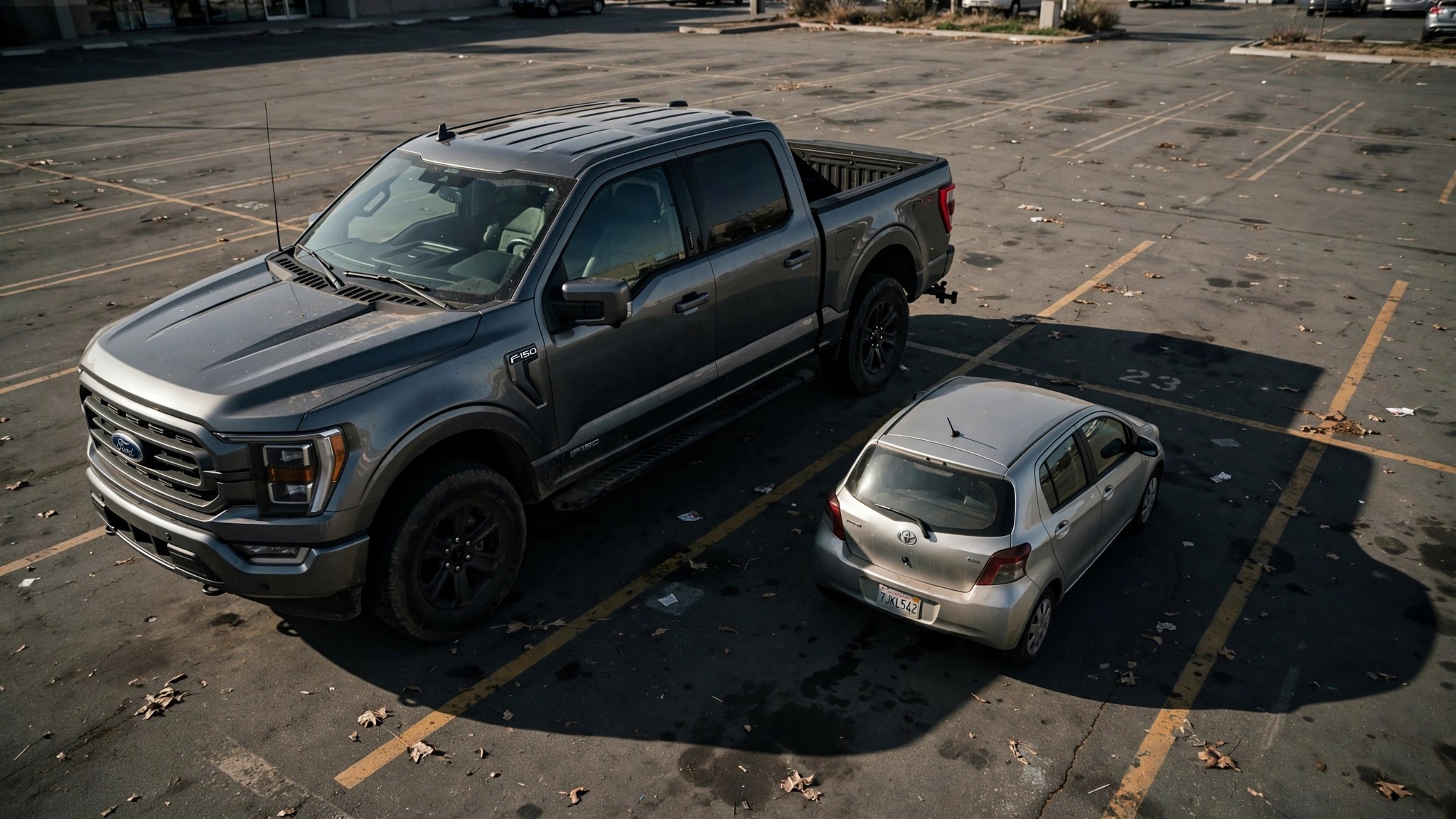
Twenty thousand and sixty-six. That is how many fatal crashes in the NHTSA Fatality Analysis Reporting System involved a Ford F-150 between 2014 and 2023. More than the Honda Civic, the Toyota Camry, or the Chevy Malibu. More, in fact, than any single sedan model in the entire database, by a margin that would embarrass most automakers into a press conference. The F-150 ranks second among all 337 vehicle models tracked by FARS in total occupant deaths, behind only the Chevrolet Silverado.[1]
Ford's half-ton earns five stars from NHTSA, and IIHS handed the 2024 crew cab a Top Safety Pick after September 2024 production changes. ANCAP gave it a Platinum rating, the highest of any large pickup tested, beating the RAM 1500, Tundra, and Silverado by double-digit percentages.[2] By every official metric we use to sell trucks, the F-150 is the safest one you can buy, which makes the body count all the more difficult to reconcile.
Consider the death-to-crash ratio, a measure of how often a vehicle's own occupants die when that vehicle shows up at a fatal crash. Of those 20,066 fatal crashes involving an F-150, the truck's own occupants died 9,194 times, producing a ratio of 0.458, which means that in more than half of the fatal crashes an F-150 participates in, nobody inside the Ford dies while someone in the other vehicle does.[1] Compare that to the Toyota Camry, which appears in 10,670 fatal crashes with 6,328 occupant deaths, yielding a ratio of 0.593. Camry occupants die at a higher rate because the Camry is a 3,500-pound sedan meeting a world designed around 5,500-pound trucks, and physics has never once agreed to negotiate on behalf of the lighter party.
Impairment cannot explain the wreckage either, because at 18.9 percent, the F-150's rate sits below the full-size truck average of roughly 20 percent, so this is not a DUI story or a reckless-driver story.[1] Nor is the per-mile death rate exceptional: at 1.04 per 100 million vehicle miles traveled, the F-150 actually underperforms the Silverado's 1.25 in lethality and lands far below older compact trucks like the Ranger at 2.91. Mile for mile, the F-150 is among the least dangerous trucks you can drive, a fact that makes the body count harder to explain and harder to ignore.
So what is the story, exactly? Ubiquity, compounded across four decades of unchallenged market dominance. Ford has sold the F-150 as America's best-selling vehicle for over forty consecutive years, building an active fleet estimated at 6.56 million units, which translates to roughly one out of every 40 registered vehicles on American roads. When you put that many 5,000-plus-pound body-on-frame trucks onto streets shared with Civics and Corollas and crossovers that weigh half as much, a "normal" death rate produces an extraordinary body count because scale turns an average hazard into a statistical catastrophe. A single truck model accounts for 4.8 percent of all 191,193 vehicle-related deaths tracked across 337 models in FARS.[1]
Model-year data traces a predictable and damning arc. Deaths peak at 672 for the 2001 model year, the saturated heart of the tenth-generation F-150's production run, when these trucks had aged into the price range where maintenance becomes aspirational and collision avoidance technology did not yet exist. Model years 1997 through 2004 account for 3,902 deaths, or 42.4 percent of the F-150's entire total, from a generation that predates the 2012 mandate for electronic stability control.[3] Post-2015 F-150s have logged 1,026 deaths, only 11.2 percent of the total, and they are genuinely safer machines: aluminum bodies, standard automatic emergency braking on recent builds, and every driver-assist acronym Ford's marketing department could print on a window sticker.
But "safer" and "safe" remain words with different zip codes when the vehicle in question matches a small asteroid in curb weight and rides on a frame shared with medium-duty commercial trucks. IIHS research has documented the arithmetic of mass disparity in unflinching detail: in a two-vehicle crash between a pickup and a car, the car's occupant is two to three times more likely to die than the truck's.[4] A five-star crash test measures what happens when an F-150 hits a barrier in a laboratory, but on public roads it collides with Corollas and Accords and Mazda3s, and the barrier never had a family inside it.
IIHS itself flagged the crack in the armor with its updated moderate overlap front test, where the F-150 scored "Poor" for rear-occupant protection: the front-seat driver walks away shielded and intact while the kid in the back seat absorbs shoulder belt migration toward the neck and lap belt submarining that dramatically increases the risk of internal injuries.[2] Across 139 vehicles evaluated under this updated protocol, roughly 42 percent scored below "Good," with pickups and SUVs disproportionately represented because the industry spent decades marketing these vehicles as family haulers while quietly declining to engineer the back seat for survival in a frontal crash.
None of this makes the F-150 a bad truck, and that is precisely the point that should keep policy makers up at night. It is a normal truck, an unremarkable, statistically average, five-star-rated truck that happens to be everywhere, all the time, in every zip code, on every highway, parked in one out of every forty driveways in America. When the most popular vehicle on the continent is a body-on-frame machine with a four-inch hood-height advantage over the median sedan, "normal" lethality multiplied by 6.56 million units becomes a public health crisis wearing a gold star.
If a pharmaceutical product killed 919 Americans every year, the FDA would have convened emergency hearings and launched prime-time PSAs before the second quarterly report was filed. Because this particular product has four wheels, leather-wrapped seats, and a trailer hitch rated for 13,000 pounds, we gave it five stars, named it the safest pickup you can buy, and wrote it a check for best-selling vehicle of the century.
Sources & References
- NHTSA, Fatality Analysis Reporting System (FARS), 2014–2023. All F-150 death counts, rates, impairment percentages, and crash involvement figures derived from FARS bulk CSV data. nhtsa.gov
- IIHS, 2024 Ford F-150 crash test ratings, including updated moderate overlap frontal test rear-occupant results. iihs.org/ratings
- NHTSA, Federal Motor Vehicle Safety Standard No. 126 — Electronic Stability Control, final rule requiring ESC on all light vehicles by 2012 model year. govinfo.gov
- IIHS, Vehicle Size and Weight research on mass disparity in two-vehicle crashes and occupant risk ratios. iihs.org
What to do: If you need a truck and you are buying new, the latest F-150 crew cab is genuinely among the safer options available in the segment, particularly models built after September 2024 with the full Co-Pilot360 suite. But if you are shopping for a vehicle and defaulted to a pickup because that is what Americans do, weigh this carefully: every truck's mass advantage for its driver is a survival disadvantage for everyone it meets head-on. Check your VIN for recalls at nhtsa.gov/recalls, where the 2024 model alone carries 10 open recall campaigns. And if you drive a sedan, understand that the truck next to you weighs twice what you do and that its five-star rating was earned in a controlled test where nobody was sitting where you are.