Your Tires Were Tested Once. When They Were New.
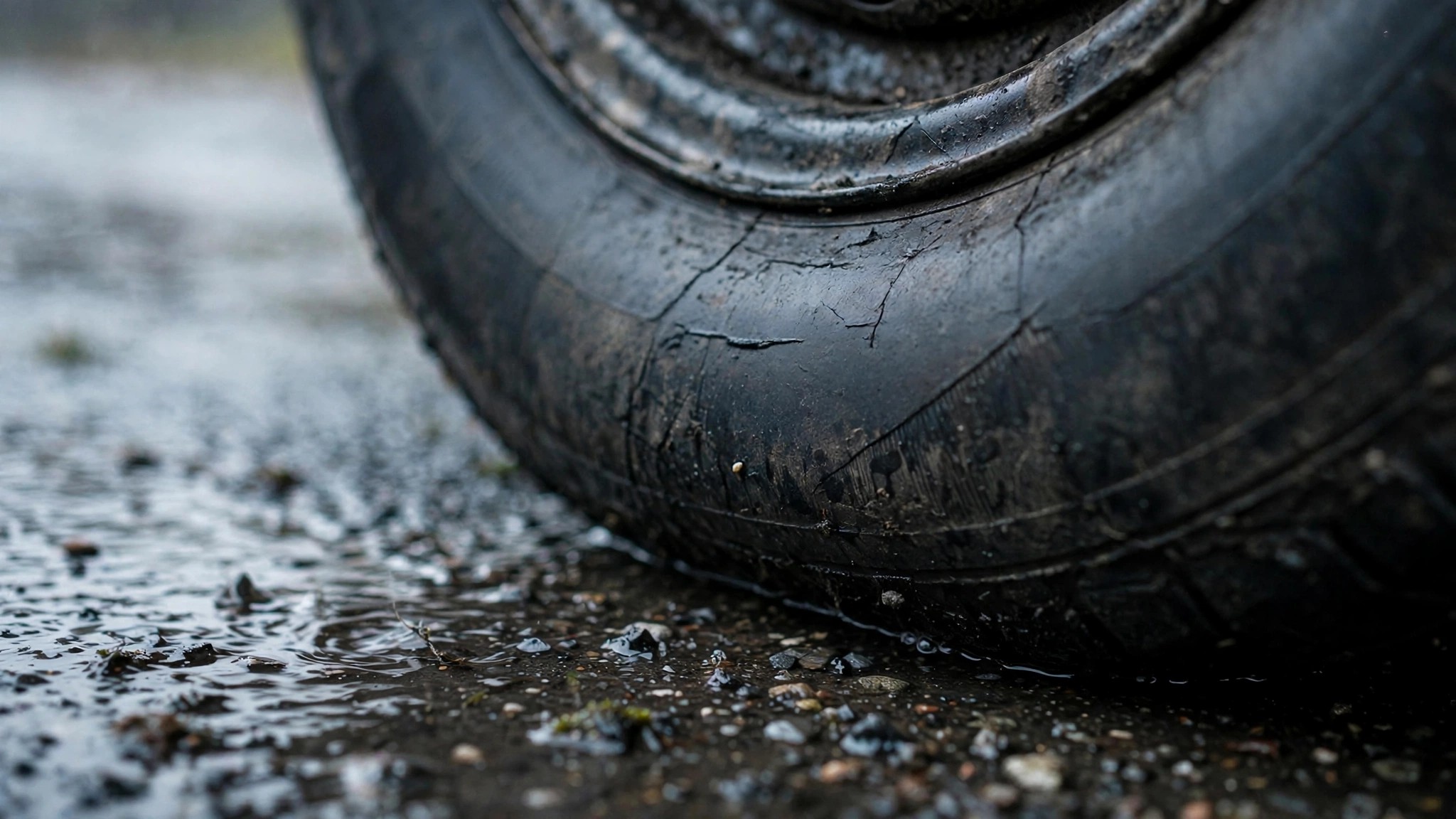
Eleven days ago, every new car sold in the European Union became subject to a requirement the United States has never imposed: tires must prove they can still grip wet pavement when worn down to their legal tread limit.[1] Machine the tire to 1.6 millimeters of remaining tread, the depth at which you’d legally need to replace it, soak a track, and measure braking performance against a standardized reference tire ground to the same depth.[2] If the tire can’t stop adequately at its worst, it can’t be sold at its best.
The American standard, FMVSS 139, tests tires exclusively when they’re brand new.[3] Traction grade, temperature resistance, treadwear rating: all measured on a tire that has never touched a public road. NHTSA’s own data says tire-related crashes kill more than 600 Americans and injure 33,000 every year.[4] Nobody at the agency has asked the obvious question: what happens to those tires at 40,000 miles?
Michelin has, because Michelin sells tires, and their published data shows a worn tire designed for end-of-life performance can stop 3.4 meters shorter on wet pavement than a new competitor tire.[5] A worn Michelin outbrakes a brand-new rival because the compound engineering and groove geometry are optimized for a condition that the American federal standard literally does not evaluate. You could design a tire that aces every FMVSS 139 benchmark on day one and hydroplanes catastrophically at month fourteen, and it would be perfectly legal to sell in every U.S. state.
We know what that looks like, because it already happened. In 2000, Firestone ATX and Wilderness tires on Ford Explorers began separating at highway speed in summer heat. Not when new, but after wear and age degraded the belt adhesion that nobody was required to test for.[6] Two hundred seventy-one people died. Congress passed the TREAD Act, which gave us tire pressure monitoring systems. TPMS solved one problem: it tells you when a tire is underinflated. It tells you nothing about whether a worn tire can still stop your car in the rain. That was twenty-five years ago, and the gap is still open.
FARS data makes the stakes concrete: vehicles with the highest fatality rates in the federal database share a trait: tall centers of gravity that turn a tire failure into a rollover. Ford’s E-350 van, NHTSA’s own poster child for tire-related rollover risk, dies at 2.51 per 100 million vehicle miles traveled, four times the fleet average.[7] Chevy Tahoe: 2.49, Ford Expedition: 2.31. And that Explorer—the truck that started this conversation a quarter century ago—still kills at 1.54 per 100 million miles, nearly 2.5 times the overall SUV class average of 0.63. These vehicles are the ones that most need their tires to work at mile 45,000, and the ones whose tires are least likely to be tested there.
R117-04 does not solve every tire safety problem. It tests wet grip on a machined surface under controlled conditions, and it ignores rubber aging, structural fatigue, and the slow chemistry of sidewall degradation that contributed to the Firestone failures.[2] A tire that passes R117-04 at simulated wear can still fail from age-related belt separation in Arizona heat. But R117-04 at least acknowledges that a tire is a wasting asset whose performance changes over its life. FMVSS 139 pretends the whole question doesn’t exist.
What you should do: Check your tread depth monthly. A penny test works, but a $4 tread depth gauge is more precise. Replace tires at 4/32″ (3.2 mm), not the legal minimum of 2/32″ (1.6 mm). At 2/32″, a 3,500-pound car on wet pavement needs roughly 100 additional feet to stop from 60 mph compared to a tire with full tread. Almost five car lengths of pure hope.[8] When buying new tires, look for brands that publish worn-tire wet-braking data: Michelin, Continental, and a few others have begun marketing this metric voluntarily, which tells you two things. First, they build for it; second, nobody’s making them.
Sources & References
- European Commission, “Safer cars, safer roads: New rules take effect,” July 7, 2026. ec.europa.eu
- TÜV SÜD, “Amendment of UN/ECE Regulation No. 117: Safe tyres up to the wear limit.” tuvsud.com
- NHTSA, Federal Motor Vehicle Safety Standard No. 139, “New Pneumatic Radial Tires for Light Vehicles.” ecfr.gov
- NHTSA, “Safety and Savings Ride on Your Tires.” nhtsa.gov
- European Rubber Journal, “Michelin welcomes new EU reg on condition of worn tires,” July 11, 2024. european-rubber-journal.com
- NHTSA, Firestone Tire Recall and Ford Explorer Investigation, 2000–2001. wikipedia.org
- NHTSA, Fatality Analysis Reporting System (FARS), 2014–2023. nhtsa.gov
- Tire Rack, “Wet Braking Distance by Tread Depth,” independent testing. tirerack.com
Source: NHTSA FARS 2014–2023. Fatality rates estimated from FARS death counts and FHWA fleet/VMT estimates; tire-specific crash causation is not available in FARS and is drawn from NHTSA’s tire safety publications. See methodology for caveats.