Every New Car in Europe Will Brake for Pedestrians Tomorrow. America Won’t Require It Until 2029.
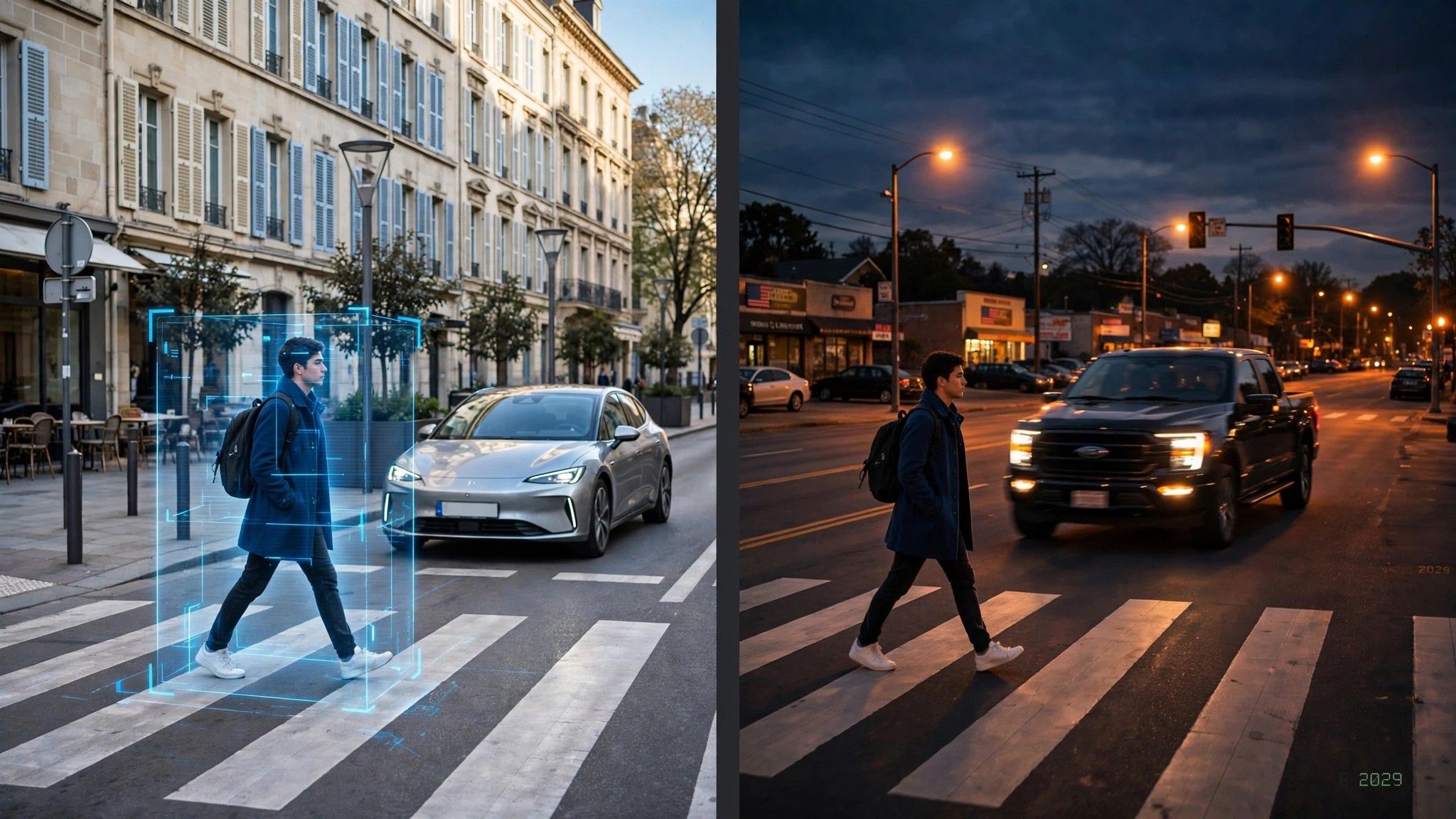
On July 7, 2026, every new passenger car and van sold in the European Union must carry advanced automatic emergency braking capable of detecting pedestrians and cyclists.[1] Distraction monitoring. Lane-keeping intervention. Pedestrian-safe glass. Not optional packages, not dealer add-ons: standard equipment, mandated by law, enforced on every vehicle rolling off a European lot starting tomorrow. Washington finalized an equivalent AEB rule in April 2024.[2] Compliance deadline: September 2029.
Three years and two months. That is how long American pedestrians will wait for protection that Europeans receive tomorrow, in a country where someone on foot dies under a driver’s wheels every 74 minutes, where 7,080 pedestrians were killed in 2024 alone, where the pedestrian fatality rate has climbed 50 percent in a decade while nearly every other wealthy nation drove theirs down.[3] [4]
NHTSA itself estimates that once AEB with pedestrian detection becomes universal, it will prevent at least 360 deaths and 24,000 injuries annually.[2] Not an advocacy estimate, not an industry projection. NHTSA’s own number, from the same agency that set the 2029 deadline and then quantified what that delay costs: roughly a death per day, every day, for three years, that existing technology could have prevented.
Between tomorrow and September 2029, approximately 50 million new vehicles will be sold in the United States without a federal requirement that they brake for a person crossing the street. Many will carry some form of AEB voluntarily, because automakers made a 2016 pledge to equip most models by 2022, and roughly 90 percent of 2023 models shipped with a system.[5] But “has AEB” and “meets the mandate’s performance standard” describe different realities entirely. Washington’s rule demands nighttime pedestrian detection, braking intervention at speeds up to 45 mph for pedestrians and 90 mph for lead vehicles, and verified stopping performance at 62 mph. IIHS has tested current voluntary systems in darkness: vehicles rated “superior” in daylight dropped to “basic” on low beams.[6] Seventy-six percent of American pedestrian fatalities happen after dark.[4]
So: existing technology fails in darkness. Most pedestrians die in darkness. No rule requiring nighttime performance takes effect for three more years. Europe fixes this tomorrow.
An International Scorecard
A CDC study published in March 2025 compared pedestrian death rates across 28 high-income nations from 2013 to 2022.[3] Results are unambiguous. America posted a pedestrian death rate of 2.33 per 100,000 population in 2022, roughly three times the median rate of 27 peer countries (0.73). Norway managed 0.17. Sweden, 0.24. Germany, whose auto industry lobbied against GSR2 timelines, still clocked 0.44. Not second-worst. Not competitive. Dead last in a ranking where last means most dead.
More damning than any snapshot is the trajectory. Between 2013 and 2022, peer nations reduced their pedestrian death rates by a median of 24.7 percent. America’s rate climbed 50 percent. In raw terms: 2,857 more Americans were killed walking in 2022 than in 2013. Across those same 27 countries combined, 3,071 fewer pedestrians died. One nation went up while the rest of the developed world went down, and it is the one waiting three extra years for technology proven to help.
Why This Gap Exists
Europe moved first because Europe moves differently. Brussels adopted GSR2 in 2019, setting a seven-year phased rollout culminating in tomorrow’s Phase 3 enforcement.[1] Congress ordered a US rule in the 2021 Bipartisan Infrastructure Law; NHTSA proposed it in May 2023, finalized it in April 2024, then granted automakers a compliance window stretching to September 2029. Europe gave manufacturers seven years of lead time. Washington gave them five from finalization, which was itself three years after Congress said “do this.” Net effect: a European three-year-old is growing up in a country where every new car brakes for her. An American three-year-old will not have that protection until approximately her sixth birthday.
None of this is about technological readiness, because both mandates reference identical sensor packages: camera-radar fusion, machine-learning pedestrian classifiers, validated braking algorithms. Bosch, Continental, and Mobileye sell these systems on both continents today. Political will, lobbying calendars, and a regulatory culture that treats 7,080 annual pedestrian deaths as a problem that can wait account for the difference.
In Fairness
When it arrives, Washington’s mandate will be stronger than Europe’s in several respects. NHTSA demands nighttime pedestrian detection with specific performance thresholds, lead-vehicle braking up to 90 mph, and pedestrian braking up to 45 mph. EU Phase 3 requirements validate performance through UN Regulation No. 152 and 159 protocols that may not cover identical scenarios. A defender of the US timeline could argue that Washington traded speed for rigor, that the extra years purchase a more comprehensive standard.
That argument collapses against one number: seven thousand eighty pedestrians killed in 2024, three out of four in darkness, where existing voluntary AEB cannot reliably see the person it was designed to protect. A more rigorous standard that arrives three years late is a eulogy dressed as engineering.
What to Do Right Now
If you are shopping for a car today, do not wait for the mandate. Check whether your prospective purchase carries an IIHS “superior” front crash prevention rating with pedestrian detection at iihs.org/ratings, and prioritize models that have been independently tested in nighttime scenarios. If you are considering an SUV or pickup, know that pedestrians struck by these vehicles are 50 to 100 percent more likely to die than those hit by passenger cars, per the National Safety Council.[7] Not an argument against buying one. An argument for buying one that actually stops.
Limitations
Fleet turnover is slow. Even a universal mandate does not protect pedestrians overnight. Average American vehicles are 12.6 years old; only about 5.5 percent of the fleet is replaced annually. NHTSA’s 360-lives-per-year figure is a steady-state projection, not an immediate benefit. Voluntary manufacturer improvements between now and 2029 may exceed the minimum standard before the deadline arrives. Nor does this analysis adjust for the declining pedestrian death trend visible in 2024 and 2025 data, which may reflect infrastructure investments, behavioral shifts, or interventions unrelated to vehicle technology.
Sources & References
- European Commission, General Safety Regulation (EU) 2019/2144, Phase 3 enforcement date July 7, 2026. Confirmed via European Commission official communication, July 5, 2026. Thatcham Research, “What is GSR2?” news.thatcham.org
- NHTSA, “NHTSA Finalizes Rule on Automatic Emergency Braking,” April 2024. Federal Motor Vehicle Safety Standard No. 127. Compliance deadline September 2029. nhtsa.gov
- Naumann RB, West BA, Barry V, Matthews S, Lee R. “Pedestrian and Overall Road Traffic Crash Deaths, United States and 27 Other High-Income Countries, 2013–2022.” MMWR 2025;74:134–139. cdc.gov
- NHTSA National Center for Statistics and Analysis, Pedestrian Safety Facts 2024. nhtsa.gov; GHSA, “Pedestrian Traffic Fatalities by State: 2024 Preliminary Data.” ghsa.org
- IIHS, Voluntary AEB commitment tracking. Twenty automakers pledged in 2016 to make AEB standard by September 2022. iihs.org
- IIHS, “Pedestrian crash avoidance systems cut crashes, but not in the dark,” 2023. Nighttime pedestrian AEB track tests. iihs.org
- National Safety Council, Road to Zero Coalition, “Massive Hazards: How Bigger, Heavier Light Trucks Endanger Lives on American Roads,” 2024. nsc.org
Source: CDC MMWR 2025;74:134–139, NHTSA FARS, GHSA preliminary state data, European Commission GSR2 enforcement timeline. International death rates use population denominators, not exposure-based metrics like VMT, which are unavailable for pedestrians across all countries. See methodology for caveats.