The 2013 Elantra Killed More People Per Unit Than Any Civic Ever Made
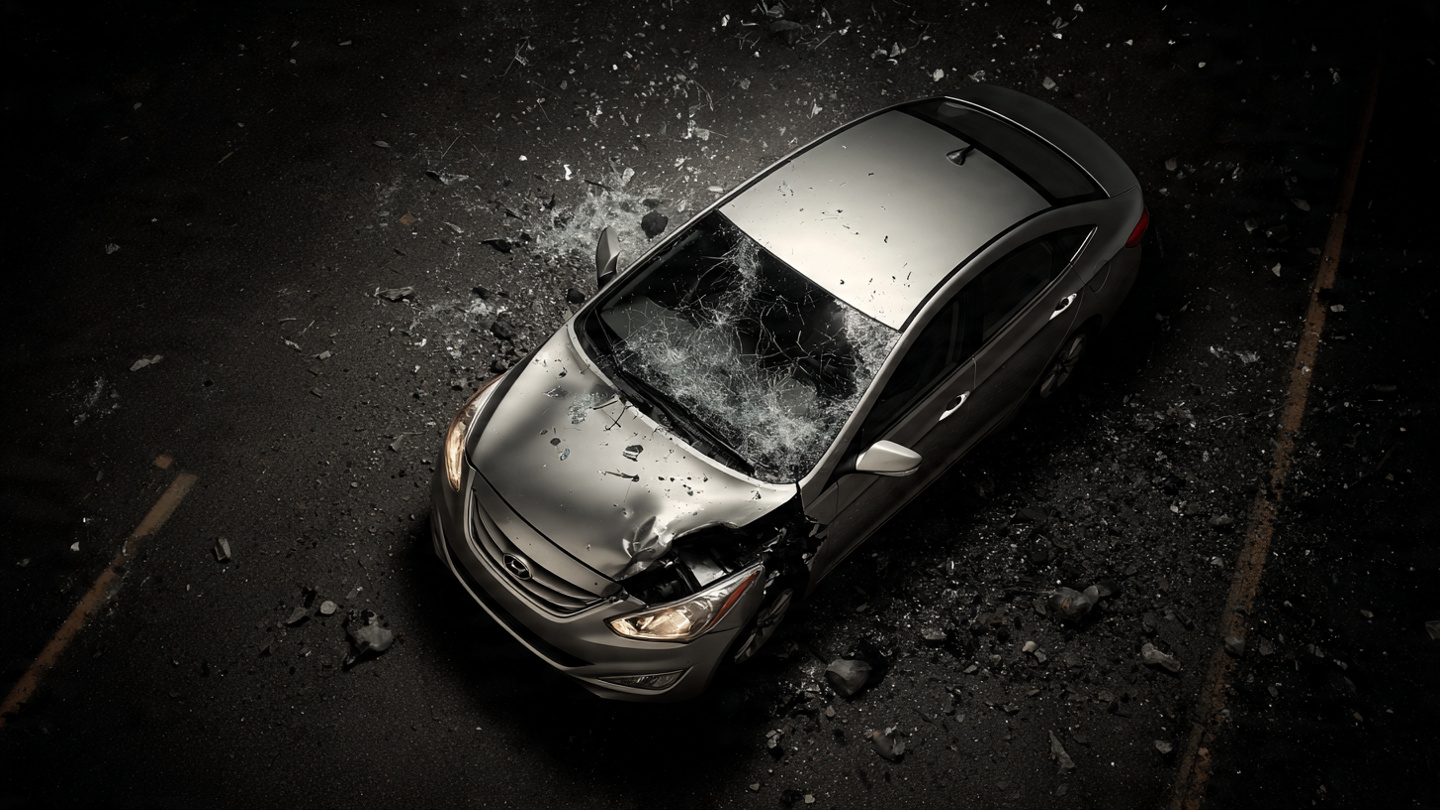
A single model year of Hyundai Elantra produced 338 fatalities in FARS data between 2014 and 2023.[1] Model year 2013. That same vintage of its platform cousin, the Kia Forte, killed 23 people. A 14.7x gap between vehicles sharing a corporate parent, a factory floor, and increasingly, actual engineering.
Put 338 in context. Among ALL vehicles across ALL model years, only trucks (Silverado, F-150, Ram), full-size sedans (Accord, Camry, Impala), and a handful of SUVs break 300. The 2013 Elantra is the only Hyundai model year to join that club. Adjacent Elantra years scored 128 (2012) and 132 (2014). Whatever happened in 2013 was a 2.6x spike against the car’s own baseline.
I pulled the IIHS small overlap front test for the 2013 Elantra.[2] Structure rating: Marginal. Lower hinge pillar intrusion: 22 centimeters. Upper hinge pillar: 18 cm. And the critical detail buried in IIHS kinematics notes: the driver’s head contacted the frontal airbag, then slid off the left side, leaving it exposed to forward structure. Hyundai designed an airbag that couldn’t hold the occupant’s head in place during precisely the crash type that was about to kill hundreds of these drivers.
Volume explains some of it. Hyundai sold roughly 247,000 Elantras in 2013 versus about 118,000 Fortes. A 2.1x sales gap. But 2.1x volume does not produce 14.7x deaths. After volume adjustment, the Elantra remains approximately 7x deadlier. And the per-unit-sold death rate tells the rest: 1.37 deaths per 1,000 units sold, which beats the deadliest single model year of the Honda Civic (2008, 1.19 per 1,000) by 15%.[1]
One more uncomfortable number: Elantra drivers involved in fatal crashes had the lowest impairment rate of any compact sedan at 18.6%.[3] Civic: 20.4%. Corolla: 19.2%. Sentra: 20.0%. Sober people were disproportionately dying in this car. When impairment rates are low and death rates are high, the engineering is talking.
By model year 2019, the Elantra/Forte death ratio collapsed to 1.2x as Hyundai-Kia converged the platforms. Same engineering, same outcomes. Which tells you what you need to know about 2013: the platforms were different enough to produce a 7x gap in deaths per unit, and one of them had an airbag that couldn’t do its job in a small overlap crash.
What You Can Do
If you own or are shopping for a 2011–2016 Elantra (fifth generation), check your VIN at nhtsa.gov/recalls immediately. Over 200,000 Elantras were recalled in March 2015 for a steering coupling bolt defect.[4] Beyond recalls: the 2013 model year specifically should be avoided in the used market. Comparable-year Corollas and Mazda3s scored dramatically better in small overlap protection and have per-unit death rates 21% and 40% lower, respectively. IIHS small overlap front ratings are the single most predictive crash test for real-world compact sedan fatalities. Check them before signing anything.
Strongest Counterargument
November 2012, Hyundai and Kia admitted overstating fuel economy by 1–3 MPG across multiple models, triggering buyer reimbursements and aggressive incentive pricing. The 2013 Elantra was Hyundai’s top seller during the resulting fire sale. Cheap cars attract price-sensitive, often younger buyers with higher baseline crash risk. We cannot isolate vehicle factors from demographic confounds in FARS data. Some portion of the 338 may reflect who bought the car, not how it was built.
Sources & References
- NHTSA, Fatality Analysis Reporting System (FARS), 2014–2023. nhtsa.gov
- IIHS, 2013 Hyundai Elantra small overlap front crashworthiness evaluation. iihs.org/ratings
- NHTSA FARS toxicology data, driver impairment rates by make/model, 2014–2023. cdan.dot.gov
- NHTSA recall, approximately 200,000 Hyundai Elantras for steering coupling bolt defect, March 2015. nhtsa.gov/recalls
Limitations
FARS captures fatal crashes only (2014–2023). The 338 figure is cumulative across all crash years for model year 2013 vehicles; we lack year-by-year breakdowns to determine whether deaths clustered early or late in the vehicle’s life. IIHS small overlap test results are lab conditions at 40 mph into a rigid barrier; real-world crashes vary in speed, angle, and overlap percentage, so the “Marginal” rating is directional, not deterministic. Sales figures are estimated from industry reports, not official Hyundai disclosures (±10% uncertainty). Per-unit-sold death rates assume all sold units remained in the U.S. fleet for the full FARS window. VMT estimates use NHTS class-level averages, introducing ±15% uncertainty for any single model.