NHTSA Ordered Its First Forced Recall In 20 Years After 10 People Died From $30 Airbags
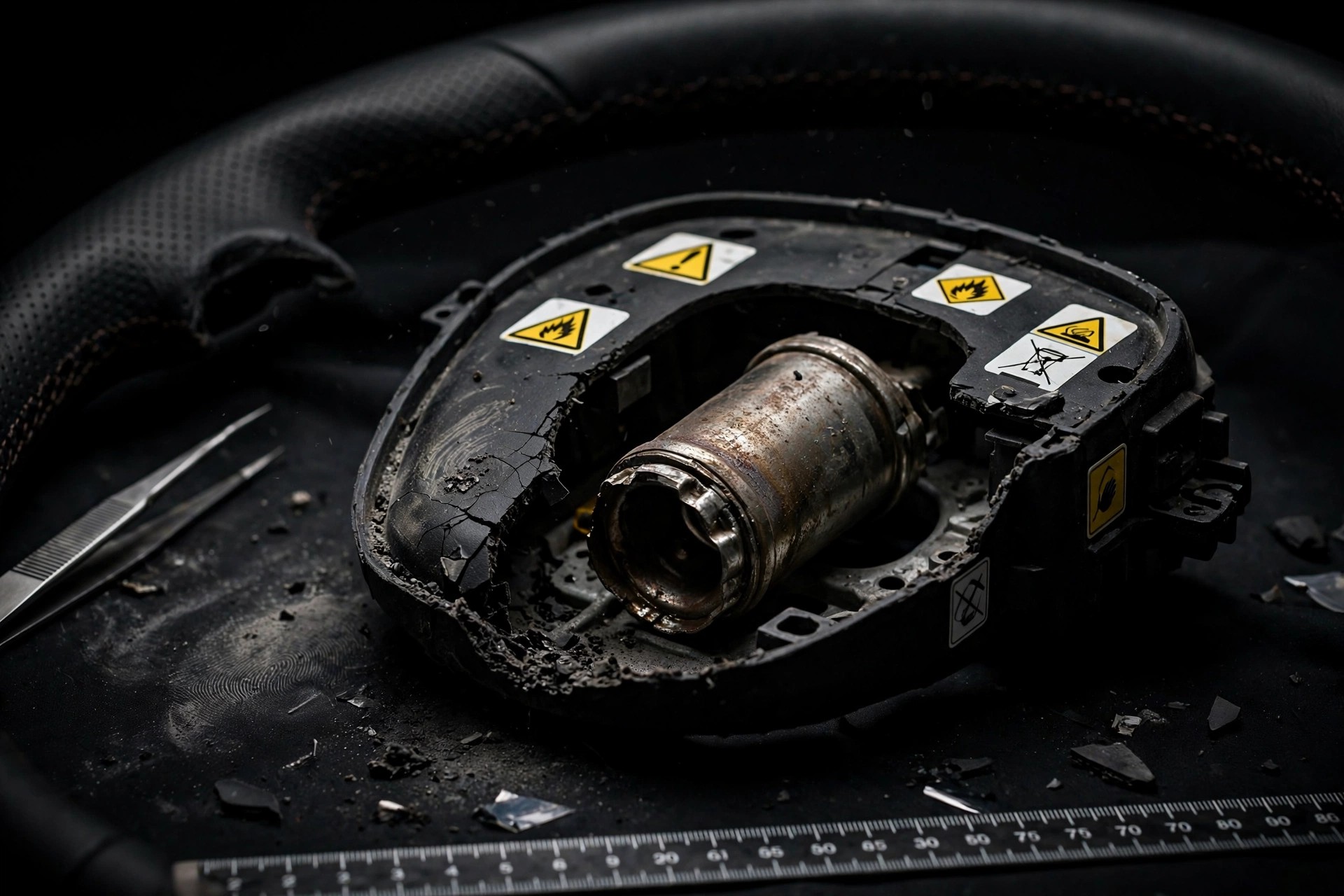
Before you sign for that used Malibu with the clean Carfax and the rebuilt title footnote, you might want to ask who replaced the airbag. Ten people died because a $30 replacement inflator turned a survivable crash into a shrapnel event, and NHTSA just issued its first forced recall order in 20 years to stop it[1].
The inflators came from Jilin Province Detiannuo Safety Technology Co., a Chinese manufacturer whose products were marked DTN60DB and likely smuggled into the United States by unknown importers. NHTSA says at least 10 of the 12 ruptures involved vehicles that had their original airbags replaced after a prior crash, the kind of repair that happens daily in salvage rebuild shops where a $300 OEM module competes with a $30 eBay special[2].
Instead of inflating the cushion, the DTN inflator explodes. Metal fragments fire into the driver compartment at head height, striking chests, necks, eyes and faces. NHTSA's language is clinical but the physics are not: drivers were killed in otherwise survivable crashes, the exact scenario an airbag exists to prevent[1]. All known incidents involved 2017-2022 Chevrolet Malibus and 2017-2019 Hyundai Sonatas, two of the most common rebuilt-title sedans in America, but the agency says it has no information indicating the problem is limited to those models[1].
Here is where the recall system collapses. Of 997 vehicle and equipment recalls in 2025, 88% were voluntary with no NHTSA involvement and 12% followed an investigation but remained voluntary. Zero were ordered[3]. This DTN action, finalized April 29, 2026, is the first ordered recall in two decades, and NHTSA openly admits a traditional recall is unlikely because no list of affected vehicles exists and the agency cannot estimate how many inflators remain in circulation[3].
It is not an isolated failure of the fix. GM's L87 6.2-liter V8 recall in April 2025 covered 597,630 trucks and SUVs for connecting rod and crankshaft defects. The remedy was an oil viscosity change or full engine replacement. NHTSA has since received 499 complaints of post-remedy engine failure, plus 191 failures in engines built after the recall window, while GM itself reported 6,953 post-remedy failures to the agency. On August 21, NHTSA expanded its probe to 2025-2026 model years, ballooning potential impact to 997,743 vehicles, 67% more than GM recalled, without GM expanding its recall[4]. Separately, Mazda's 2024 CX-90 Recall 24V022 is under Recall Query RQ26002 after 26 reports of sudden increased steering effort immediately after the remedy was applied[5].
What This Means for You
Three different components, three different manufacturers, one pattern: the replacement or the fix becomes the new hazard. For DTN inflators, you cannot check your VIN at nhtsa.gov/recalls and get an answer. The inflators will not appear because there is no VIN list. You have to inspect the physical part.
If you bought a used 2017-2022 Malibu or 2017-2019 Sonata, especially with salvage or rebuilt title, demand the airbag module be inspected for DTN60DB marking on the inflator cap and barcode 144415654 666631 or 666633 on the connector side. That label remains visible when installed, but you need a dealer to remove the module to see it[1]. If you had an airbag replaced after any crash, demand OEM documentation with manufacturer and part number. If the shop cannot produce it, assume aftermarket and request OEM replacement. A $270 savings is not worth an 83% fatality rate when the part fails.
For GM L87 owners - Silverado 1500, Tahoe, Suburban, Sierra 1500, Yukon, Yukon XL, Escalade and Escalade ESV, 2021-2026 - if you received the viscosity change, monitor for loss of motive power. NHTSA's 499 post-remedy complaints include 473 viscosity-change vehicles and 26 full engine replacements. The 10-year, 150,000-mile special coverage applies even if you passed inspection[4].
For 2024 CX-90 owners who had Recall 24V022 performed: any momentary increase in steering effort while driving should be reported immediately to safercar.gov. That investigation is active and your report becomes primary data[5].
The uncomfortable truth NHTSA will not state plainly: its $665 million in traffic safety grants funds enforcement, child seat clinics, and post-crash care, but zero dollars for tracking aftermarket airbag parts because the system assumes manufacturers control the supply chain. When the supply chain is a body shop ordering from an importer who may have committed a federal crime by importing the part, that assumption fails, and you are the crash test dummy for a $30 counterfeit.
Sources & References
- NHTSA, Initial Decision That Certain Frontal Driver Air Bag Inflators Manufactured by DTN Contain a Safety Defect, Docket NHTSA-2026-0793, April 2, 2026. 12 ruptures, 10 deaths, 2 severe injuries, DTN60DB marking, illegally imported, at least 10 aftermarket replacements after prior crash. nhtsa.gov
- NHTSA, NHTSA to Ban Defective Air Bag Inflators, Press Release Final Decision, April 29, 2026. Banning sale/import, quotes from Secretary Sean P. Duffy and Administrator Jonathan Morrison, first ordered recall in 20 years, metal fragments in chests/necks/eyes/faces. nhtsa.gov
- Sidley Austin LLP, NHTSA Issues the First Defect Recall Order in Decades, Environmental Health and Safety Brief, May 11, 2026. 997 recalls in 2025, 88% uninfluenced, 12% influenced, 0 ordered; 6-month EA to final, 15-day comment, skipped PE, traditional recall unlikely. sidley.com
- Detroit Free Press / NHTSA, NHTSA expands GM engine recall probe to include more model years, Aug 21, 2026. L87 6.2L V8: 877,710 initial, 597,630 recalled (721k global), 499 post-remedy NHTSA complaints (473 oil, 26 engine), 191 post-production failures, GM reports 6,953, expanded to 997,743. freep.com
- NHTSA, Recall Query RQ26002, Feb 6, 2026. 2024 Mazda CX-90, Recall 24V022 remedy causes 26 reports of momentary increase in steering effort, KJK8-32-110 steering gear. nhtsa.gov
- NHTSA, Fatality Analysis Reporting System (FARS) 2014–2023, via fars_output.js. Chevrolet Malibu 3,465 deaths rate 2.03 fleet 1,487,500; Hyundai Sonata 1,887 deaths rate 1.56 fleet 1,050,000; contextualizing exposure for high-volume used vehicles frequently rebuilt. nhtsa.gov
- IIHS, Fatality Statistics: Driver Death Rates by Make and Model, methodology for fleet estimation and salvage prevalence in high-volume sedans. iihs.org