America Didn’t Get Safer. Its Cars Just Got Harder to Die In.
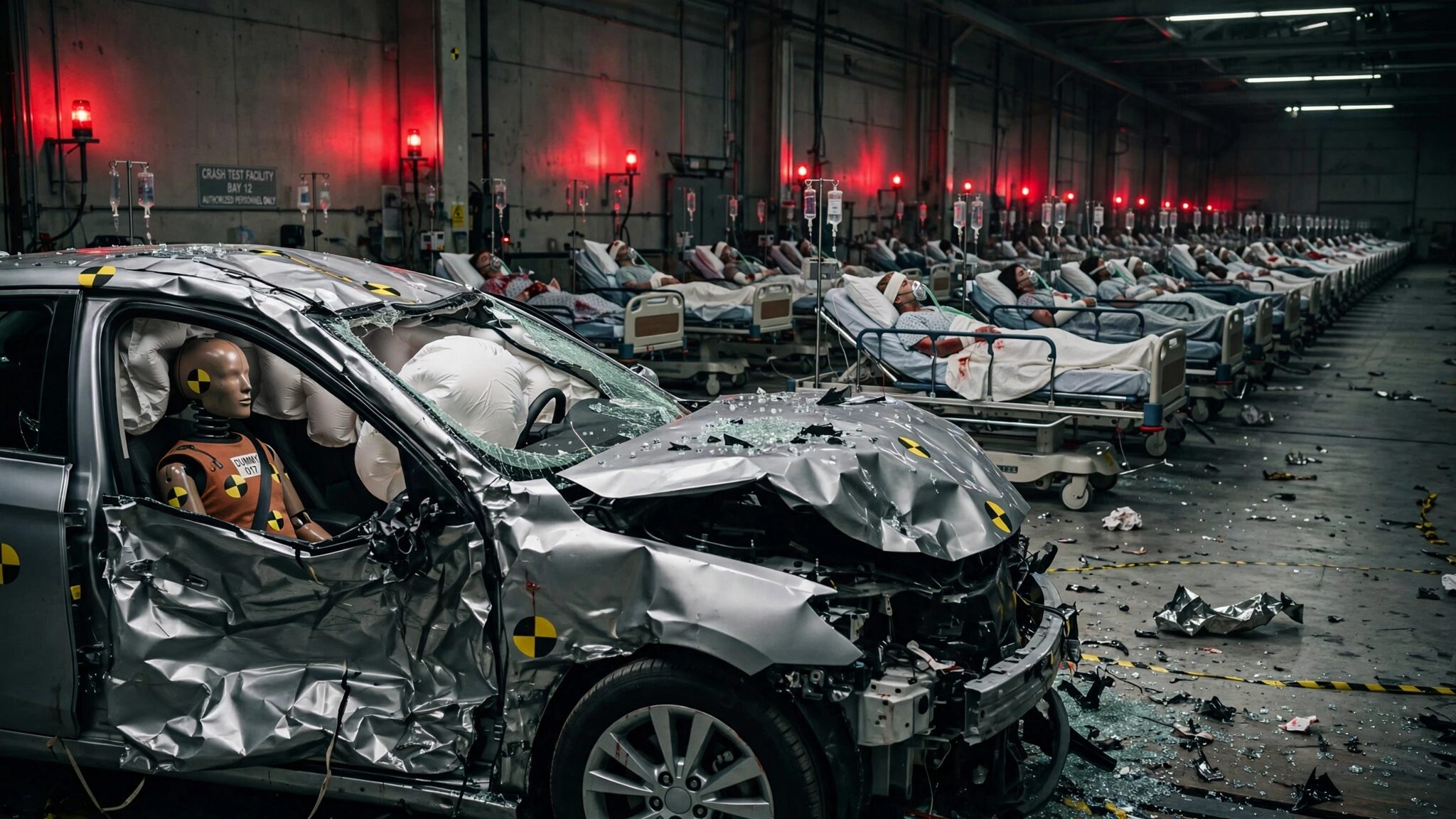
Two numbers landed on the same desk at NHTSA on April 1, and nobody seems to have noticed they contradict each other. First: 39,254 people died in motor vehicle crashes in 2024, a 4% decline from 2023 and the lowest count since before COVID.[1] Second: 2.42 million people were injured, a number that, per Advocates for Highway and Auto Safety, “decreased only slightly after increasing in 2023.”[2]
Deaths plummeted. Injuries shrugged. If Americans were crashing less often, both lines would move together, the way they did through the 1990s and 2000s when seat belt laws and drunk-driving crackdowns attacked the crash itself. But they’re not moving together anymore, and the divergence has been widening for three years now, through nine consecutive quarters of declining fatalities while injury totals hover stubbornly near the 2.4 million mark,[4] which tells us something the press releases don’t want to say out loud: the crash didn’t get rarer, it got less lethal, and that is a fundamentally different kind of progress with a fundamentally different expiration date.
Fleet turnover is the mechanism: FARS data shows 78% of all fatal-crash deaths involve vehicles model-year 2013 or older, cars built before side-curtain airbags, electronic stability control, and automatic emergency braking reached mass adoption.[3] Every year, a few million of those vehicles age out and get replaced by something with a high-strength steel passenger cell and six more airbags, and the death rate drops, but the injury rate doesn’t, because the crash still happened, and you still rear-ended someone while checking your phone. Your car just kept you alive through it.
Here is the strongest counterargument, and it is also the simplest: who cares why? If 1,647 fewer people died in 2024 because of better crumple zones instead of better driving, those 1,647 people are still alive. Engineering out fatalities is exactly how aviation safety works. You do not fix human error; you build a system where human error is survivable. Fair enough. But aviation didn’t declare victory after improving crash survivability and leave the root causes untouched, and vehicle crashworthiness has diminishing returns; once side-curtain airbags and AEB are standard on everything, the curve flattens, and you are left with 2.4 million injuries per year and no structural reason for that number to improve.
Early estimates for 2025 project 36,640 deaths, another 6.7% drop.[2] Expect applause, and expect nobody to mention the injury number. If you drive a pre-2014 vehicle, you predate this entire armor upgrade. Check whether yours has AEB and ESC at safercar.gov. If you are buying used, understand that a 2019 is not five years older than a 2024; in crash-survivability terms, it is a different species from a 2012, because every model year matters and the car learned something the driver didn’t.
Sources & References
- NHTSA, 2024 Annual Report File (ARF): Fatality Analysis Reporting System, released April 1, 2026. cdan.dot.gov
- Advocates for Highway and Auto Safety, Statement on 2024 Final and 2025 Early Estimates, April 1, 2026. saferoads.org
- NHTSA FARS 2016–2022, model-year cross-tabulation by The Crash Report. Methodology: deaths aggregated by struck-vehicle model year across all makes and models in fatal crashes. Vehicles MY ≤ 2013 account for 78.3% of the 179,911 total deaths in the dataset. nhtsa.gov/fars
- NHTSA, Early Estimates of Motor Vehicle Traffic Fatalities, First Half 2024, September 2024. Reports 18,720 deaths (H1 2024), fatality rate 1.17/100M VMT, ninth consecutive quarterly decline. crashstats.nhtsa.dot.gov