25% of Driving Happens at Night. 50% of the Dying Does Too.
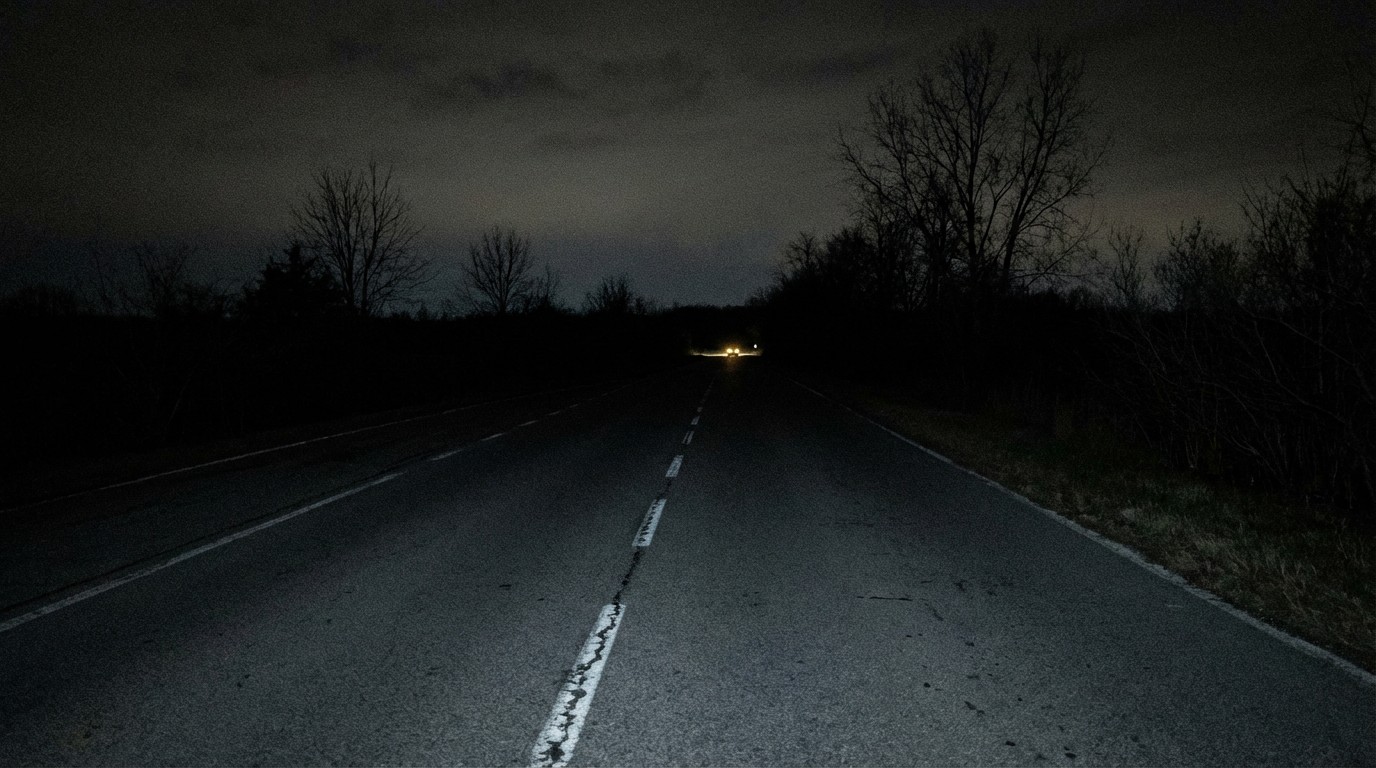
Drive I-80 west out of Reno at 11 PM. The casino lights shrink in your mirror. Within ten miles, the road is a black ribbon. No overhead lighting. No edge reflectors worth mentioning. Your headlights carve out maybe 400 feet of asphalt. Everything beyond that is a guess.
Now check the math: a quarter of all miles driven in this country happen after dark. Half of all driver fatalities happen after dark. And 76% of pedestrians killed on American roads die in conditions the National Safety Council classifies as "dark."
That gap between 25% and 50% has a body count north of 20,000 people per year.
The Cochrane Number Nobody Uses
In 2009, researchers Beyer and Ker published a Cochrane systematic review examining whether street lighting actually reduces crashes. Cochrane reviews are the gold standard of medical and public health evidence: pooled data across multiple controlled studies, rigorously filtered for methodological quality. This one looked at 17 controlled before-and-after studies spanning decades of data.
Their finding: street lighting reduced fatal crashes by 66%.
Risk ratio: 0.34, with a 95% confidence interval of 0.17 to 0.68. For total crashes (not just fatal), the reduction ranged from 32% to 55% depending on area controls. Injury crashes dropped 22-32%. (Beyer & Ker, 2009, DOI: 10.1002/14651858.CD004728.pub2)
A 66% reduction in fatal crashes. From installing lights.
FHWA's Crash Modification Factor Clearinghouse independently confirms a 20-28% reduction in total nighttime crashes from adding lighting, a more conservative number but directionally identical. Lights work. Evidence is as close to settled as traffic safety research gets.
So Why Is Most of America Still Dark?
America has 4.19 million miles of public roads. Most rural roads, which carry 19% of vehicle miles traveled but account for 43% of fatalities, have no overhead lighting at all. Drive any two-lane state route through the Central Valley, the Appalachian foothills, the Texas Panhandle, or rural Minnesota. The lighting infrastructure is headlights and hope.
Seventy percent of rural fatal crashes occur in dark conditions, per FARS data. That number should be shocking. It isn't, because nobody talks about lighting as a safety intervention the way they talk about speed limits or seatbelts or drunk driving enforcement.
And the cost argument is real. Lighting every mile of every rural road is genuinely expensive. LED street lights run $150-300 per unit, installation adds $1,500 per fixture, and standard spacing calls for roughly 53 lights per mile. That's $54,000 to $80,000 per mile just for installation. For 4.19 million miles, you'd need a budget that makes infrastructure bills look modest.
But nobody is proposing lighting every mile. FHWA guidelines identify high-fatality corridors, isolated intersections, and curve segments as priority targets. These targeted installations cost a fraction of full-corridor lighting and capture an outsized share of the fatal crash reduction.
Twenty Thousand Deaths and a Cost-Benefit Problem That Isn't Close
Run the numbers that DOT itself publishes. A Value of Statistical Life of $13.2 million per fatality as of 2023.
Over 20,000 people die annually in dark-condition crashes. If targeted lighting could prevent even a quarter of those, 5,000 lives, that represents $66 billion in prevented losses per year. America's entire street lighting inventory costs $10-15 billion annually to operate. The payback period for new installations on high-fatality corridors is measured in months, not years.
Compare that math to virtually any other traffic safety intervention on the federal agenda. Retroreflective pavement markings. Rumble strips. Cable median barriers. All good. None of them have a Cochrane review showing a 66% reduction in fatal crashes.
The Three Multipliers
Nighttime driving doesn't just add risk. It multiplies it. Three independent factors compound every time someone drives after dark:
Visibility deficit. Human scotopic vision operates at roughly 5% the acuity of daytime photopic vision. Standard low-beam headlights illuminate 250-500 feet of road. At 65 mph, your stopping distance exceeds your sight distance. You are literally outdriving your headlights on every highway in America every night.
Behavioral overlay. Fatigue, alcohol impairment, and drug impairment cluster heavily after dark. Seventy-five percent of drunk driving fatalities occur at night. But here's what makes the lighting data important: even after controlling for alcohol involvement, the fatality rate per mile driven is three times higher at night than during the day. NHTSA's own data confirms this. Alcohol is part of the nighttime problem, not all of it.
Infrastructure absence. Roads provide less information after dark. Edge markings fade. Signage reflectivity degrades with age and grime. Curve geometry that's readable at 40 mph in daylight becomes an ambush at night. When lighting is simply absent, not degraded, not dim, just gone, the driver navigates on memory and headlight range alone.
These three factors multiply. A fatigued driver on a well-lit urban boulevard might drift slightly. That same driver on an unlit rural two-lane with worn edge markings and a drainage culvert at the shoulder doesn't drift; they depart the roadway. The Cochrane data captures the net effect of breaking even one of those three multipliers.
The Pedestrian Catastrophe
If the driver numbers are bad, the pedestrian numbers are devastating.
NSC reports that 76% of pedestrian fatalities in 2022 occurred in dark conditions. Pedestrians do not carry headlights. They are entirely dependent on the visibility the road provides. On an unlit arterial with a 45 mph speed limit, a pedestrian wearing dark clothing is functionally invisible at any meaningful reaction distance.
AAAM's 2021 position statement on nighttime driving explicitly calls out the lighting deficit as a primary contributor to pedestrian deaths. Not driver behavior. Not pedestrian behavior. Infrastructure.
And the pedestrian fatality surge of the past decade has been driven overwhelmingly by SUV front-end geometry and rising speed limits. But it's happening disproportionately at night, on roads without adequate lighting, in exactly the conditions where a $300 LED fixture could make a person visible at 500 feet instead of 50.
The Counterarguments, Addressed
"Alcohol is the real night driving problem." Partially true. But the 3x fatality rate per mile at night holds even after removing alcohol-involved crashes from the dataset. Lighting addresses the visibility multiplier independent of impairment.
"Light pollution is an environmental concern." Modern LED fixtures with full-cutoff shielding direct light downward, not outward or upward. This objection conflated 1980s cobra-head sodium lights with current technology.
"Drivers compensate by speeding on lit roads." Risk compensation theory. But the Cochrane meta-analysis accounts for this: the net effect after any behavioral adaptation is still a 66% reduction in fatal crashes. Whatever speed increase lighting induces, it's overwhelmed by the visibility benefit.
"We can't afford to light every road." Nobody said every road. Targeted lighting at high-fatality intersections, curves, and corridors captures most of the benefit at a fraction of the cost. FHWA already publishes the priority list. States just don't fund it.
A Policy Choice, Not a Force of Nature
Twenty thousand deaths per year in dark conditions is not weather. It's not fate. It's the predictable outcome of a decision, made at the state and federal level year after year, to not fund roadway lighting at the scale the evidence demands.
A Cochrane systematic review. A cost-benefit ratio of 4:1 at minimum. A commodity LED fixture that costs less than a set of tires. And the deaths keep happening because funding for roadway lighting in America is fragmented across 50 state DOTs, 3,000+ counties, and 19,000+ municipalities, none of whom see the full picture.
A quarter of the driving. Half the dying. And a proven intervention sitting on the shelf.
Methodology note: Fatality data from NHTSA's Fatality Analysis Reporting System (FARS), 2022 final file. VMT data from FHWA Highway Statistics 2022. Lighting effectiveness from Beyer & Ker Cochrane systematic review (2009, 17 studies). CMF data from FHWA Crash Modification Factor Clearinghouse. Pedestrian data from NSC Injury Facts 2022. Cost estimates from FHWA Roadway Lighting Handbook (2023). All figures represent reported data with inherent limitations: FARS captures only fatal crashes, VMT estimates have margin of error, and the Cochrane review drew primarily from European and Australian studies whose transferability to U.S. road geometry is assumed but not guaranteed.