Your Car's AEB Sees Pedestrians. Cyclists Are Invisible.
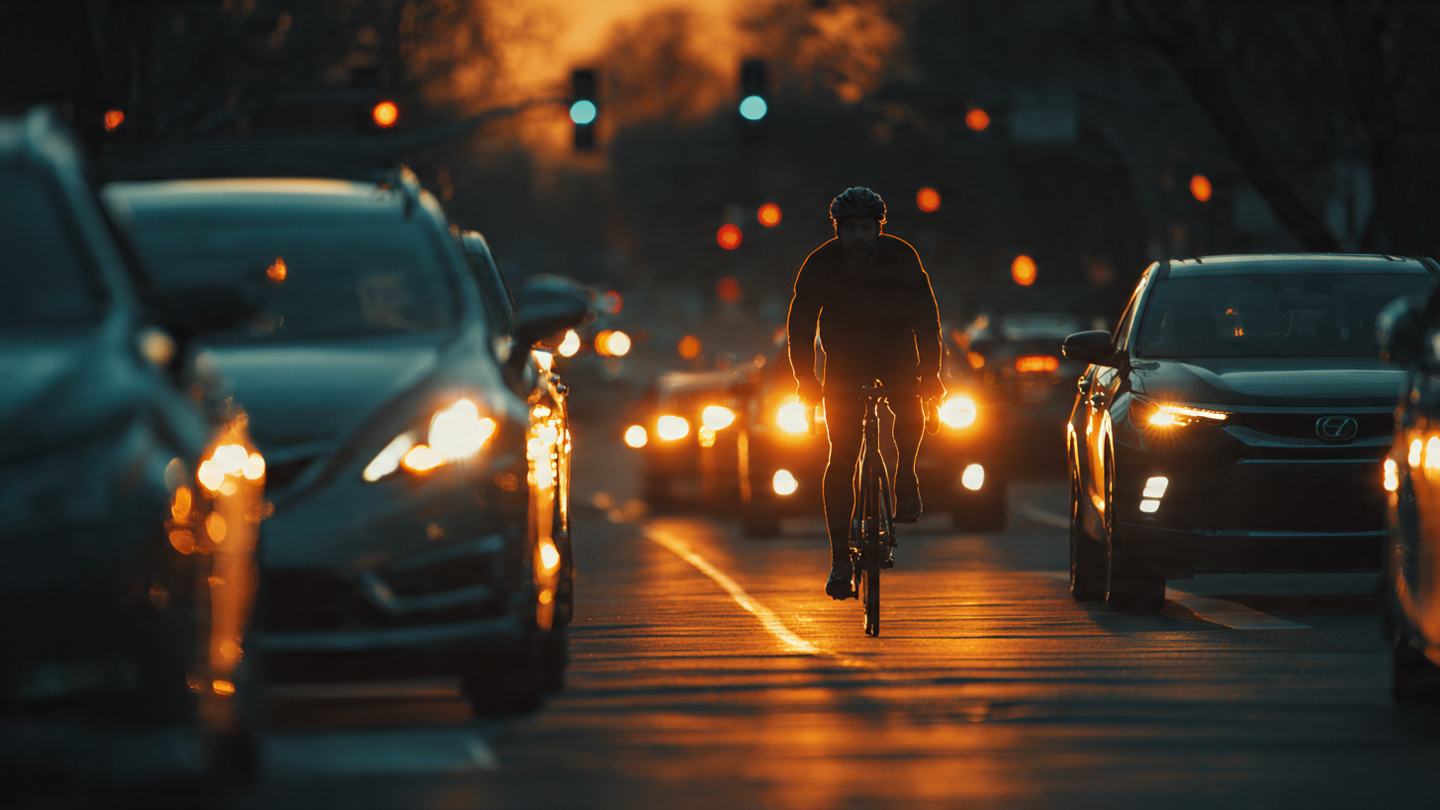
When NHTSA finalized FMVSS 127 in April 2024, it mandated that every new vehicle sold in America must have automatic emergency braking capable of detecting and stopping for pedestrians by September 2029.[1] Buried in the regulatory text was a deliberate exclusion: cyclists were left out, not because the technology doesn't exist, not because automakers objected, but because NHTSA decided a moving person on two legs warranted protection and a moving person on two wheels did not.
The engineering case against this exclusion is nonexistent. Two independent Swedish studies found that cyclist AEB reduces real-world crash risk by roughly 20%.[3] IIHS measured a 29% reduction in parallel-path crashes specifically, the geometry that kills cyclists most often: car and bike traveling the same direction, rider struck from behind or beside because the driver never looked.[4] Of the 159,474 police-reported car-cyclist crashes IIHS analyzed, 28,600 annually fell within the addressable envelope of current AEB sensor capability.[4]
Six hundred of those are fatal.
The cost question is almost insulting given the numbers involved. For vehicles that already carry pedestrian AEB hardware (cameras, radar, processor), adding cyclist detection is a software calibration update. NHTSA's own cost estimate for the base AEB system was $82.15 per vehicle.[1] Industry estimates for the cyclist software layer range from $23 to $30.[5] At $30 across 17 million new vehicles sold annually, the total fleet cost is $510 million. The DOT's Value of Statistical Life is $11.6 million.[6] Preventing even 45 cyclist deaths per year would break even. The data says the technology prevents roughly 120.
Europe Did This Already
The EU General Safety Regulation 2 mandated cyclist AEB on all new vehicles sold in Europe by July 2026.[7] That regulation passed in 2019, giving automakers seven years of lead time, and every major automaker selling in Europe already builds the system for those vehicles. GM offers cyclist AEB on approximately 20 U.S. models right now, though not on its highest-volume trucks or entry-level vehicles where the feature would prevent the most deaths.[5] Tesla's Model Y passed every new NHTSA ADAS evaluation, including pedestrian scenarios.[5] The hardware is in production, the software is written and shipping, and the only thing missing is the three letters on page 47 of FMVSS 127 that would make it mandatory.
The Body Count of Delay
FMVSS 127 compliance begins September 2029, and the EU mandate took effect July 2026, leaving a minimum three-year gap. At 600 addressable fatal cyclist crashes per year, simple multiplication produces 1,800 deaths during the period when the technology exists, works, costs less than a tank of gas per vehicle, and is not required.
Congress noticed. HR 7353, the Magnus White and Safe Streets for Everyone Act, would extend FMVSS 127 to cover cyclists, motorcyclists, and wheelchair users by the same September 2029 deadline.[8] Named for a 17-year-old cyclist training for Team USA who was struck and killed by a driver who never saw him. Passed the House Energy and Commerce Subcommittee by voice vote in February 2026. Currently sitting in committee, accumulating dust at approximately the same rate that FARS accumulates cyclist fatalities.
What This Doesn't Prove
The 20-29% crash reduction figures come from Swedish data, where cycling infrastructure, helmet laws, road geometry, and driver behavior all differ meaningfully from U.S. conditions. American cycling happens disproportionately on roads without protected lanes, at higher traffic speeds, alongside larger vehicles. The real-world effectiveness of cyclist AEB in American conditions could be materially lower than Swedish studies suggest.
Current systems also struggle in darkness, which is precisely when cyclist fatalities cluster. Over 70% of pedestrian deaths occur at night, and cyclist crash patterns are similar.[2] A mandate could create false confidence in a system that works well at noon and poorly at midnight. That is a legitimate engineering concern worth addressing in the rulemaking.
It is not a reason to skip the rulemaking entirely.
The strongest counterargument: NHTSA might be playing regulatory chess rather than ignoring cyclists. Finalizing pedestrian AEB first establishes the legal framework, the testing protocols, and the compliance infrastructure, and a cyclist AEB rule built on top of FMVSS 127 would move faster than one written from scratch. The delay might be strategy rather than indifference, and that argument deserves to stand at full height even if NHTSA has not publicly made it and even if 600 cyclists per year cannot wait for optimal regulatory sequencing.
What To Do
If you ride a bicycle on American roads, your federal government has not required the cars around you to see you, and that changes with purchase decisions. Check whether your next vehicle includes cyclist AEB: GM's Ultifi-platform models, Volvo's full lineup, and most Subarus include it standard. Stellantis brands (Ram, Dodge, Chrysler, Jeep) mostly do not.
If you vote, HR 7353 has a bill number and a committee, so contact your House representative. The subcommittee vote was unanimous, which means nobody is politically opposed to this; they just haven't been asked to care yet.
Sources & References
- NHTSA, Federal Motor Vehicle Safety Standard No. 127: Automatic Emergency Braking, Final Rule, April 2024. nhtsa.gov
- NHTSA, Fatality Analysis Reporting System (FARS), cyclist fatality data 2010–2023. nhtsa.gov
- Rizzi, M., et al., “Effectiveness of cyclist-AEB in reducing car-to-cyclist crashes,” real-world analysis, Sweden, 2023 & 2025 studies.
- IIHS, Cyclist AEB Effectiveness Analysis, parallel-path crash reduction data, 159,474 police-reported crashes. iihs.org
- HR 7353 fact sheet and automaker cyclist AEB deployment data, legislative brief, 2026.
- U.S. Department of Transportation, Departmental Guidance on Treatment of the Value of a Statistical Life. transportation.gov
- European Commission, General Safety Regulation (EU) 2019/2144, cyclist AEB requirements effective July 2026. eur-lex.europa.eu
- U.S. Congress, HR 7353: Magnus White and Safe Streets for Everyone Act of 2026, passed House E&C Subcommittee by voice vote, February 10, 2026.