The Cadillac CT5 Got Five Stars and Four ‘Poors.’ Both Are Correct.
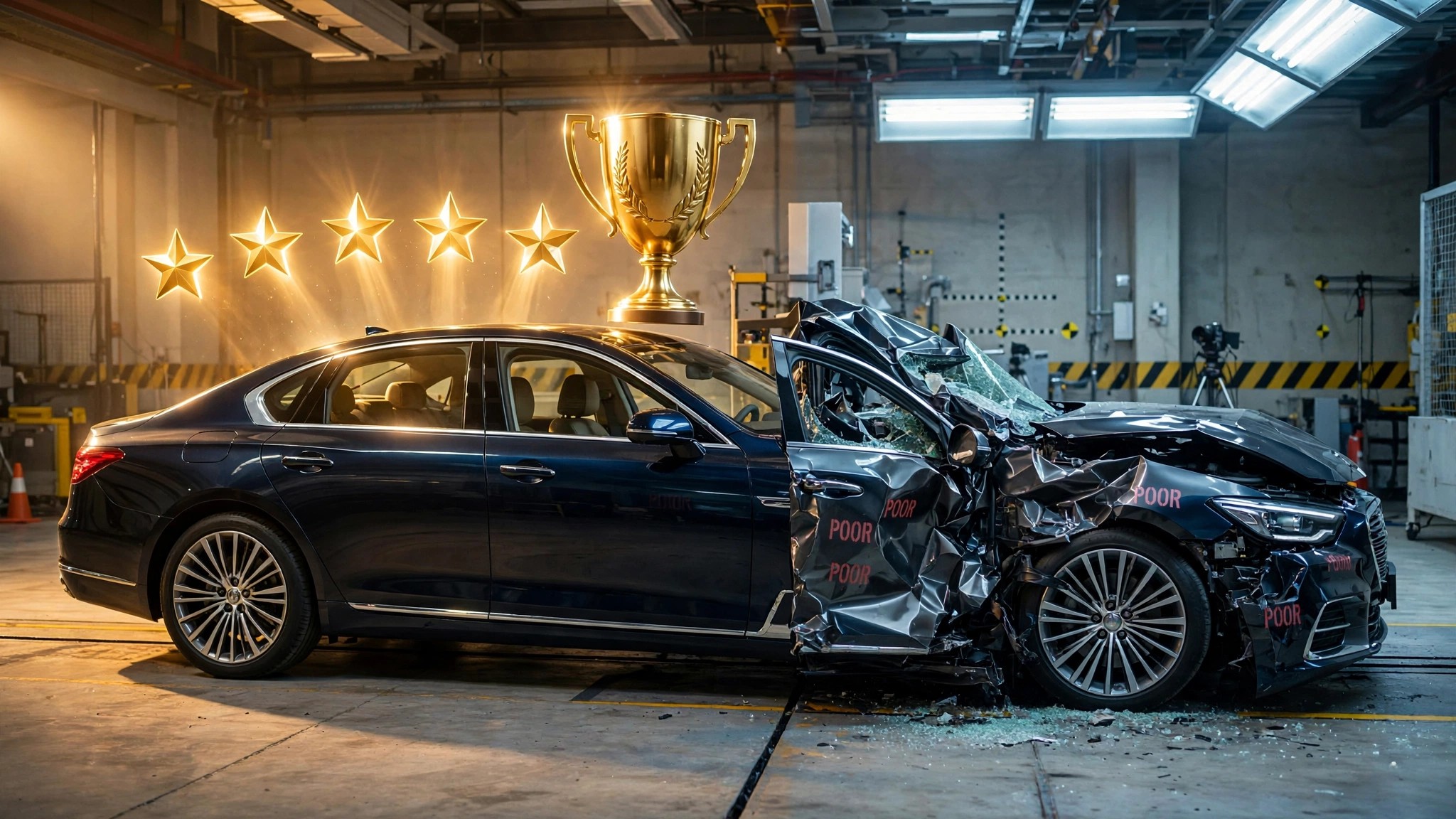
A $46,000 luxury sedan walks into two crash labs, and the results split like a personality disorder. One hands it a trophy; its neighbor hands it a body bag. GM's 2026 Cadillac CT5 holds NHTSA's 5-star overall safety rating and IIHS "poor" marks in four separate test categories, making it simultaneously the safest and least safe car in its class depending on which website you check first.
IIHS tested the CT5 last week and the results read like a vehicle that wandered in from 2008: poor in moderate overlap front, poor in side impact, poor in headlights, poor in front crash prevention. During the side test, the B-pillar crushed into the passenger compartment and the curtain airbag failed to stop the dummy's head from slamming into the windowsill. Jessica Jermakian, IIHS senior VP for vehicle research, was unusually direct: "It seems the crashworthiness and crash avoidance results weren't important for GM when they were redesigning the Cadillac CT5."[1]
GM's response deserves to be framed and hung in a corporate communications textbook. Spokesman Kevin Kelly said the company is "confident in the safety of the 2026 Cadillac CT5 that achieved a 5-Star rating in NHTSA's New Car Assessment Program" and characterized the IIHS results as "consumer metric ratings."[1] Read that again, because the word choice is surgical. GM's government rating is a "5-Star rating," dripping with authority and capital letters. Its insurance-industry rating is a "consumer metric," a phrase engineered to sound optional. Same car, same physics, same human bodies at risk, but GM gets to pick which grade goes on the refrigerator.
They can do this because the two systems measure fundamentally different things. NHTSA scores are relative: they rank vehicles against others in the same class within a 250-pound weight band, and 98% of new cars land at four or five stars.[2] It is a grading curve where almost everyone passes. IIHS scores against absolute thresholds using more demanding protocols, including a side-impact test that slams a 4,200-pound barrier into the vehicle at 37 mph to simulate what actually happens when a modern SUV T-bones a sedan on a suburban intersection.[3] NHTSA's own website concedes the point in fine print most buyers will never read: "A vehicle can have a high star rating, but still have a safety concern."[4]
That "redesign" triggering the new IIHS evaluation was a 2025 styling refresh: updated headlights, revised interior trim, the usual mid-cycle cosmetic surgery with zero structural changes underneath. GM gave the CT5 a facelift without touching the bones, then sent it off to crash testing as though good looks would absorb the impact. Nine vehicles were tested in this IIHS round, and four earned Top Safety Pick+. Out of the entire batch, only the CT5 scored "poor" in multiple crashworthiness categories, beating out the $26,000 Nissan Kicks, the Toyota Tacoma crew cab, and the Audi A3 for the dubious distinction of worst-in-class from a luxury brand that charges a premium for the badge.[1]
FARS data doesn't yet have enough CT5-specific fatalities to calculate a reliable death rate (the nameplate launched in 2020), but Cadillac sedans as a class carry a checkered history that makes the IIHS results sting harder. Its predecessor, the CTS, logged 265 deaths and a fatality rate of 1.32 per 100 million vehicle miles traveled across FARS reporting years, running 52% higher than the Lexus IS at 0.87 and trailing only the BMW 3 Series among luxury midsize sedans.[5] Luxury badge, middling survival odds, and now a crash test scorecard that reads like a warning label.
In the CT5's defense, the two rating systems genuinely ask different questions at different difficulty levels, and that distinction matters. NHTSA wants to know whether the vehicle is safer than average among its peers; IIHS wants to know whether it meets a fixed engineering standard. Both can be technically correct because neither is lying about its own methodology. But "both are technically correct" is cold comfort to the buyer who checked one rating and not the other before signing a lease on a sedan whose side structure folds like origami when hit by something the size of a Toyota Highlander, which is to say the most common vehicle on American roads. That buyer doesn't care about methodology disputes between two agencies that can't agree on how hard to hit a car.
If you're shopping for a midsize luxury sedan, check both ratings. Specifically, check the IIHS side-impact result, which uses a barrier weight that reflects the vehicles most likely to hit you. The Audi A6, BMW X1, and Mazda CX-5 all earned Top Safety Pick+ in the same round the CT5 failed. If you already own a CT5, your vehicle is not inherently unsafe, but know that it was tested against a standard GM chose not to design for, and GM's official position is that the standard doesn't count.
Sources & References
- Charniga, J., “New Cadillac CT5 gets ‘poor’ marks on safety tests from IIHS,” Detroit Free Press, Jul. 9, 2026. freep.com
- Center for Auto Safety, “It is time to stop giving NHTSA five stars for doing nothing,” 2023. autosafety.org
- IIHS, “Few midsize cars excel in updated side crash test,” 2022. iihs.org
- NHTSA, 5-Star Safety Ratings Methodology. nhtsa.gov
- NHTSA, Fatality Analysis Reporting System (FARS), 2014–2023. nhtsa.gov