The Crosstrek’s Battery Pack Just Outperformed Its Engineers
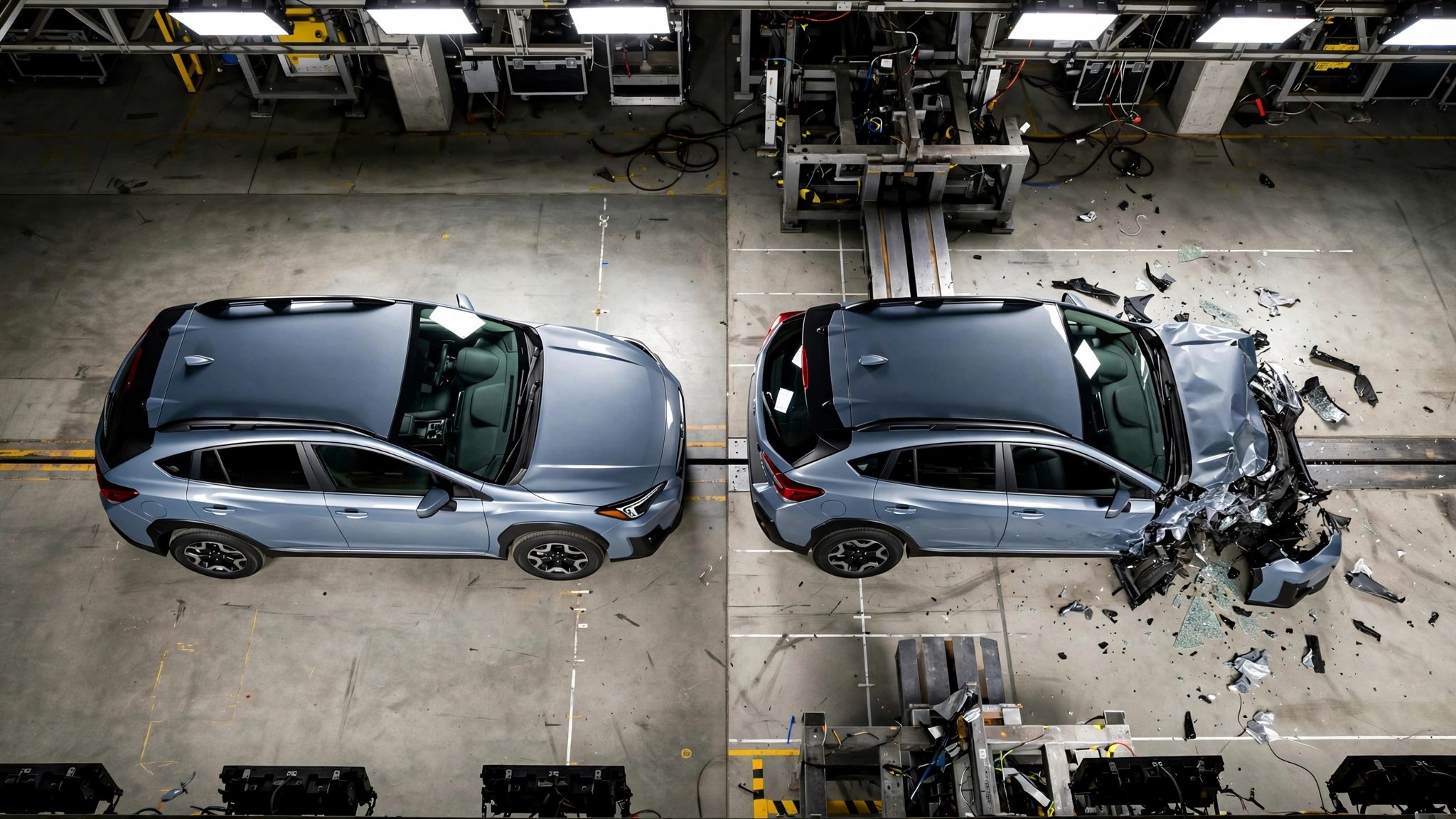
Subaru builds two Crosstreks on the same line in the same factory. One runs on gasoline. Its twin carries a series-parallel hybrid drivetrain and a battery bolted to the floor. IIHS crashed both into the same 40-mph moderate overlap barrier this month. Gas version: "marginal." Hybrid: "good."[1]
That gap matters because of what happened to the dummy in row two. In the gas Crosstrek, the rear-seat occupant submarined. A lap belt that should have stayed across the pelvis slid upward into the abdomen, where soft tissue meets crash forces and loses. Forward head travel closed the gap to the front seatback.[2] A 12-year-old or a small adult in that seat at 40 mph would face elevated risk of serious internal injuries.
In the hybrid, the shoulder belt stayed centered on the chest while the lap belt anchored across the pelvis, head excursion within limits, low risk of neck injury, managed chest compression — every restraint worked the way restraint systems are supposed to work.
IIHS doesn't test the two together by accident. They rate the Crosstrek Hybrid separately from the gas Crosstrek because, and this is the critical detail, "the structures and restraints differ."[1] A battery pack mounted under the floor changes load paths and stiffens the lower body, and in a frontal overlap crash, those structural differences determine whether the rear passenger's belt geometry holds or collapses.
Subaru didn't engineer the hybrid to ace a crash test — they engineered it to carry a battery, and crash protection was a side effect.
This isn't a one-off: an IIHS study comparing electric and hybrid versions of nine models against their ICE equivalents found that driver and passenger injury claims were more than 40 percent lower for the electrified versions, corrected for miles driven.[3] Across more than 40 crash-tested EVs and hybrids, IIHS and the Australian NCAP recorded nearly 100 percent "good" ratings in the moderate overlap test. Conventional vehicles don't come close.[4]
Which brings us to the longest-running natural experiment in hybrid crash safety: the Toyota Prius. FARS data from 2014 through 2023 records a fatality rate of 0.55 per 100 million vehicle miles traveled for the Prius. Compare that to the Corolla at 1.85, the Camry at 2.03, the Civic at 2.25, and the Accord at 3.07.[5] Not a little safer. One-third to one-fifth the death rate of sedans in the same size and price class.
Some of that is the driver: Prius owners show a 16.0 percent impairment rate in FARS fatal crashes, well below the sedan average, and they're older, more cautious, less likely to be doing 95 in the left lane after four beers. Demographics absolutely explain part of the gap, maybe most of it. But the IIHS study controlled for that variable by comparing hybrid and ICE versions of the same nine models, and the hybrids still posted 40 percent fewer injury claims.[3] Structure matters, even after you subtract the driver.
Subaru's crash test is the closest the industry has come to isolating the variable: same badge, same showroom, same marketing demographic, but a different floor and a different crash outcome.
If you're shopping for a compact SUV and a hybrid version exists, the IIHS results suggest you're buying more than fuel economy. A 2026 Crosstrek Hybrid starts at $33,995, about $1,700 more than the gas model, and that premium buys a different crash structure. Check IIHS ratings for the specific powertrain, not just the model name — they test them separately for a reason.
Sources & References
- IIHS, “Four more models take home Top Safety Pick+ awards in latest IIHS ratings,” July 9, 2026. iihs.org
- AutoEvolution, “2026 Subaru Crosstrek Hybrid Deemed Safer Than Combustion-Only Sibling by the IIHS,” July 17, 2026. autoevolution.com
- IIHS, “Electric vehicles continue to show injury claim advantages over conventional ones,” Highway Loss Data Institute. iihs.org
- Doyle, M., Stockman, I., “Crashworthiness testing of electric and hybrid vehicles,” IIHS / ANCAP, 2021. iihs.org
- NHTSA, Fatality Analysis Reporting System (FARS), 2014–2023. nhtsa.gov