 ← Back to The Crash Report
By The Numbers
← Back to The Crash Report
By The Numbers
86% of Cavalier Crashes Are Fatal. For a Ram 2500, It’s 21%.
0.857 vs. 0.205 — deaths per FARS crash for the Chevrolet Cavalier vs. the Ram 2500. A 4.2:1 gap in survivability.
Every article this site publishes uses the same metric: deaths per 100 million miles driven. It answers the question “how often does this vehicle end up in a fatal crash?”
That’s not the only question.
There’s another one, and it might be more important: once you’re in the crash, do you die?
FARS records every crash that produces at least one fatality. It also counts the total deaths per crash. Divide deaths by crashes, and you get a lethality ratio — the fraction of FARS-reportable crashes that kill the vehicle’s occupant. A ratio near 1.0 means almost every crash this vehicle appears in kills somebody inside it. A ratio near 0.2 means most of the time, somebody else died — the vehicle’s occupants walked away.
I ran all 337 models in the FARS dataset. The spread is ugly.
The 15 least survivable vehicles in America
| Vehicle | Type | Deaths | FARS Crashes | Lethality |
|---|---|---|---|---|
| Chevrolet Cavalier | Sedan | 1,225 | 1,429 | 0.857 |
| Dodge Neon | Sedan | 602 | 703 | 0.856 |
| Buick LeSabre | Sedan | 1,344 | 1,633 | 0.823 |
| Chevrolet Cobalt | Sedan | 1,540 | 1,907 | 0.808 |
| Chevrolet HHR | Sedan | 534 | 667 | 0.801 |
| Pontiac Grand Am | Sedan | 713 | 921 | 0.774 |
| Buick Century | Sedan | 849 | 1,106 | 0.768 |
| Mercury Grand Marquis | Sedan | 1,153 | 1,516 | 0.761 |
| Chevrolet S-10 | Pickup | 1,427 | 1,890 | 0.755 |
| Chevrolet Sonic | Sedan | 494 | 655 | 0.754 |
| Pontiac Grand Prix | Sedan | 970 | 1,295 | 0.749 |
| Chevrolet Spark | Sedan | 517 | 695 | 0.744 |
| Nissan Versa | Sedan | 722 | 999 | 0.723 |
| Hyundai Accent | Sedan | 360 | 502 | 0.717 |
| Chrysler PT Cruiser | Sedan | 653 | 918 | 0.711 |
Fourteen sedans and one compact pickup. Every single one weighs under 3,400 pounds.
The 15 most survivable vehicles
| Vehicle | Type | Deaths | FARS Crashes | Lethality |
|---|---|---|---|---|
| Ram 2500 | Pickup | 153 | 748 | 0.205 |
| Ford Transit | Van | 178 | 577 | 0.308 |
| Ram 1500 | Pickup | 714 | 2,095 | 0.341 |
| GMC Acadia | SUV | 197 | 575 | 0.343 |
| Toyota Land Cruiser | SUV | 343 | 988 | 0.347 |
| Ford F-250 | Pickup | 909 | 2,499 | 0.364 |
| Chevrolet Traverse | SUV | 265 | 675 | 0.393 |
| Lexus RX | SUV | 327 | 798 | 0.410 |
| Ford E-350 | Van | 776 | 1,892 | 0.410 |
| Toyota Tundra | Pickup | 1,223 | 2,947 | 0.415 |
| Honda Odyssey | Van | 864 | 2,028 | 0.426 |
| Dodge Durango | SUV | 356 | 828 | 0.430 |
| Dodge Ram | Pickup | 4,407 | 10,110 | 0.436 |
| Jeep Grand Cherokee | SUV | 1,161 | 2,637 | 0.440 |
| Dodge Journey | SUV | 317 | 709 | 0.447 |
Pickups, SUVs, and vans. Everything over 4,000 pounds. No sedans. Not one.
What the gap actually measures
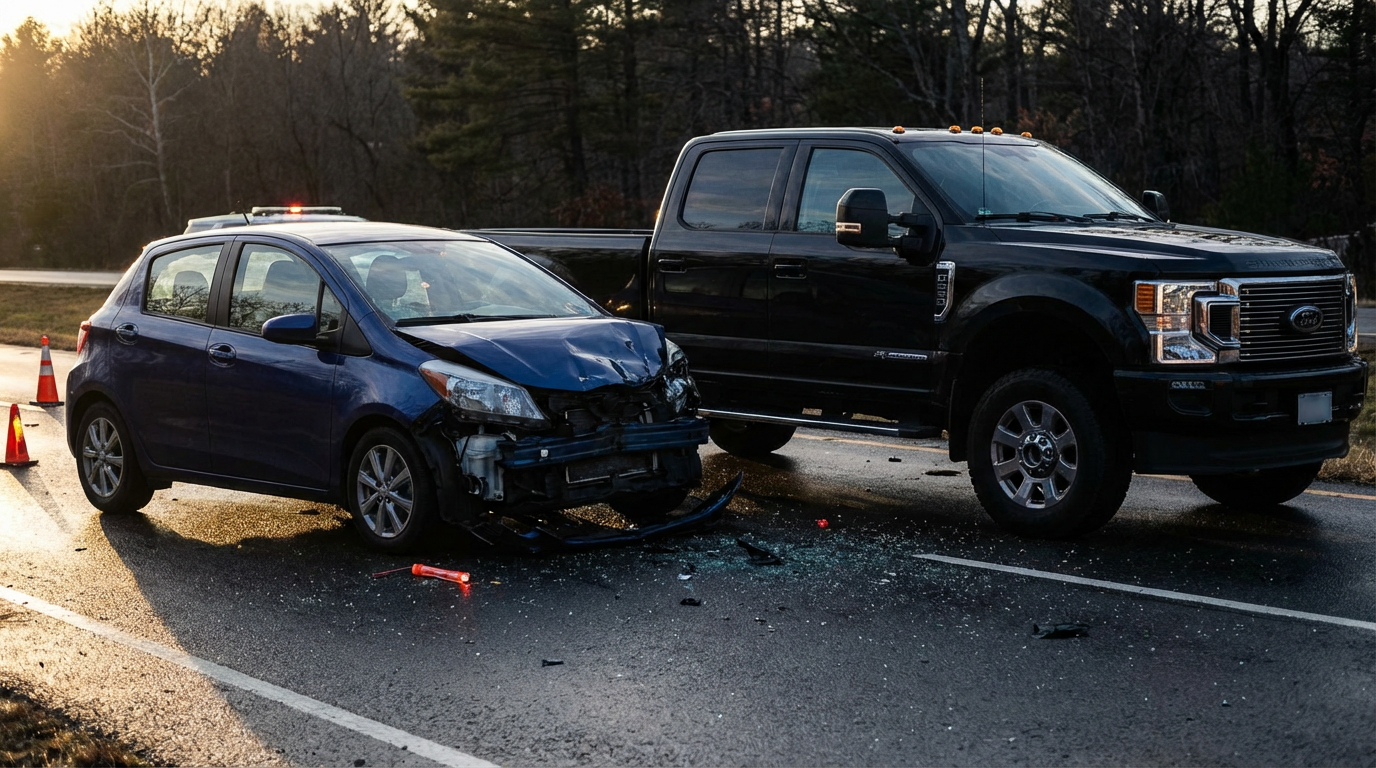
The lethality ratio isn’t a perfect safety metric. A low ratio can mean two very different things: your vehicle protected you, or your vehicle killed the other driver while you walked away. The Ram 2500’s 0.205 ratio is partly engineering and partly physics — a 7,000-pound truck in a head-on with a Civic is going to produce a fatality in the Civic, not the Ram.
But that’s the point. This is what the vehicle arms race looks like in data.
When a Cavalier crashes, 86 out of 100 times the person inside the Cavalier dies. When a Ram 2500 crashes, 79 out of 100 times the person inside the Ram lives — because somebody in the other vehicle absorbed the energy instead.
The weight line
Every vehicle with a lethality ratio above 0.70 weighs under 3,200 pounds. Every vehicle under 0.40 weighs over 4,500 pounds. There is no vehicle in the dataset that breaks this pattern with more than 500 FARS crashes. None. The weight boundary is absolute.
IIHS published this relationship in 2020: for every 1,000-pound decrease in vehicle weight, fatality risk increases 12%.[1] The lethality ratio confirms it at scale. Lighter vehicles don’t just crash more often — they crash worse.
The GM concentration
Eight of the 15 least-survivable vehicles are General Motors products: Cavalier, Cobalt, HHR, S-10, Sonic, Spark, Grand Am, Grand Prix, Century. GM dominated the American small car and compact truck market from the 1990s through 2010s, and their economy platforms share a common trait: thin steel, minimal structural reinforcement, and crumple zones designed to pass federal minimums rather than exceed them.
The Cavalier and Cobalt are basically the same car separated by a decade. Both were entry-level platforms priced under $15,000. Both register above 0.80 lethality. GM didn’t improve crash survivability between them — they just changed the sheet metal.
What this means
Death rate (deaths per 100 million VMT) tells you your odds of being in a fatal crash. Lethality ratio tells you whose funeral it’ll be. One is about exposure. The other is about physics.
The Toyota Land Cruiser has a death rate of 6.27 — the worst in the FARS dataset. But its lethality ratio is 0.347. It gets into fatal crashes constantly, but the Land Cruiser’s occupants survive 65% of the time. The other vehicle’s occupants don’t.
The Nissan Versa has a death rate of 0.90 — low, respectable, unremarkable. But its lethality ratio is 0.723. When a Versa does end up in FARS, the person inside the Versa almost always dies. It doesn’t crash often. But when it does, the Versa loses.
Rate tells you frequency. Lethality tells you outcome. The vehicles Americans can afford have the worst outcomes. That hasn’t changed in 30 years of FARS data.
Sources & References
- IIHS, “Vehicle Size and Weight” — fatality risk and vehicle weight relationship. iihs.org
- NHTSA, Fatality Analysis Reporting System (FARS), 2014–2023. All crash and fatality counts derived from FARS bulk data. nhtsa.gov
- IIHS, “Life-saving benefits of ESC continue to accrue”, 2011. Referenced for structural safety improvements across generations. iihs.org
Lethality ratio defined as deaths per FARS-reportable crash for each vehicle model, 2014–2023. Only vehicles with 500+ FARS crashes are included. FARS records crashes involving at least one fatality — a lethality ratio below 1.0 means the vehicle’s occupant survived while a fatality occurred elsewhere in the crash. All data from NHTSA FARS public files.