Your Garage Door Is Better Regulated Than Your Car Seat
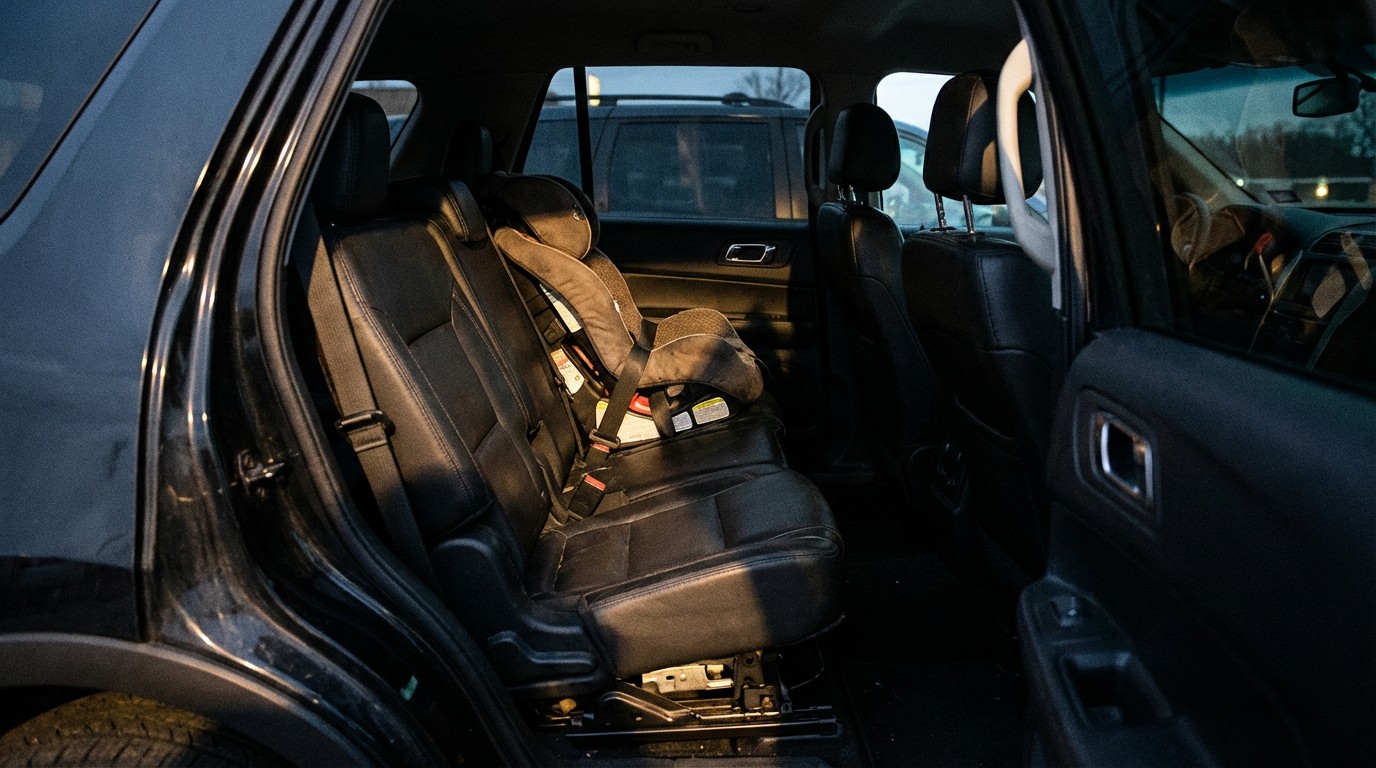
On March 7, a two-year-old girl in Ohio was crushed to death by the power-folding second-row seat of a 2026 Hyundai Palisade.[1] The seat didn’t detect her. It just kept folding. Hyundai has since recalled 69,060 vehicles in North America, issued a stop-sale, and offered rental cars to affected owners. They don’t have a permanent fix yet.
This is not a Hyundai problem. This is a pattern that has repeated, almost identically, for half a century.
Power windows started killing children in the 1970s. The mechanism exerts 30 to 80 pounds of upward force.[2] It takes 22 pounds to suffocate a child. Auto-reverse technology — which stops and reverses the window when it hits an obstruction — cost $8 to $10 per window. More than 80 percent of European models included it as standard equipment. Fewer than 10 percent of GM, Ford, and Chrysler models did.[3] The same Ford Focus sold in Europe with auto-reverse was sold in the United States without it.
Consumer groups documented 33 children killed. NHTSA acknowledged the problem averaged 1.5 deaths per year and roughly 500 emergency room visits, half involving children.[2] The agency first addressed power window switch design in 2004 to prevent accidental actuation, but didn’t require auto-reverse for express-close windows until 2010, when the Cameron Gulbransen Act forced its hand[4][5] — nearly four decades after FMVSS 118 first took effect in 1971.
Then backovers. Cameron Gulbransen was two years old when his father, a pediatrician, backed over him in the driveway and killed him. He never saw the boy. Congress passed the Cameron Gulbransen Kids Transportation Safety Act in 2008, directing NHTSA to require rear visibility systems within three years.[5] NHTSA took ten. The backup camera mandate didn’t take full effect until May 2018. Kids and Car Safety documented more than 1,500 children killed in non-traffic vehicle incidents since 2000, with backovers accounting for a significant share.[6]
Now power seats. The Palisade’s second-row seats fold flat with the push of a button. Hyundai received 17 complaints about unexpected seat operations between August 2025 and March 9, 2026, including four injuries, before the fatal incident.[1] There is no federal safety standard requiring anti-crush protection for power-adjustable or power-folding seats. None.
Your garage door, by contrast, has been required to auto-reverse upon contact since 1993 under UL 325.[7] A mechanism in your garage meets a higher safety bar than a mechanism six inches from your toddler’s head.
The cycle is always the same. An automaker adds a powered convenience feature. The feature lacks basic anti-pinch protection because no one mandates it. Children die. Advocacy groups spend years compiling body counts and begging NHTSA to act. Automakers argue the numbers are too small to justify the cost. NHTSA eventually mandates what should have been standard from the beginning. Then the next feature ships without safeguards, and the clock resets.
Strongest counterargument: These are statistically rare events. Power window deaths averaged 1.5 per year. The absolute numbers for backovers, while heartbreaking, are small relative to a fleet of 290 million vehicles. Mandating expensive safety changes for low-frequency events raises vehicle costs for everyone. NHTSA itself called power window incidents a “small, but persistent problem.”[4]
Run the math anyway. Auto-reverse cost $8 to $10 per express-close window mechanism. NHTSA estimated the per-vehicle cost for the switch-design rule at $1.41 to $8.17 depending on configuration.[4] Even using the industry’s higher estimates across 17 million new vehicles per year, the Department of Transportation’s value of a statistical life — $13.2 million in 2024 dollars — means the mandate needed to prevent just a handful of deaths annually to break even.[8] NHTSA itself projected auto-reverse would prevent at least two fatalities per year. Over nearly four decades of inaction, that’s at least 70 preventable deaths. The economics never supported waiting. The automakers just didn’t want to pay.
Limitations: These non-traffic fatalities — power windows, backovers, power seats — are not captured in FARS, which tracks only on-road crash deaths. Kids and Car Safety data is compiled from media reports and family accounts, not systematic government surveillance, meaning the true toll is almost certainly higher than documented. The Palisade recall involves one model year of one vehicle; we cannot determine how many other power-seat-equipped vehicles lack anti-crush protection because no one has been required to check.
Hyundai says a software update is coming by the end of March. It won’t be a permanent fix.[1] A permanent fix would be a federal standard that says: if a mechanism in your car can crush a child, it must detect the child and stop. We have this standard for garage doors. We have it for elevator doors. We have it, now, for power windows. We do not have it for power seats, power liftgates, or power sliding doors. Each of those will need its own body count before anything changes.
Sources & References
- Joel Feder, “Hyundai Stops Sales and Recalls Over 69,000 2026 Palisades Because the Power Seats Can Crush You,” The Drive, March 24, 2026. thedrive.com
- Safe Automobile Power Window Campaign, “Fact Sheet,” Ascencioné Technology Partners. ascencione.com
- Ibid. Survey data: 80%+ European models vs. <10% US Big Three models with auto-reverse.
- NHTSA, “FMVSS 118: Power-Operated Window, Partition, and Roof Panel Systems,” Final Rule on switch design, Federal Register, September 15, 2004 (FR Doc. 04-20714). Auto-reverse provision for express-close windows took effect October 2010 per Cameron Gulbransen Act implementation. federalregister.gov
- Cameron Gulbransen Kids Transportation Safety Act of 2007, Pub. L. 110–189, signed Feb. 28, 2008. Backup camera mandate effective May 1, 2018 (FMVSS 111). congress.gov
- Kids and Car Safety, “Nontraffic Data Collection, Research and Analysis.” kidsandcars.org
- UL 325 Standard for Door, Drapery, Gate, Louver, and Window Operators and Systems. Garage door auto-reverse requirement effective January 1, 1993.
- U.S. DOT, “Departmental Guidance on Valuation of a Statistical Life in Economic Analysis,” 2024 update: $13.2 million. transportation.gov