GM Killed 1,540 People Before It Learned to Listen. This Week, Listening Saved One.
Somewhere inside General Motors, an engineer saw the news about a dead toddler in Ohio and thought: wait, our seats do that too.
That engineer used an internal program called Speak Up For Safety to flag the problem. On July 1, GM filed a recall with NHTSA for every Cadillac Vistiq it has ever built. All 14,540 of them. The power-folding third-row seats can trap a child and won’t reverse.[1] Same defect that killed two-year-old Lucia Ayala in a Hyundai Palisade on March 7.[2]
Nobody has been hurt in a Vistiq. The program worked. But the program exists because GM spent a decade ignoring a defect that FARS data says was killing people at industrial scale.
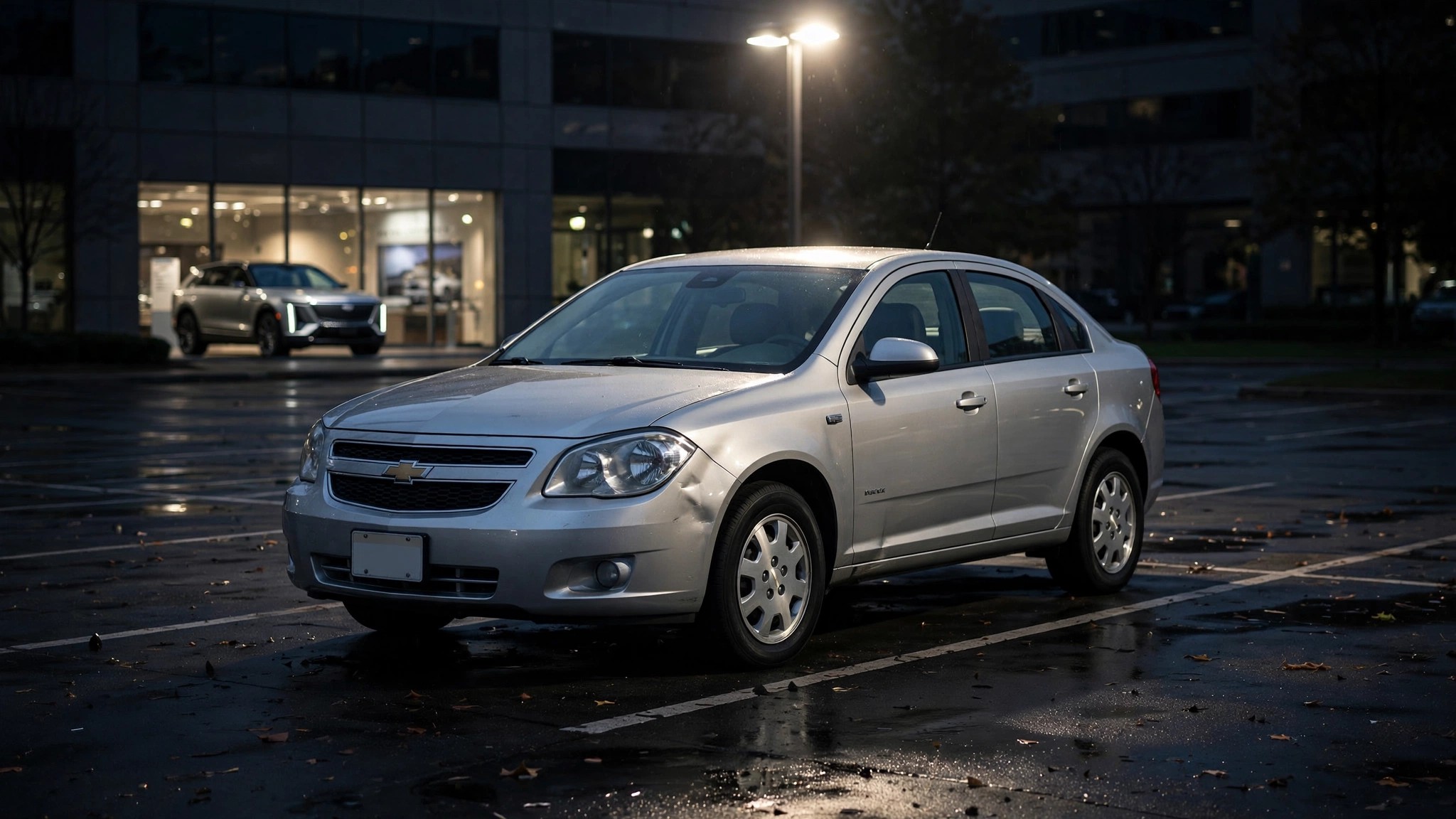
GM’s Chevrolet Cobalt had a fatality rate of 5.10 deaths per 100 million vehicle miles traveled. That is 2.5 times the rate of a Toyota Camry from the same era and more than double the class average for sedans. Its deaths-per-crash ratio was 0.808, meaning four out of every five FARS-recorded crash incidents involving a Cobalt produced a fatality. Only four sedans in the entire dataset scored worse.[3]
The ignition switch was the catalyst. A defective part worth less than a dollar could rotate out of the “run” position while driving, cutting engine power, disabling power steering and brakes, and preventing airbags from deploying on impact. GM engineers first documented the problem internally in 2005. Recall came in 2014.[4] Nine years. And a body count. Model year 2006 Cobalts alone account for 328 FARS fatalities, the most concentrated single-year death toll of any sedan in the dataset at 21.3% of the car’s entire body count.[3]
GM’s official count for ignition-switch deaths, the number they put in front of Congress and settled with the families and wrote into a Department of Justice deferred prosecution agreement, was 124. FARS says 1,540 Cobalt occupants died in the decade the data covers, a gap of 12.4 times GM’s official number. Not every Cobalt death was an ignition switch failure. Fair enough. But when your airbags sometimes don’t fire and your power steering sometimes cuts at highway speed, the line between “driver error” and “undiagnosed defect” gets awfully blurry.
What followed restructured GM’s safety apparatus from the ground up, which is what happens when a Senate hearing goes badly enough and the Justice Department starts asking questions that executives cannot answer without lawyers present. Mary Barra created the Vice President of Global Vehicle Safety position, a title that functionally concedes the company had been building cars for a century without one. Fifteen employees were fired, Congress hauled executives to Washington for hearings that played on loop, and GM paid $900 million to the Department of Justice. And it launched Speak Up For Safety: a program that trains every employee, every year, on the ignition switch disaster and encourages them to report concerns without fear of retaliation.[5]
A decade later, an anonymous engineer saw the Palisade recall, walked over to a Vistiq, put a 33-to-40-pound box on the third-row seat, pressed the fold button, and watched the seatback pin the box in place without reversing. That engineer reported through SUFS in late March, and by July every one of the 14,540 Vistiqs on the road had a recall notice for a defect that had already killed a child in another manufacturer’s vehicle.
The math of it is brutal: at the Palisade’s observed incidence rate of roughly one death per 60,000 vehicles, 14,540 Vistiqs would statistically produce about 0.24 fatalities over the vehicle’s lifetime — call it one child who never meets a power-folding seat at the wrong angle, one name that never appears in a coroner’s report because an engineer spoke up first.
So this is what institutional learning costs in the auto industry: 1,540 dead to build the program that saved one. A ratio that should make every automaker check whether they need their own ignition switch moment to start listening, or whether they can learn from GM’s.
Most will not.
What You Should Do
If you own a 2026 or 2027 Cadillac Vistiq, take it to your dealer. They will disable the power-folding third-row seat until a replacement module is available, but until that appointment, do not allow children near the third-row seats unsupervised.
If you own any three-row SUV with power-folding rear seats, test the mechanism yourself: place a firm object on the seat, press the fold button, and see if the seatback reverses when it meets resistance. If it doesn’t, contact the manufacturer and file a complaint at nhtsa.gov/report-a-safety-problem, and understand that you are doing the thing GM employees spent a decade being afraid to do. Palisade, Telluride, and Vistiq are not the only vehicles with this feature, just the first three to get caught.
Sources & References
- NHTSA Recall N262555780, Cadillac Vistiq power-folding third-row seat defect, filed July 1, 2026. nhtsa.gov/recalls
- Jalopnik, “Cadillac Recalls Every Vistiq After Internal Investigation Spurred By Deadly Hyundai Palisade Power-Folding Seat Incident Reveals Similar Fault,” July 7, 2026. Confirmed SUFS program usage and 33–40 lb box test protocol.
- NHTSA, Fatality Analysis Reporting System (FARS), 2014–2023. Cobalt: 1,540 deaths, 1,907 crashes, rate 5.10/100M VMT, fleet ~262,500. nhtsa.gov
- General Motors ignition switch recalls, 2014. ~30 million vehicles, 124 deaths and 275 injuries officially attributed. $900M DOJ deferred prosecution agreement. Wikipedia
- U.S. Senate Committee on Commerce, Science & Transportation, “Examining Accountability and Corporate Culture in Wake of the GM Recalls,” S.Hrg. 113-715, 2014. Mary Barra testimony establishing SUFS program. congress.gov
Limitations
FARS captures only fatal crashes. Of 1,540 Cobalt deaths, not all were ignition switch failures. Actual ignition-switch death toll falls somewhere between GM’s 124 and FARS’s 1,540. Our VMT estimates use industry averages, introducing ±15% uncertainty for low-volume models like the Cobalt. And the Vistiq has been on the road for less than two years, so the statistical projection of 0.24 expected fatalities is a rough extrapolation from the Palisade’s single incident, not a validated actuarial model.
Strongest Counterargument
SUFS did not need 1,540 deaths to exist. It needed 124 officially attributed ones and a Senate hearing. Most of the Cobalt’s FARS body count was unrelated to the ignition switch. Fair point. But the Cobalt’s overall fatality rate of 5.10 was more than double its class average even before the ignition switch was identified. A vehicle that dangerous, built by the largest American automaker, should have triggered alarm long before Congress forced the issue. That 1,540 is the bill for not asking why the car was killing people at that rate from the start.