96% of New Cars Fail the Car Seat Test. The Industry Blames You.
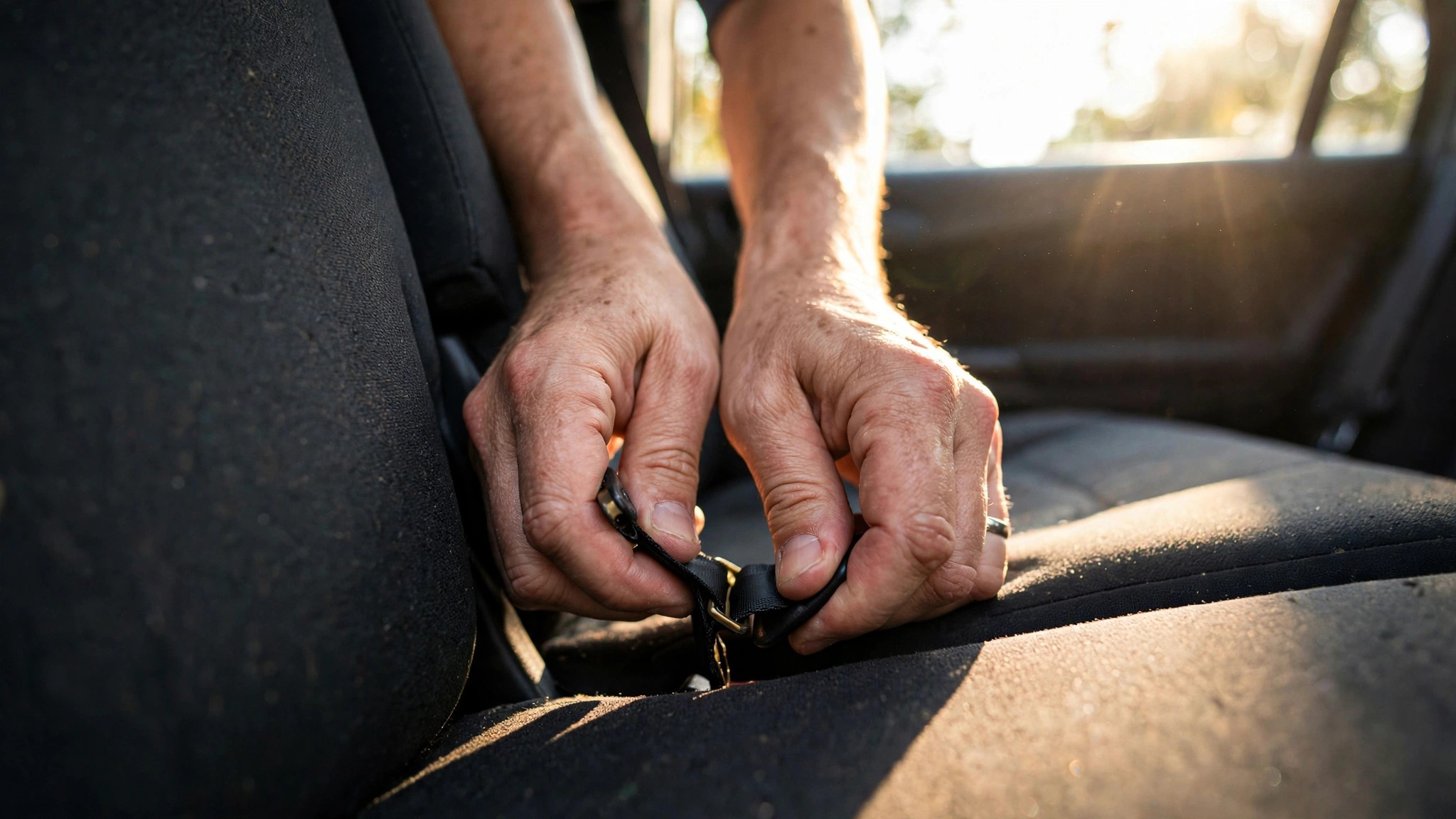
Cars.com just finished testing 56 model-year 2025 and 2026 vehicles for how well they accommodate child car seats. Certified technicians installed infant seats, convertible seats, and high-back boosters in every one of them, checking LATCH anchor accessibility, fit against the seat back, and whether a kid could actually reach the buckle. Two vehicles earned straight A's—a $96,000 Mercedes-Benz GLS580 and a Volkswagen Tiguan, which amounts to a 96.4% failure rate across the vehicles Americans are buying right now to haul their children around in.[1]
The industry has had twenty-four years to get this right. LATCH—Lower Anchors and Tethers for Children—became mandatory in every new vehicle and child restraint sold after September 1, 2002. The whole point was to create a universal, foolproof attachment system so parents wouldn't have to wrestle with seat belt routing anymore. A quarter-century later, the IIHS's own assessment of the program is blunt: "incompatibility between child restraints and vehicle seat designs" remains a primary driver of installation failure. Anchors buried under leather trim, tethers hidden behind panels you need a flashlight to find, buckle stalks so short a toddler in a booster can't reach them without a parent contorting into the back seat to help. The system that was supposed to eliminate guesswork has become its own obstacle course.
And the numbers downstream are exactly what you'd expect. NHTSA's national child restraint study found 59% of car seats are misused. AAA's 2024 inspection data pushed that to 74%. Here is the statistic that should terrify every product liability attorney in Detroit: 45% of parents who told NHTSA they were "confident" or "very confident" their child's seat was installed correctly still had at least one critical misuse.[2] These are not negligent parents. These are parents doing their best with hardware that was designed to look good in a marketing render and never tested with actual human hands trying to thread a LATCH strap through a gap the width of a credit card.
Between 2018 and 2022, more than four million children age eleven and under were involved in car crashes in the United States, producing 547,000 injuries and nearly 3,000 fatalities. Over 100,000 children were injured in crashes in 2022 alone.[3] Child restraints, when properly installed, reduce fatalities by 71% for infants and 54% for children aged one through four. That "when properly installed" caveat is doing an enormous amount of load-bearing work, and the vehicle itself is why it keeps collapsing. Safe Kids Worldwide found 64% of car seats aren't installed using the top tether at all—a strap most parents don't even know exists because automakers bury the anchor point behind a trim cover with a symbol the size of a shirt button.[4]
Consider the vehicles that families actually buy. The Ford Explorer, America's default "family SUV," has accumulated 3,797 fatalities in the FARS database from 2014 through 2023, while the Chevy Tahoe sits at 2,592 and the Toyota Highlander at 1,106. None of these are on Cars.com's top-performer list for car seat accommodation.[5] The vehicles that earned A's or near-A's are a $96K luxury SUV most families will never cross-shop and a Volkswagen Tiguan with 126 total FARS deaths over the same period, a vehicle whose entire market presence is a rounding error next to the Explorer's fleet. The gap between "vehicles marketed to families" and "vehicles that actually accommodate the safety devices families are legally required to use" is not a crack in the system—it is the system.
There is a specific, actionable thing wrong here, and it has a name: the LATCH weight limit. Federal regulations cap LATCH use at a combined child-plus-seat weight of 65 pounds. After that, parents must switch to seat belt installation, which reintroduces all the routing complexity LATCH was supposed to eliminate. For a large four-year-old in a convertible seat, you can hit that limit before the child outgrows the harness. Manufacturers could have lobbied for higher LATCH anchoring standards in the vehicle structure. They didn't. Instead they built thinner, cheaper anchor points rated to exactly the federal minimum and then printed the weight limit on page 247 of the owner's manual.
If you are shopping for a family vehicle in 2026, here is what Cars.com's technicians found actually works: the VW Tiguan, Honda CR-V Hybrid, Honda Passport, Hyundai Tucson Hybrid, Kia Sportage Hybrid, and Subaru Outback all earned A's in every car seat category but one. Mercedes GLS580 aced everything but will cost you six figures. Before you sign anything, install your actual car seats in the vehicle on the dealer lot, not a display model seat. Bring every seat your children use, and if the LATCH anchors require a zip tie and a prayer, that vehicle failed the test, and no amount of third-row marketing copy changes the physics of a 30-mph frontal impact with a loose harness strap.
Sources & References
- Cars.com, 2026 Best Cars for Car Seats Report, July 30, 2026. prnewswire.com
- Greenwall, N. K., National Child Restraint Use Special Study (Research Note DOT HS 812 157), NHTSA, 2015. crashstats.nhtsa.dot.gov
- AAA Newsroom, “Baby on Board, But Is Baby Properly Buckled?” September 13, 2024. newsroom.aaa.com
- Safe Kids Worldwide, “More Than Half of Car Seats are Not Installed Correctly.” safekids.org
- NHTSA, Fatality Analysis Reporting System (FARS), 2014–2023. nhtsa.gov