100 Cars a Day Hit Buildings. FARS Counts 210 a Year.
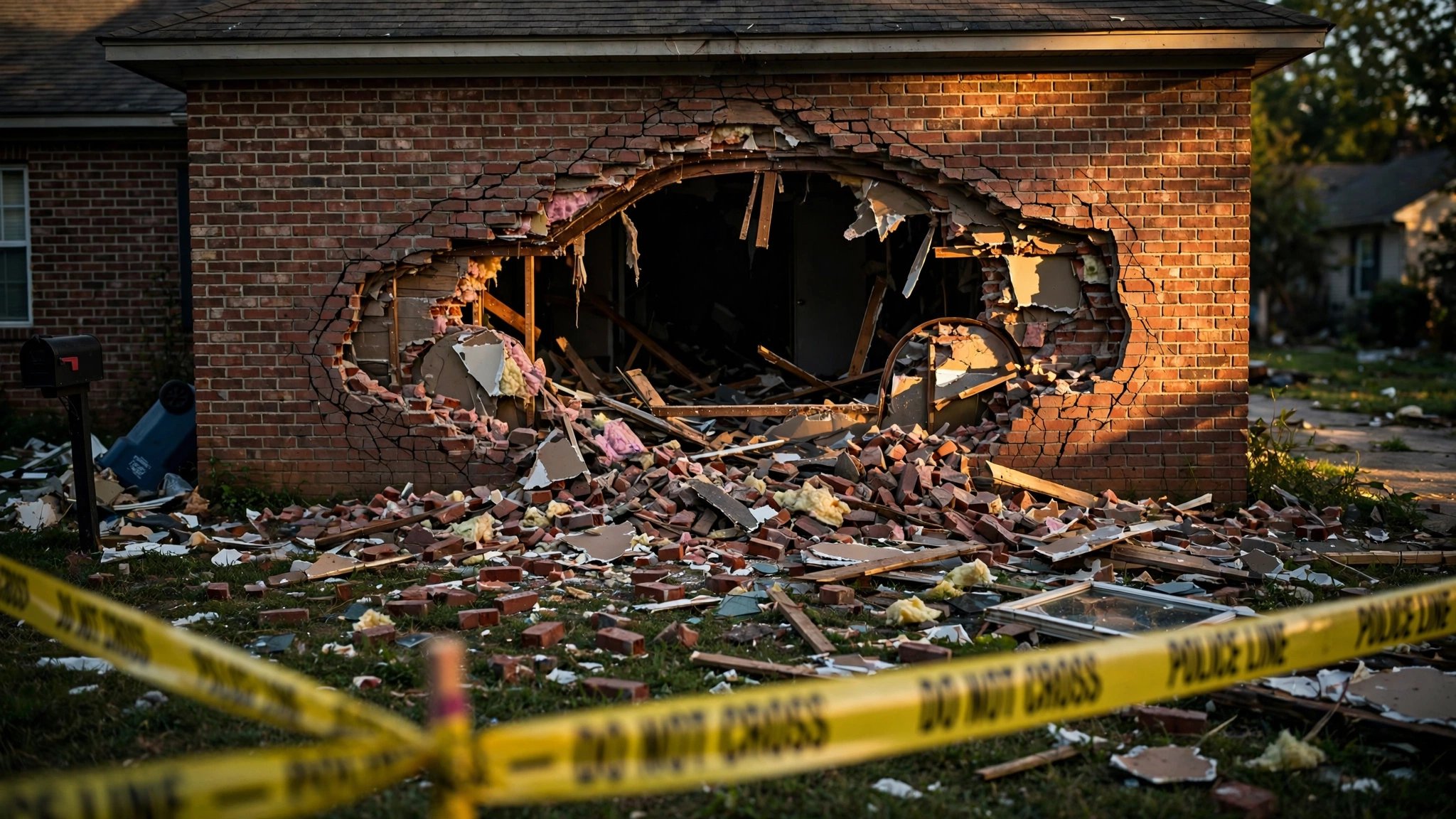
On June 19, a Tesla Model 3 traveling 73 mph punched through the brick wall of a residential home in Katy, Texas, and killed Martha Avila, 76, who was standing inside.[1] NHTSA opened a Special Crash Investigation. That death will almost certainly appear in the Fatality Analysis Reporting System. Most don't.
The Storefront Safety Council, which has catalogued vehicle-into-building crashes since 2014 using police reports, court records, and litigation data, estimates that up to 2,600 Americans die annually when a vehicle enters an occupied structure, with another 16,000 injured.[2] Lloyd's of London audited the Council's methodology in 2022 and validated the data collection process, revealing roughly 100 such collisions every day. It adds 200 to 250 incidents to its database each month, and even that pace captures just one in twelve events, by their own estimate.[3]
NHTSA, the agency whose data underpins every traffic safety conversation in America, recorded 210 vehicle-into-building crashes in all of 2020.[3] Two hundred ten. For context, Las Vegas transit officials documented 27 bus-stop strikes in a single year within one city's network; only two of those appeared in the Council's database, let alone NHTSA's.[3]
Why the gap? FARS has long excluded crashes on private property, including parking lots and driveways, from year-end totals.[4] IIHS clarifies that NHTSA does record some building crashes but only when the building impact is coded as the "most harmful event" in the collision sequence. If the driver clips another car or a pedestrian before plowing into a storefront, and more people are hurt in the initial impact, the building penetration may never be coded at all.[3] Every death inside the building becomes statistically invisible, uncounted by the system that drives every policy conversation about traffic safety in this country.
Physics makes the undercount worse every year: average new-vehicle curb weight hit 4,329 pounds in 2022, up from 3,220 pounds in 1980. Kinetic energy scales linearly with mass: a 6,000-pound Silverado at 30 mph delivers roughly 119,000 foot-pounds of energy into a wall. A 3,000-pound Civic at the same speed delivers half that. Residential walls, strip-mall facades, gas station convenience stores were never engineered to absorb pickup-truck-scale kinetic loads. Vehicles got heavier, but walls did not get stronger, and FARS kept not counting the bodies.
Strongest counterargument: The Storefront Safety Council sells bollard and barrier products, which creates a financial incentive to inflate vehicle-into-building crash numbers. Henry Grabar at Slate has questioned the 2,600-death estimate based on public methodology gaps.[5] Some FARS exclusions are defensible: a parking-lot fender-bender that scuffs a building facade is not the same category of event as a 73-mph penetration of a brick residence. An honest estimate of annual deaths may land substantially below 2,600.
Limitations: We cannot independently verify the Council's estimates. FARS may capture more building-impact deaths than the 210-crash figure implies, since one crash can involve multiple fatalities and not all building-crash deaths occur in crashes coded with buildings as the primary event. Our kinetic energy comparison assumes perpendicular impact; oblique angles reduce energy transfer. Avila's death in Katy will likely appear in FARS because it began on a public road, meaning it is one of the better-counted events, not a representative case.
What you should do: If you live or work in a ground-floor space facing a road without bollards or concrete barriers between the traffic lane and the wall, you are occupying an unprotected position that approximately 100 drivers per day fail to avoid. For commercial properties, the Storefront Safety Council recommends steel bollards rated to stop a 15,000-pound vehicle at 30 mph as a minimum standard. For homes, a concrete planter or earthen berm between the road and the structure is the cheapest intervention that actually works. And if your local government is widening a road adjacent to occupied buildings without adding physical barriers, the question to ask at the public meeting is simple: who gets counted when one of the 36,500 annual incidents goes through a wall?
Sources & References
- Reuters, “Tesla sued over fatal Texas crash linked to Autopilot,” June 24, 2026. reuters.com
- ASIS International / Storefront Safety Council, “Head-On Collision: Storefronts Are No Stranger to Vehicle Crashes,” Security Management, Feb 2025. asisonline.org
- Streetsblog USA, “Vehicle-Into-Building Crashes 40% Higher Than Previously Thought,” June 2022. streetsblog.org
- NHTSA, Fatality Analysis Reporting System (FARS), 2014–2023. nhtsa.gov
- Henry Grabar, “How Many Times a Day Does a Car Crash Into a Building?,” Slate, June 2022. slate.com
Source: NHTSA FARS 2014–2023; Storefront Safety Council crash statistics (2014–2024, validated by Lloyd’s of London). FARS methodology excludes most crashes on private property and building-impact events not coded as “most harmful event.” Storefront Safety Council estimates are advocacy-sourced and have not been independently verified by a government agency. See methodology for caveats.