GM Bought a Bankrupt Korean Automaker and Sold You Its Deadliest Car for $9,995
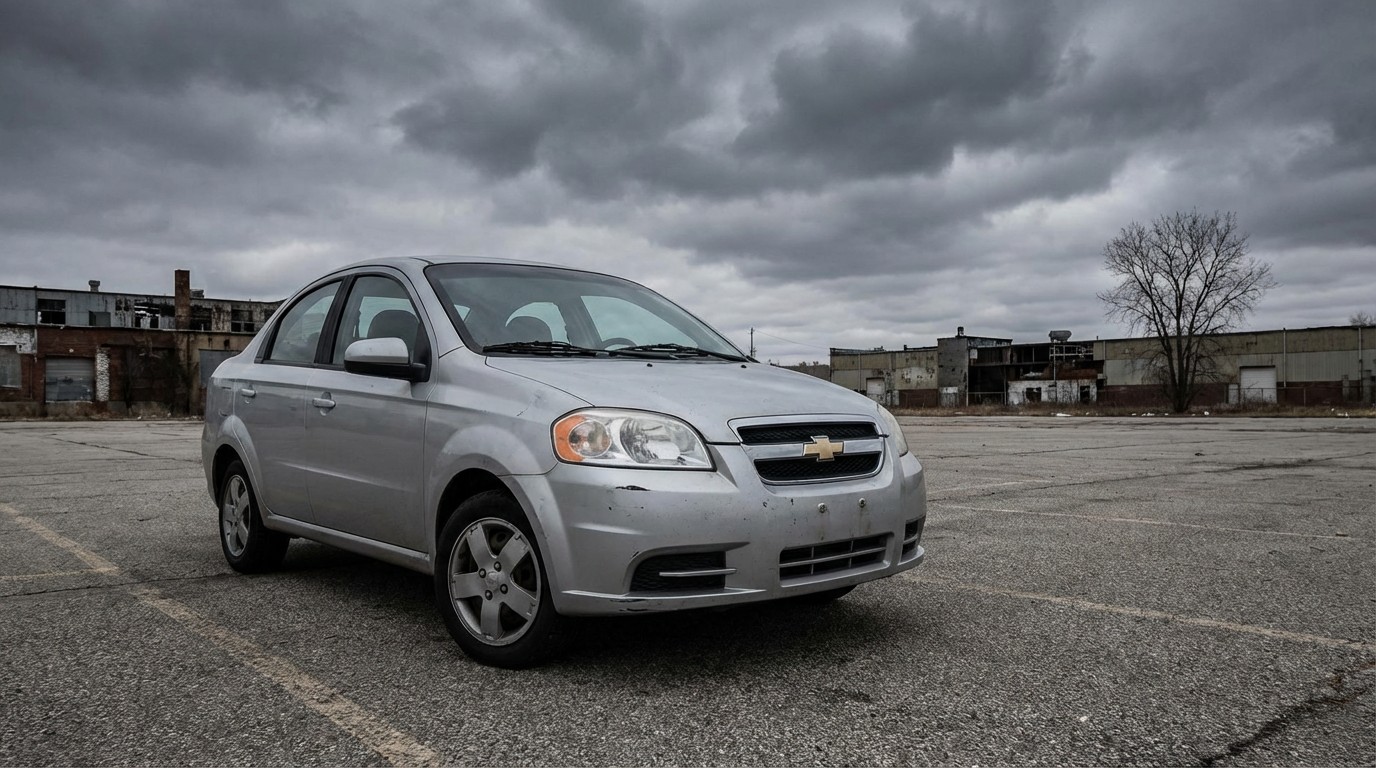
Before you sign that lease, you might want to see this. Daewoo Motors went bankrupt in 2000. GM picked through the wreckage, slapped a Chevrolet badge on a car called the Kalos, and shipped it to American dealerships as the Aveo. Sticker price: under ten grand. Marketing pitch: “the lowest-priced new car in America.”[1] Of 155 Chevrolet Aveo appearances in FARS fatal crash data, 138 ended with someone dead.[2] That’s 89.0%. Second worst of any vehicle with 100 or more fatal crashes in the entire database. Only the Saturn S Series scored higher.
Nine out of ten. If an Aveo appeared in a fatal crash report, the occupant was almost certainly not walking away. For comparison, the Honda Fit manages 72.0%. Toyota Yaris: 66.9%. Ford Fiesta: 47.3%.[2] Same segment, same buyers, same budget. Wildly different odds of survival.
Designed During a Collapse
Daewoo was hemorrhaging cash when engineers finalized the Kalos platform. Italdesign drew the exterior, which was the easy part. Underneath sat a structure engineered by a company that couldn’t make payroll.[1] When GM acquired the corpse in 2002, they got a factory, a supply chain, and a car that was already tooled up and ready to sell. They changed the badge. They did not meaningfully change the engineering.
IIHS gave the 2007 Aveo a “Marginal” rating in their frontal offset crash test.[3] NHTSA handed out four stars overall but only three stars for frontal driver protection in certain model years.[4] None of this stopped GM from selling it for eight consecutive model years (2004 through 2011) to buyers whose primary selection criterion was “I need a car and this is what I can afford.”
Subcompact Lethality, Ranked
| Vehicle | Deaths | Crashes | Lethality |
|---|---|---|---|
| Chevrolet Aveo | 138 | 155 | 89.0% |
| Chevrolet Sonic | 494 | 655 | 75.4% |
| Kia Rio | 268 | 367 | 73.0% |
| Nissan Versa | 722 | 999 | 72.3% |
| Honda Fit | 290 | 403 | 72.0% |
| Hyundai Accent | 360 | 502 | 71.7% |
| Toyota Yaris | 190 | 284 | 66.9% |
| Ford Fiesta | 513 | 1,084 | 47.3% |
Look at that Fiesta number. Ford somehow built a subcompact where barely half of fatal crashes killed someone. Every Fiesta that shows up in FARS essentially gave its occupant a coin flip. GM built a car where the coin has heads on both sides.
GM’s Cheap Car Problem
This was not an isolated incident. GM’s bargain-bin lineup during this era was a graveyard in miniature. The Cobalt: 80.8% lethality and an ignition switch defect that disabled airbags.[5] The Saturn Ion: 80.7%, same defect. The Cavalier: 85.7%. Every budget car GM sold between 2000 and 2011 posted lethality numbers that would get a pharmaceutical pulled from shelves.
And the impairment data makes it worse, not better. Only 22% of drivers in fatal Aveo crashes tested positive for any substance.[2] Nearly four out of five were sober. These weren’t reckless drivers. They were people who bought the cheapest car available and found out what that price actually costs.
Limitations
FARS captures fatalities only, not all crashes. A vehicle can have a high lethality ratio because of how and where it crashes, not solely because of structural weakness. Small sample size matters here too: 155 crashes is far fewer than the thousands logged by Civics or Corollas, so the percentage carries more statistical noise. Still, 89% is 89%. Even with generous error bars, the Aveo sits in a tier occupied by cars that are no longer manufactured for good reason.
GM replaced the Aveo with the Sonic in 2012. Second generation, new platform, actual GM engineering. Lethality dropped to 75.4%. Better. Still above the class average. But at least they stopped selling a bankrupt company’s leftover as new.
Sources & References
- Wikipedia, Chevrolet Aveo. Originally developed as the Daewoo Kalos; marketed as “lowest-priced new car in America.” en.wikipedia.org
- NHTSA, Fatality Analysis Reporting System (FARS), 2014–2023. nhtsa.gov
- IIHS, Crash Test Ratings: Chevrolet Aveo. iihs.org
- NHTSA, 5-Star Safety Ratings (New Car Assessment Program). nhtsa.gov
- NHTSA, GM Ignition Switch Recall. See also: Wikipedia: GM ignition switch recalls
Data sourced from NHTSA’s Fatality Analysis Reporting System (FARS), 2014–2023. FARS records fatal motor vehicle crashes on public roads; it does not capture non-fatal crashes. Lethality ratios represent the proportion of FARS-recorded crashes involving a given vehicle that resulted in occupant death. Death rate estimates use fleet size approximations derived from industry sales data and NHTS mileage averages, which carry inherent uncertainty. This analysis cannot establish causation between vehicle design and crash outcomes.