168,000 SUVs Had the Wrong Weight Limit. The Infiniti Version Had the 7th-Highest Impairment Rate in America.
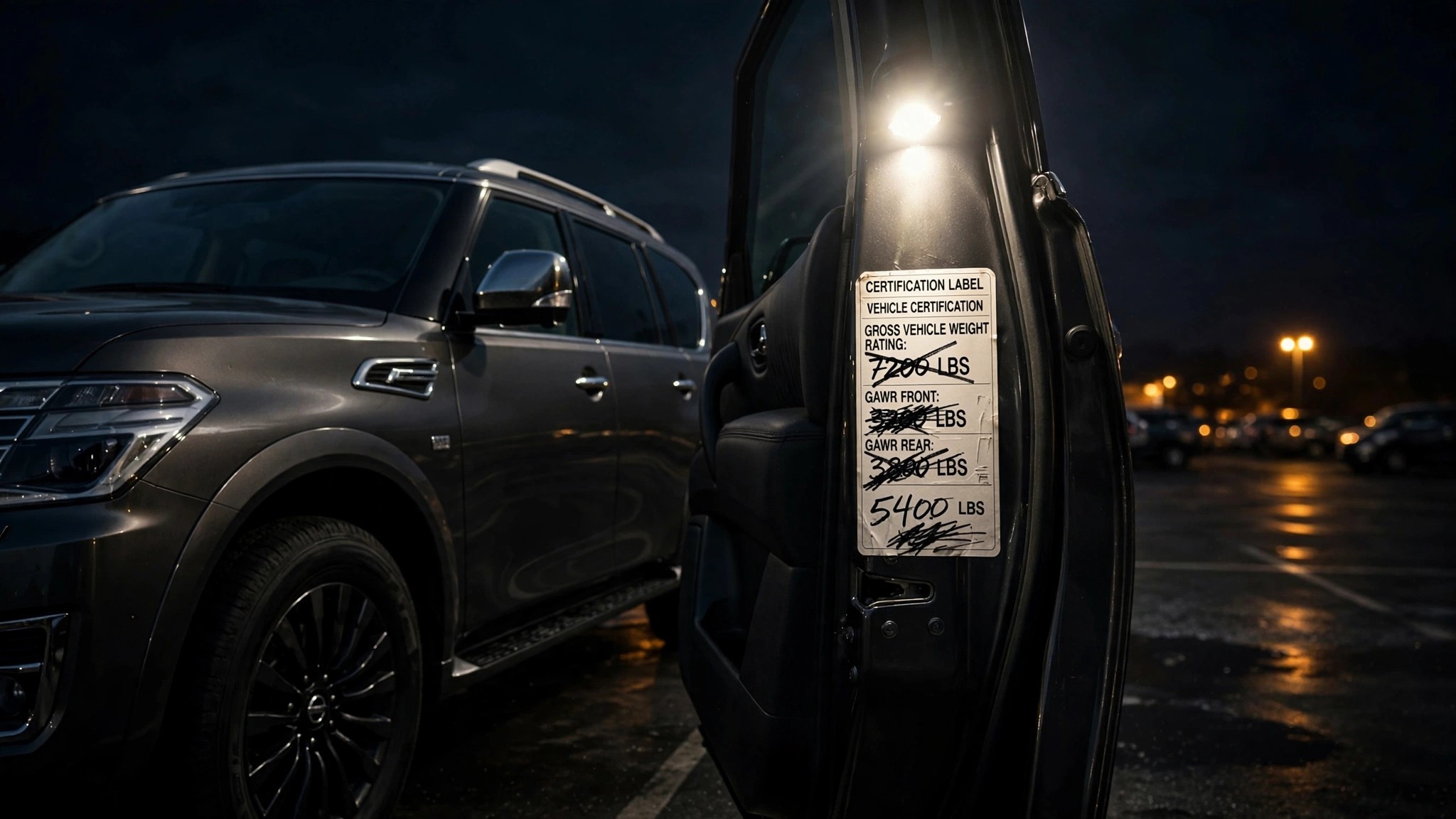
Nissan recalled 168,149 of its biggest body-on-frame SUVs today because someone printed the wrong number on a door sticker. The Gross Axle Weight Rating on 2020–2026 Armadas, 2011–2013 Infiniti QX56s, and 2014–2017 QX80s overstated what their axles could carry, meaning owners have been legally allowed to overload these vehicles beyond their structural limits for up to fifteen years.[1] NHTSA says this violates Federal Motor Vehicle Safety Standard 110, the rule governing tire selection and load capacity. The fix, as is increasingly typical of modern safety recalls, is a new sticker, dealer-applied or mailed to your house.
But the sticker is the boring part. Run these same vehicles through FARS toxicology data, though, and a different kind of overloading emerges: the Infiniti QX56, mechanically identical to the Nissan Armada, built on the same Y62 platform with the same 5.6-liter VK56VD V8, riding on the same frame with the same axles that now carry the wrong rating, has the seventh-highest driver impairment rate of any vehicle in the entire FARS dataset. Out of 274 QX56 drivers involved in fatal crashes between 2014 and 2023, 72 tested positive for alcohol or drugs. That is a 26.3% impairment rate, higher than the Corvette (26.2%), the Cadillac CTS (25.9%), and 300 other vehicles NHTSA tracks.[2]
The Nissan Armada, meanwhile, comes in at exactly 20.0% — dead center at the dataset average of 20.3%. Same truck. Same powertrain. Same chassis, carrying the same wrong weight label on the door. But slap an Infiniti badge on the grille and charge an extra fifteen to twenty thousand dollars, and the impairment rate jumps 6.3 percentage points, a 31.5% relative increase. You cannot engineer your way out of a buyer-profile problem, and the six-point impairment gap between Infiniti and Nissan badges on an otherwise identical chassis is emphatically a buyer-profile problem.
To be specific about what we are not claiming: FARS captures fatal crashes only. The 1,038 combined Armada and QX56 drivers in this dataset represent the subset involved in someone dying, not the full population of owners. But the divergence between platform twins is the finding. If impairment were distributed randomly across platforms, two vehicles sharing every structural component should show similar rates, and they do not. The QX56 rate is 31.5% higher, and the confidence on 274 drivers at that rate is not trivially dismissible, though a formal chi-squared test would sharpen the margin of error, and we have not run one. This is a population-level observation, not a causal claim about badge engineering.
Nissan is not having a quiet July. This GAWR recall follows a pattern the Crash Report has documented across the industry: safety failures whose remedies involve printing new paperwork rather than replacing parts. The overloading risk is real — incorrect axle ratings on a vehicle that already weighs north of 5,600 pounds means tire blowouts, brake fade, and suspension failures become more likely when owners load up for vacation towing or haul their rated-but-not-actually-rated payload. But the impairment data suggests that the most dangerous thing about this platform was never the axle rating. It was who was behind the wheel after spending the badge premium at dinner, overloaded in every sense of the word.
If you drive a 2020–2026 Armada or a 2011–2017 QX56/QX80 with 22-inch wheels, check your VIN at nhtsa.gov/recalls. Dealer appointments for the label replacement open when notification letters go out September 4. And while you are checking your VIN, consider checking your toxicology report. At these rates, the data suggests roughly one in four QX56 drivers involved in a fatal crash would fail.
Sources & References
- NHTSA Recall R26B1/R26B2, “Nissan Armada, Infiniti QX56, QX80 — Incorrect Gross Axle Weight Rating,” July 21, 2026. nhtsa.gov/recalls; Reuters, “Nissan to recall about 168,000 US vehicles over incorrect weight rating labels.” reuters.com
- NHTSA, Fatality Analysis Reporting System (FARS), 2014–2023. QX56 toxicology: 274 drivers, 72 any-impairment-positive (26.3%), 51 alcohol-positive (18.6%), 30 drug-positive (10.9%). Armada toxicology: 764 drivers, 153 any-impairment-positive (20.0%). Dataset average across 307 models: 20.3%. nhtsa.gov
- FMVSS 110, “Tire Selection and Rims for Motor Vehicles with a GVWR of 4,536 Kilograms (10,000 Pounds) or Less.” 49 CFR § 571.110. ecfr.gov