Your Car Knows You Crashed. It Won’t Call 911 Unless You Pay.
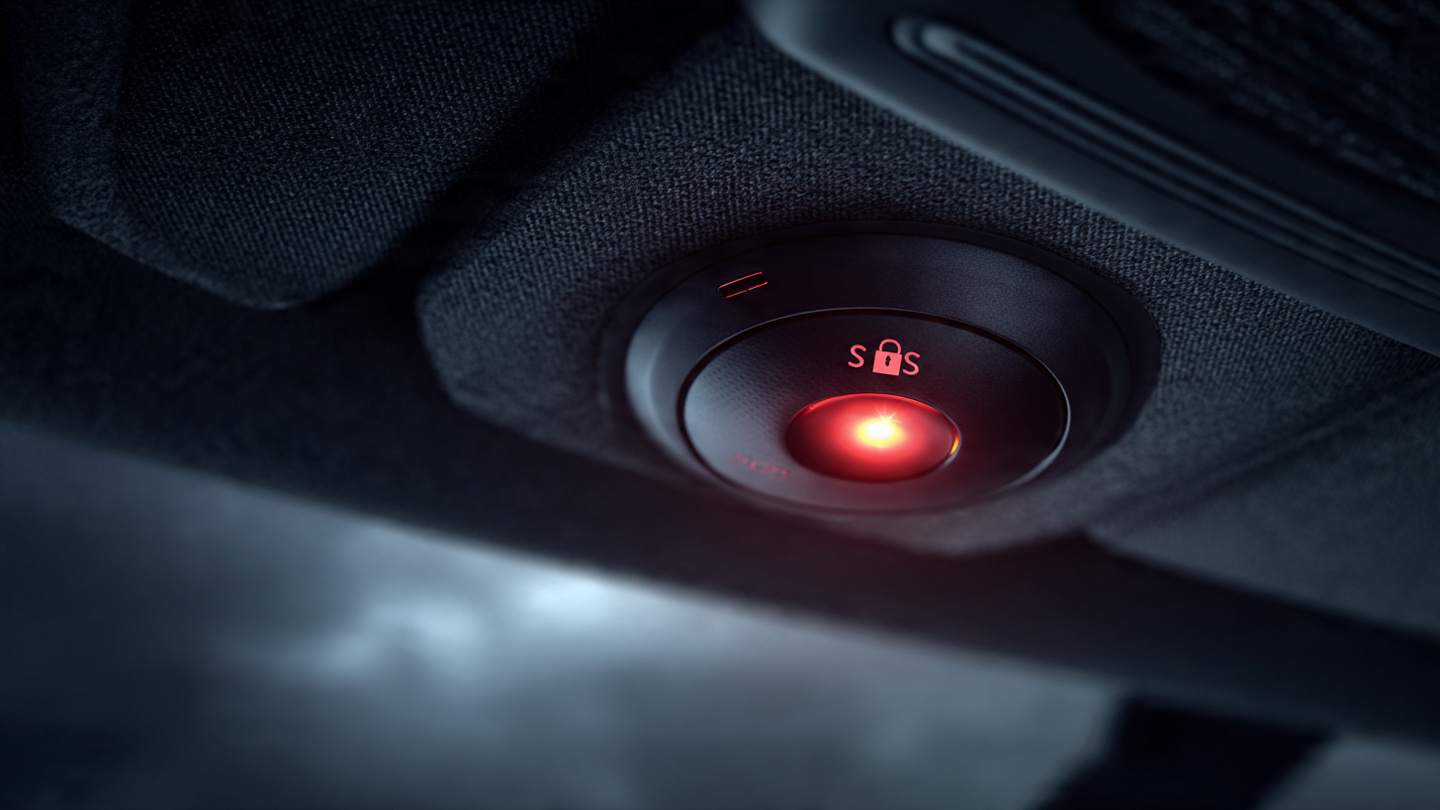
A woman drove off a road and down a ravine in the Pacific Northwest. Nobody saw it happen, and she was conscious but couldn’t move enough to reach her phone, which wouldn’t have had signal in the ravine anyway. Rescuers found her eight days later, critically dehydrated, her injuries survivable but her body shutting down from exposure.[1] Her car had the hardware to call for help the moment it detected the impact. The cellular module was installed at the factory, the GPS antenna was wired, and the SOS button was right there on the ceiling. All of it was disabled because she hadn’t paid her connected-services subscription.
That number comes from NHTSA’s own 2019 research on automatic crash notification, or ACN: the technology that detects an impact, pinpoints the vehicle’s GPS coordinates, and contacts emergency services without waiting for a conscious, uninjured human to dial. A deeper NHTSA analysis using FARS and NASS-CDS data found that advanced ACN systems, which also transmit crash severity, airbag deployment status, and occupant count, could reduce motor vehicle fatalities by 1.6 to 3.3 percent per year, with net benefits exceeding costs by $2.18 billion.[3] An industry-backed study by Intrado and SBD Automotive put the ceiling even higher: 2,129 preventable deaths annually, a 13.2 percent reduction in total roadway fatalities.[4]
The technology works. The math is overwhelming, and most American drivers don’t have it active because their automaker turned it off.
The subscription trap
A Consumer Reports investigation found that most automakers require a subscription fee, often $8 to $10 per month, to keep ACN working.[1] Stop paying and the system goes dark: the SOS button becomes decorative, the cellular module sits inert in your dashboard, perfectly capable of saving your life but contractually forbidden from doing so. GM was the most aggressive: OnStar charged $39.99 per month before the company reversed course in 2025, offering eight years of free ACN on new vehicles.[1] Before that reversal, GM was charging families $480 a year for the privilege of having their car call an ambulance.
Only 16 car brands offer free ACN on at least some of their vehicles. Three brands, Nissan, Infiniti, and Subaru, don’t even offer a free trial of five years or longer.[1] ACN is almost always bundled with convenience features nobody asked for in an emergency: remote start, WiFi hotspots, concierge services. CR’s engineers confirmed the obvious: the hardware is already installed, and separating ACN from the entertainment package to activate it for free would be trivial.[1]
Europe solved this in 2018
The European Union mandated eCall, a free automatic crash notification system, in every new car sold after March 31, 2018.[5] No subscription, no trial period, no bundling with a WiFi hotspot you’ll never use. The system triggers on impact, dials 112 (Europe’s 911), and transmits location, time, direction of travel, and vehicle type. The EU projects 2,500 lives saved per year, with emergency response times cut by 50 percent in rural areas and 40 percent in urban ones.[5] Total hardware cost per vehicle: less than 100 euros.[6]
Within two years, more than 3 million eCall-equipped vehicles were on European roads, spanning 27 brands and over 65 models.[7]
The contrast is almost too clean. Europe spent less than 100 euros per car to make crash notification permanent and free. In America, GM alone was collecting $480 per vehicle per year for the same capability, projecting $3.1 billion in total digital-services revenue and 13 million subscribers by 2026.[8] The math is blunt: the automaker revenue from paywalling emergency services exceeds the entire cost of deploying it for free, by an order of magnitude, every single year.
The body count arithmetic
NHTSA values a prevented fatality at $6,714,814.[3] At 700 preventable deaths per year, that is $4.7 billion in statistical lives lost annually because a technology that exists, that is installed, and that the EU gives away for free is gated behind a recurring payment most owners cancel within three years.
Roughly 17 million new vehicles sell in the United States each year, and the average vehicle on the road is 12.6 years old.[9] Most cars built in the last decade have ACN hardware, and most of those subscriptions have lapsed. The installed base of vehicles physically capable of calling for help but contractually silenced is enormous, likely numbering in the tens of millions. Every one of them represents a crash where the golden hour starts ticking with no call placed, no GPS coordinates transmitted, and no dispatcher alerted.
Dr. Eileen Bulger, chief of surgery at Harborview Medical Center, a Level 1 trauma center in Seattle, has studied ACN’s effect on survival rates and presented findings to NHTSA. She treated the ravine patient, and her position is unequivocal: “All cars should be required to have this feature, and nobody should pay for it. It’s a safety feature.”[1]
What you should do
Check whether your car has active crash notification right now. Look for the SOS button on your ceiling near the rearview mirror. If you have one, call your automaker and ask whether it is active. If it requires a subscription, ask what it costs to activate ACN alone, without the entertainment bundle, because some automakers will negotiate. Ford, Mazda, and Tesla route ACN through your paired Bluetooth phone at no charge, but this is less reliable than a built-in system: your phone can be destroyed in the crash, or it might not be in the car.[1]
If you are buying a new car, the brands offering free ACN with no expiration include Acura, Audi, BMW, Ford, Genesis, Honda, Hyundai, Jaguar, Land Rover, Lincoln, Mazda, Polestar, Porsche, Tesla, and Volvo.[1] GM’s Buick, Cadillac, Chevrolet, and GMC now offer eight free years on 2025+ models, and Stellantis brands get ten years. Nissan, Infiniti, and Subaru remain the worst performers.
Limitations
NHTSA’s 700-life estimate assumes universal deployment and an optimally equipped 911 infrastructure, which does not exist everywhere. Not all dispatch centers can receive advanced crash data electronically; some still rely on voice relay from OnStar advisors. Phone-based ACN from Ford and Tesla is free but fundamentally less survivable than a hardwired system. And the EU’s eCall cost projections predate deployment and may undercount ongoing maintenance. New York’s 2025 law banning subscription fees for installed features (Senate Bill S5708) exempts services requiring ongoing data transmission, a loophole wide enough to drive an OnStar-equipped Tahoe through.[10]
Strongest counterargument
Cellular connectivity costs money. The module is in the car, but someone pays the carrier for the data connection. Automakers are not paywalling safety out of malice; they are recovering ongoing operational costs. The EU mandated eCall through regulatory force and carrier obligations that do not exist in the United States.
This argument collapses the moment you look at the numbers. A single emergency ACN ping transmits kilobytes of data, and the bandwidth cost is negligible compared to the streaming, hotspot, and telemetry data that the same module handles for paid subscribers. If Ford and Mazda can route crash calls through a paired phone at zero cost, the infrastructure argument is not about engineering; it is about revenue.
Sources & References
- Consumer Reports, “Cars That Come With Free Automatic Crash Notification,” August 2024. consumerreports.org
- NHTSA, Advanced Automatic Collision Notification Research Report, DOT HS 812 873, 2019. rosap.ntl.bts.gov
- NHTSA / ITS Deployment Evaluation, “AACN can Reduce Fatalities by 1.6 to 3.3 Percent per Year,” 2021. itskrs.its.dot.gov
- Intrado & SBD Automotive, “How Advanced Automatic Collision Notification Could Save More Than 2,000 Lives Annually.” intrado.com
- European Parliament, “Saving lives: eCall mandatory in new car models from this week,” March 2018. europarl.europa.eu
- European Commission, “The interoperable EU-wide eCall,” Mobility & Transport. transport.ec.europa.eu
- EGNOS User Support, “eCall: 2 years of saving lives,” 2020. egnos.gsc-europa.eu
- CarBuzz, “GM Won’t Back Down From Subscription Services,” 2024. carbuzz.com
- S&P Global Mobility, “Average Age of Vehicles in the U.S.,” 2024. spglobal.com
- New York State Senate, Bill S5708, 2025–2026 Session. nysenate.gov